
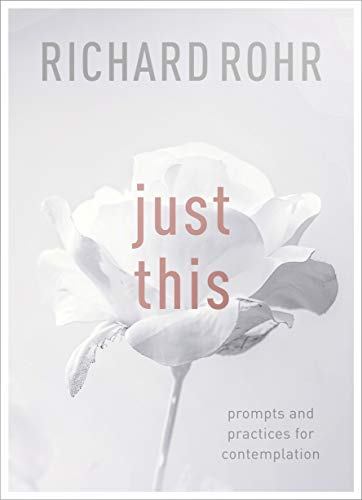
Just This: Prompts and Practices for Contemplation
Written by Richard Rohr Reviewed By David YuAt a time when spiritual formation, contemplative practices, and discussions surrounding Christian mindfulness have become increasingly influential within evangelical circles, Richard Rohr’s Just This: Prompts and Practices for Contemplation is highly relevant, despite its publication several years ago.
Rohr writes from a Franciscan and contemplative tradition markedly different from mainstream evangelical theology. Nevertheless, engaging voices like his can help evangelicals clarify both the strengths and the limits of contemporary contemplative spirituality. Indeed, his emphasis on awakening, surrender, and awareness raises important theological questions concerning revelation, Christology, sanctification, and the work of the Holy Spirit.
Rohr proposes a contemplative vision of the Christian life centered on “awe,” “awakening,” “nondual consciousness,” “suffering,” and radical presence in the “now” (pp. 5–8). The book is neither a systematic theology nor a prayer manual. Rather, it is a spiritual invitation, calling readers to relinquish control, suspend judgment, and inhabit reality as the primary means of divine encounter.
Rohr opens with a foundational claim: contemplation begins in awe. Awe interrupts habitual consciousness—our constant analyzing, judging, comparing, and controlling. It “stops you in your tracks” and ushers the soul into simple presence (pp. 9–10). Contemplation, he suggests, is not discursive reasoning but “a different way of knowing,” a direct, loving gaze upon reality (p. 12).
This insight carries genuine spiritual weight. Given the common tendency to reduce faith to moral correctness or doctrinal precision, awe destabilizes such reductionism. It exposes the limits of the ego and reorients the self toward receptivity rather than mastery.
Yet a theological question emerges: Is awe sufficient to ground authentic spiritual awakening? While it may interrupt self-enclosure, it does not necessarily interpret itself. Without divine revelation, awe may devolve into vague mysticism. From a gospel-centered perspective, awe becomes transformative not merely because reality is overwhelming but because it is illuminated by God’s self-disclosure in Scripture and in Jesus Christ. Awe before creation finds its fullness when directed toward the Creator; awe before suffering becomes redemptive when interpreted through the cross. Thus, while Rohr rightly identifies awe as an experiential threshold, evangelical theology insists that revelation gives awe its true epistemological focus and saving orientation.
One of Rohr’s most provocative distinctions is between “growing up” and “waking up” (pp. 18–21). A person may mature morally, psychologically, and religiously (“grow up”) without experiencing a fundamental shift in consciousness (“wake up”). Awakening involves liberation from the ego’s need to be right and from dualistic thinking that divides reality into rigid binaries.
Against what he calls the “dualistic mind,” Rohr argues that ego-driven certainty fuels division and violence (pp. 24–27). Whereas awakening entails a “nondual way of seeing”—a mode of perception that transcends oppositional categories and fosters compassion.
Here, the dialogical tension of Rohr’s approach intensifies. Evangelical theology also affirms the danger of self-righteous certainty. Indeed, history—both secular and ecclesial—demonstrates how claims to moral superiority breed conflict. However, Christian faith is not a rejection of truth distinctions. God remains the source and standard of truth; good and evil are not mere constructs of limited consciousness.
Theologically, humanity’s problem lies not in the existence of moral distinctions, but in the attempt to determine them autonomously. Human beings seek to “decide good and evil” apart from God. In that sense, Rohr’s critique of ego-centered dualism resonates. Yet the solution is not merely a shift in awareness; it is repentance and reconciliation through Christ. Awakening, from a gospel perspective, requires not only psychological expansion but spiritual regeneration. It is the Holy Spirit who convicts of sin and illuminates the depth of divine love—dimensions of experience that exceed self-discovery and depend entirely upon divine grace. Thus, while Rohr’s nondual emphasis can function as a corrective to self-righteous religion, it must be integrated with a robust theology of revelation and redemption.
Rohr presents suffering as a “necessary teacher” (pp. 49–52). Loss of control exposes the fragility of the ego and creates the possibility of surrender. Surrender, he insists, is not defeat but trust—“giving over” rather than “giving up” (p. 55). This framework aligns with human experience. Even outside Christian faith, suffering often catalyzes maturation. It disrupts complacency, exposes irresponsibility, and demands re-evaluation of priorities. Rohr’s insight that suffering confronts the illusion of control is psychologically astute.
Yet the theological depth of suffering cannot rest on existential realism alone. Without hope rooted in God’s sovereignty and redemptive purpose, suffering may just as easily produce bitterness as transformation. The gospel situates suffering within a larger narrative: God remains sovereign; Christ has entered human suffering; resurrection reframes despair. Trust, therefore, is not an abstract spiritual posture but confidence in a personal, covenantal God.
In this light, surrender is not merely acceptance of reality but faith in divine providence. It involves repentance, a recalibration of desires, and renewed obedience. While Rohr’s language of surrender is helpful, it is only properly grounded when placed within this framework. Otherwise put, it is only “those who love God” who truly know that “all things work together for [their] good” (Rom 8:28).
A central thesis of Just This is that the present moment is the only place where God can be encountered. We cannot meet God in nostalgia or speculative futures; we meet God in the concrete now. This emphasis is compelling. Christian discipleship is indeed enacted in present obedience. While memory of God’s past faithfulness and hope in future grace is indispensable, relationship with God unfolds in lived immediacy. Faith is not an abstraction; it is an embodied response in the present.
However, theological nuance is required. The present moment is not sacred simply because it is immediate; it is sacred because God is sovereign over it and at work within it. The Christian does not merely embrace reality as it is but entrusts it to divine governance. Thus, presence is inseparable from providence. The believer’s acceptance of the present is grounded in the conviction that history—including the present moment—is under God’s redemptive authority.
Rohr resists the accusation that contemplation is escapist. Instead, he argues that contemplative awareness purifies action by exposing ego-driven motivations (pp. 68–73). Contemplation, therefore, becomes the ground of compassionate engagement with the world. This claim finds resonance within evangelical spirituality. True inward renewal precedes authentic outward service. When believers discern their pride, insecurity, and hidden ambitions, and bring these sins to the foot of the cross, ministry becomes less about self-justification and more about humbly loving others for Christ’s sake.
Nevertheless, the transformative power of contemplation must again be connected to grace. Self-awareness alone cannot overcome sin. The Spirit’s sanctifying work, grounded in Christ’s atonement, sustains moral transformation. Contemplation, therefore, is not an autonomous technique but a means of grace—effective insofar as it draws the believer into deeper communion with the triune God.
Just This offers a profound invitation: stop controlling, stop judging, and inhabit reality with awakened awareness. Rohr’s emphasis on awe, surrender, presence, and compassionate seeing provides a needed corrective to anxious, performance-driven religiosity.
Yet his approach requires gospel framing and theological anchoring. Awe must be illuminated by revelation; awakening must be grounded in regeneration; surrender must rest upon providence; presence must be sustained by hope in Christ. Without these, contemplation risks becoming anthropocentric spirituality. With them, however, it can become a deepened mode of genuine Christian discipleship.
In the end, Rohr’s work calls for discernment and development. It challenges readers to wake up, which raises the question, wake up to what? While Rohr’s answer has much to commend it, the fullest answer is to the living God revealed in Jesus Christ, present in this moment, sovereign over suffering, and faithful in redeeming grace.
David Yu
David Yu, Wismer Baptist Church, Markham, Ontario, Canada
Other Articles in this Issue
Main-Point-Driven: A Clear Methodology for Implementing the Christ-Centered Hermeneutic
by Dan AllenThis article addresses the need for a clear methodology for implementing the Christ-centered interpretation...
LaMaster considers Elizabeth Castelli’s contention that Paul’s use of imitative language reinforces power in authority relationships...
Cameron Schweitzer argues that Drew Hunter’s earlier work on Jonathan Edwards’s understanding of typology is too narrowly christological...
This essay argues that evangelical retrieval of the Christian tradition finds a particularly fruitful interlocutor in Athanasius of Alexandria, whose “ruled readings” of Scripture and trinitarian exegesis model a canonically-coherent theological hermeneutic...
Wisdom and Folly in Laodicea: Revelation’s Message to the Laodiceans as Wisdom Discourse
by Joel MacInnesThis article examines Christ’s message to Laodicea as “wisdom discourse,” arguing that it employs “wisdom forms,” “allusions to wisdom literature,” and addresses “wisdom concerns...
Other Reviews in this Issue