
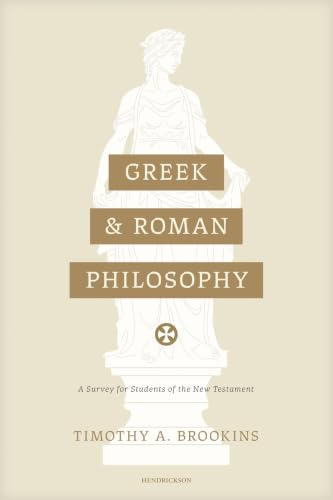
Greek and Roman Philosophy: A Survey for Students of the New Testament
Written by Timothy A. Brookins Reviewed By R. Thomas SmylyTertullian famously asked, “What hath Athens to do with Jerusalem?” Because much of the New Testament (NT) was originally addressed to churches in the gentile world, NT interpreters might answer, “Much in every way.” Every student of the NT must determine how to relate the NT writings to the philosophical traditions that were influential for the audiences they addressed. Timothy Brookins—professor of Early Christianity at the University of St. Thomas and author of Corinthian Wisdom, Stoic Philosophy, and the Ancient Economy (Cambridge: Cambridge University Press, 2014) and Rediscovering the Wisdom of the Corinthians: Paul, Stoicism, and Spiritual Hierarchy (Grand Rapids: Eerdmans, 2024)—has written a primer to help his readers address this perennial issue.
Brookins writes Greek and Roman Philosophy to offer “a survey of the Greek philosophical tradition from its inception in the Classical period until the final stages of its evolution beginning in the first part of Late Antiquity” (p. 1). He plots his course with an angle toward how Greek philosophical traditions impacted the thought world of the NT.
Brookins chronologically surveys the ancient philosophical landscape (p. 5). He overviews the Greek philosophical tradition in chapters 1–2 before segmenting his book into four parts. Part 1 (chs. 3–6) surveys classical philosophy, covering the pre-Socratics, Socrates, Plato and Aristotle, and the Cynics (early sixth to late fourth century BCE). Part 2 (chs. 7–10) reviews Hellenistic philosophers, including the Stoics, Epicureans, and the Skeptics. Part 3 (chs. 11–15) examines the post-Hellenistic period, which treats Roman variants of different schools, the revival of Platonism, and the development of popular philosophy. Part 4 (chs. 16–17) examines how NT authors and early Christians received and utilized Greek and Roman philosophy.
As Brookins narrates the unfolding story of philosophy in Athens, Socrates emerges as the root of most schools. Socrates emphasized ethics over physics, bringing philosophy “down to earth from the heavens” (p. 24; citing Cicero, Tusculan Disputations 5.4.10). Far from being a highbrow discipline, Socrates saw philosophy as a way to order one’s life to achieve happiness and live the good life (pp. 29, 42, 48, 79). Different schools achieved this end differently. Platonists looked beyond the physical world and its faults to the realm of the forms to understand the virtues (p. 42). Aristotelians saw virtue as a means toward the end of happiness (p. 48). Stoics reasoned with philosophy to live according to nature (p. 68). Epicureans reasoned with philosophy to achieve the most pleasure and least pain through the virtues (p. 89). Rather than portraying these ancient philosophers as disassociated scholars or caricatured figures isolated in ivory towers, Brookins presents them as practical guides—life coaches devoted to the pursuit of happiness.
Though Brookins rightly demonstrates how these philosophies treasure ethics more than physics, he does still discuss their physical—and metaphysical—differences. Platonists drew a sharp distinction between the physical world and its imperfect projections with the immaterial realm and its forms (p. 39). Like the Platonists, the Aristotelians distinguished between the material and the immaterial; however, they understood the immaterial as immanent within the material rather than a transcendent reality standing apart from it (p. 46). Stoics and Epicureans did not differentiate between the non-physical and physical realms. In fact, the Stoics saw spirit (pneuma) as a physical reality (p. 78). Brookins notes how these different understandings of the physical world impacted understandings of ethics. Though Brookins does not overtly say it, one must account for the difference between how the philosophers conceived of the universe and how NT authors conceived of the same before appropriating ethical parallels between Greco-Roman philosophies and the NT.
Brookins demonstrates a thorough understanding of the schools of ancient philosophy, granting the reader helpful context for how the philosophies developed over centuries. He strikes a balance of competency and lucidity, introducing the new student without overwhelming them. Brookins supplies primary and secondary source literature for each philosophical school for students who desire to study further.
Although Brookins describes each tradition with care, he rightly does not grant each tradition the same influence in the Greco-Roman world. Through numerical charts, Brookins assists students by demonstrating which philosophical schools had sway at different moments of history (pp. 120, 147). Brookins especially notes how Stoicism stood in contested eminence at the time the NT was penned (p. 120).
The only complaint one might offer with this volume is that, although Brookins subtitled his volume A Survey for Students of the New Testament, the chapter he devotes to Greek and Roman Philosophy in the NT is two pages long. Readers do not finish this book with a methodology or heuristic to aid their interpretation of the NT with their newfound knowledge of the philosophical traditions. A test case of how one of the philosophies affects the interpretation of a NT text would have helped readers apply the material. Even so, the first appendix provides a helpful bibliography of recent scholarly interaction with NT texts and philosophers, so the student can pursue the subject beyond the book.
Overall, Brookins has contributed an accessible and engaging volume that introduces his readers to a pivotal aspect of background study of the NT. Greek and Roman Philosophy would serve equally well as a textbook for a NT Backgrounds course or for the interested layperson. His concise but accurate descriptions ensure that his volume should have a lasting impact for the foreseeable future.
R. Thomas Smyly
Southeastern Baptist Theological Seminary, Wake Forest, North Carolina, USA
Other Reviews in this Issue