
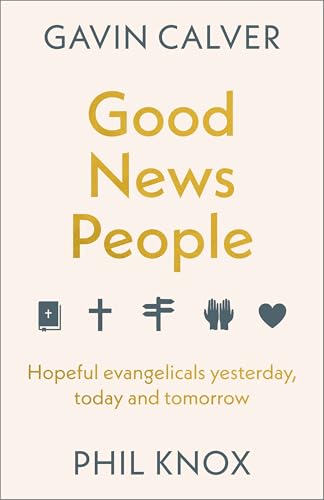
Good News People: Hopeful Evangelicals Yesterday, Today and Tomorrow
Written by Gavin Calver and Phil Knox Reviewed By Jeremy S. GreerThe title, Good News People, is an apt one for this book. On the one hand, Calver and Knox associate the name with the organization with which they work, the Evangelical Alliance. For the authors, to speak of “evangelicals” and “good news people” is to say the same thing (p. 3). On the other hand, the title is appropriate because Calver and Knox offer the reader good news about God’s work in the UK. With story after story throughout the book, the reader who cares about the growth of the kingdom of God is encouraged by the good news that the supposed demise of evangelicalism in the post-Christian UK is not the whole story. According to the authors, there is, in fact, good news to celebrate: God is at work.
The authors organize the book into two parts. In part 1, the authors define “evangelical” as they mean it, appealing to the word’s roots and the movement they reflect. Calver and Knox use appropriate care in these efforts. Contemporary readers know all too well that the term “evangelical” has been utilized, perhaps even co-opted, to refer to a particular set of voters and political activists in the United States. The authors themselves note this unfortunate reality (pp. 11–14). Not to confuse that usage with theirs, they briefly explain their understanding of the term and the movement through Bebbington’s quadrilateral: bibliocentric, cruciocentric, conversionist, and activist. Their careful distinction advances their purpose. They advocate for a heavenly kingdom, not an earthly one.
In the second and most extensive part of the book (two-thirds of its content), Calver and Knox offer a series of five challenges, or “postures,” as the writers call them, to UK evangelicals. The writers challenge the readers to embody seemingly paradoxical traits: to “be brave and kind” (ch. 4), to “be culturally relevant without selling out” (ch. 5), to “be hopeful and realistic” (ch. 6), to “go for decisions and make disciples” (ch. 7), and to “be united and diverse” (ch. 8). The authors argue that, by virtue of their evangelical identity and convictions, evangelicals should exemplify these paradoxical traits. For each posture, the writers illustrate how evangelicals in the UK express it effectively and appropriately. The cumulative weight of the stories communicates an encouraging picture of strength and growth among UK evangelicals. Though reflecting their UK context, the authors do not limit their charge to the UK only but commend these postures to evangelicals everywhere.
At the end of each chapter, the authors provide reflective questions for the reader to make personal application of the chapter’s content and invite readers to find resources for corporate use at www.goodnewspeople.church. Each chapter concludes with a few annotated “recommended reading” selections to help readers explore the chapter’s contents further.
Overall, the book fulfills its purpose in providing challenge and hope to evangelicals. It offers good news to good news people. The book could legitimately be characterized as an explanation and promotion of the Evangelical Alliance. One cannot fault the authors for introducing the organization they work for and clearly esteem. While the authors promote evangelicalism above all, they do not shy away from championing the Evangelical Alliance as a model for faithful imitation.
My sole criticism concerns the concluding chapter, where the authors take a tough stance. The conclusion opens with a brief story about a friend who told the authors he had departed from evangelicalism. The authors lament this person’s departure from evangelicalism toward what they label “experi-angelicalism” (p. 190). The authors choose here to exhibit cleverness (bordering on cheekiness) that they discouraged in chapter 4. The conclusion also overgeneralizes and advances a caricature of embattled evangelicals who alone have the courage and conviction to uphold Christianity in a harsh world. The authors are gracious gentlemen who care deeply about people and the truth; that much is clear from the rest of the book. The conclusion, though, presents a clumsy digression from that stance.
The book does not break any new ground in terms of theological ideas or practices. Most of what the authors offer on faith and practice follows well-worn trails. This does not constitute a weakness. In fact, their method aligns with the book’s purpose: to reinvigorate and encourage evangelicals by revisiting their roots and reclaiming their mandate rather than pioneering a new way forward. As mentioned above, the authors recommend a concise number of works for further study at the end of each chapter. Consequently, readers should recognize the book’s limitations. If one desires to be encouraged and challenged by the relevance and progress of evangelicalism, this is a fitting book. If one wants an in-depth examination of evangelicalism or of current societal research, this is not the book. After all, the book covers a broad swath of material, including “yesterday, today, and tomorrow” in less than two-hundred pages.
Jeremy S. Greer
Ouachita Baptist University, Arkadelphia, Arkansas, USA
Other Reviews in this Issue