
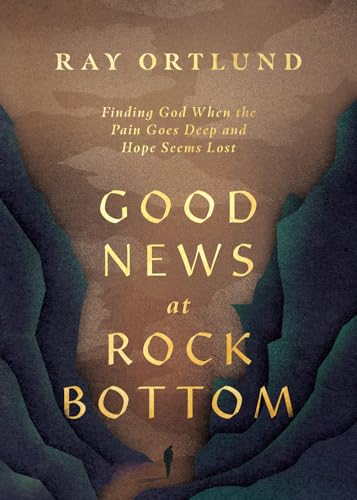
Good News at Rock Bottom: Finding God When the Pain Goes Deep and Hope Seems Lost
Written by Ray Ortlund Reviewed By Candice BergaminBetrayed. Trapped. Lonely. Dying. How does the gospel help—really help—at the lowest points in life? In Good News at Rock Bottom, Ray Ortlund comes alongside readers as a fellow traveler who knows what it is to experience pain and disappointment. As he does so, he lifts up Jesus, the one we can trust to meet our most desperate needs. Ortlund sits down beside the reader and points out that it is only from low places that true hope can be found. He is also alert to the fact that “our painful experiences raise huge questions about God. Like, ‘Where was he when I needed him most?’ And the Bible doesn’t always answer our questions. What it offers is a new way to hope and to worship—right where we are” (p. 8).
The book springs from a teaching series, and the author’s heart as a pastor of real people with real struggles is evident in both his content and manner. His tone is gentle, speaking as to those who are in the pit: perhaps wary because they have been burned by the sin of others, unable to face the possibility of another disappointment, or feeling crushed by the weight of their own guilt or shame.
The structure of the book is built around an extended meditation on Isaiah 57:15:
For thus says the One who is high and lifted up, who inhabits eternity, whose name is Holy: “I dwell in the high and holy place, and also with him who is of a contrite and lowly spirit, to revive the spirit of the lowly, and to revive the heart of the contrite.”
Each chapter contains reflection on an aspect of this verse, followed by application of that truth to the various ways we may find ourselves at rock bottom. The aim is not to provide an apologetic argument, however; logic is rarely what hurting hearts need to hear. Rather, Ortlund aims to offer rest and hope in the loving presence of God, who dwells with the contrite and lowly.
It is a challenge for any author to address some of the biggest and darkest experiences of the human condition. Sin and suffering come with great complexity, and those who speak need to grasp this in order to avoid trite answers or misguided comforts. Ortlund shows he is equal to this task, weaving together acknowledgement of how such experiences feel with theological truths that help readers look to the Lord. He validates the pain of betrayal by exploring the covenantal faithfulness that ought to lie at the heart of relationships. He tackles how our own sin can leave us feeling trapped, “defeated and despairing” (p. 57). But from there he moves to show us how “God invites us back, fallen all the way to rock bottom, just by being true to himself, not lowering his standards at all. He really is that merciful” (p. 60).
He then recognizes the way that loneliness amplifies the pain of both sin and suffering. Yet he counters the temptation to withdraw from others during such times by simultaneously holding out the all-sufficiency of Jesus and the goodness of our imperfect church communities, which are founded on God’s grace. Finally, in the face of death—so rarely talked about directly in Western cultures—Ortlund provides wise guidance for how to persevere to life’s end, reflecting on the difference it makes to know that Christ is with us always and that he will carry us in our weakness.
The use of numerous passages of Scripture throughout, along with apt words from church history and testimonies of God’s work in his people, help to make God’s promises concrete and relatable. The overall effect is that readers are nudged toward trust in God and godliness in life by words of compassion and, in the truest sense of the term, encouragement.
Good News at Rock Bottom is the kind of book that is easy to pick up even if your emotional bandwidth is, well, at “rock bottom.” Ortlund knows the human heart and is almost deceptively astute in bringing not just the facts but the hope of the gospel to bear upon its darkest places. There are thoughtful questions for reflection or discussion at the end of each chapter, which add to the book’s usefulness as a companion to personal devotions or for reading with a friend or small group.
The conversational style and use of colloquial language may take readers less familiar with the author’s manner a little while to settle into. And those looking for a dense and detailed theological tome may find themselves slightly disappointed. But what this book offers is something more like a letter from a beloved and wise uncle or favorite teacher, who knows how to comfort and challenge you in the same breath.
As rock bottom is a place that many of us can find ourselves, and some of us more than once, Ortlund’s book meets a very real need and deserves to be widely read.
Candice Bergamin
Moore Theological College, Newtown, New South Wales, Australia
Other Articles in this Issue
I first heard Don Carson speak in 1993 at Cornerstone Church, Nottingham...
A Better Priest and the Problem of Abiathar: Literary and Biblical-Theological Reflections on Mark 2:23–28
by Matthew EmadiI began my NSBT volume, The Royal Priest: Psalm 110 in Biblical Theology, with a quote from a sermon Don Carson preached, called “Getting Excited about Melchizedek...
Christianity brought two startlingly new ideas into the ancient world: the one God is Trinity, and God the Son became incarnate...
Key Questions Concerning the Book of Ecclesiastes: An Explanation of the Negative Views of Qohelet
by Richard P. Belcher Jr.I have two fond memories of meeting Dr. Carson...
Friends, Non-Israelites, and the Surprising Grace of God: A Grateful Retrospective on New Studies in Biblical Theology at 30
by Daniel C. TimmerIt is a joy and an honor to contribute to this special volume of Themelios dedicated to celebrating the thirtieth anniversary of New Studies in Biblical Theology...
Other Reviews in this Issue