
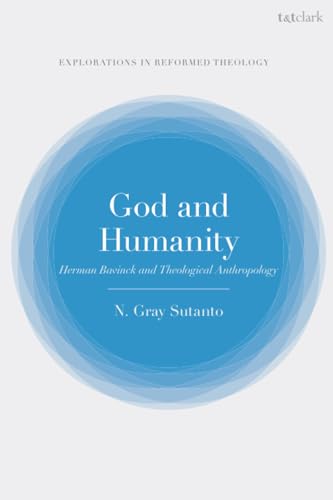
God and Humanity: Herman Bavinck and Theological Anthropology
Written by Gray N. Sutanto Reviewed By Devon GoingsAlthough scholarly discourse has acknowledged Herman Bavinck’s significant contributions and relevance to contemporary discussions, a comprehensive resource on his theological anthropology has been absent until the publication of Sutanto’s God and Humanity: Herman Bavinck and Theological Anthropology. In this book, Sutanto seeks to give a wide-ranging, yet not exhaustive, account of Bavinck’s theological anthropology, situating him within the context of his contemporaries and modern issues.
In chapter 1, Sutanto aims to illustrate the scope and relevance of Bavinck’s theological anthropology, positing that Bavinck delineates a holistic, religious, embodied, and corporate account of humanity that is rooted and finds its ultimate purpose in the triune God.
In chapter 2, Sutanto works through Bavinck’s view of personality and the unconscious, tracing the latter’s view on the body-soul relationship. Chapter 3 examines Bavinck’s thoughts on the religious character of humanity through the trajectories of affect and cognition. Sutanto puts Bavinck in conversation with Aristotle’s psychology (p. 18) and contends that Bavinck saw the unconscious as the “heart” of the person (p. 23). Humans are not brains on a stick that are shaped by reason; rather, they are actively responding to God’s revelation, which penetrates and models the whole person. Sutanto continues Bavinck’s argument by placing him in conversation with affect theory, which argues that “the body is already formed in particular ways that precede and inform cognition” (p. 43). Bavinck maintains humans are religious by nature, and Sutanto explains that “religious expressions may arise out of basic affects precisely because our bodies have been formed by an unconsciously religious psyche and an environment of revelation” (p. 52). Humans, then, holistically respond to God’s revelation.
In chapters 4–5, Sutanto investigates the impact of sin on humanity by continuing his dialogue between Bavinck and affect theory (p. 75). He argues that sin has malformed the human heart, which leads humanity to suppress God’s general revelation (p. 74). The fallen human heart resists dependence on God and instead constructs an idol in God’s place, such that true conformity to God’s revelation requires the illumination of the Holy Spirit (pp. 90–91). Sin, then, distorts God’s revelation at the affective, heart level. Sutanto’s fifth chapter broadens the purview of human sin, shifting the focus from the individual to the corporate. This is justified by humanity’s creation in the image of the triune God (p. 104) and their organic unity, which finds its origin in Adam (p. 105). Sin is described as egocentricity, which loosens the unity of humanity and atomizes it (pp. 112–13). The corporate, generational nature of sin requires the Holy Spirit to bring about renewal and unity (p. 119).
In chapters 6–7, Sutanto describes the goodness of human cultural diversity, its corruption by sin, and its subsequent redemption and consummation. The author places Bavinck in conversation with his contemporary, Abraham Kuyper, arguing that Bavinck has a more nuanced and biblical vision of race. Sutanto further contextualizes Bavinck’s work within the framework of German nationalism, contending that Bavinck foresaw its emergence and distinguished humanity (p. 130), which represents another instance of egocentrism (p. 133). According to Sutanto, Bavinck saw human history as pluriform rather than as a singular line of development (p. 142), which is what led Bavinck to the conclusion that God’s kingdom cannot be reduced to a single culture (p. 123). The conversation proceeds on how human diversity impacts religion: Bavinck argues that every religion arises out of a response to God’s creational revelation (p. 148), so there is no nation or people who have exclusive access to the creational knowledge of God (p. 147). Sutanto posits that while humanity’s fallen nature influences its reactions, divine redemption is provided and will culminate in God’s overarching plan.
Within chapter 8, Sutanto contrasts Bavinck’s ideas with those of Mark Cortez, arguing that consummation is a natural consequence of Reformed theology, predicated on God’s benevolent covenantal relationship with humankind. Although Adam failed to attain consummation (p. 174), Christ fulfills what Adam failed to do (p. 179) and stands as God’s intended mediator for humanity (p. 183). In chapter 9, Sutanto constructs Bavinck’s view of the beatific vision, which is informed by his Christology and understanding of the nature-grace relationship (p. 185). He contends Bavinck understood sin as primarily ethical and not metaphysical; therefore, when humans are renewed by the Holy Spirit, they can once again display righteousness and have their relationship with God restored (p. 187). Christ, who is both God and man, allows humans to fellowship with God religiously and ethically through covenant (pp. 192, 199). In its final section, Sutanto offers a beneficial overview of each chapter’s content.
Sutanto’s God and Humanity is truly a noteworthy contribution. The book elucidates Bavinck’s theological anthropology, engages him with his contemporaries, and offers insights into how his work can enrich modern discourse. Sutanto walks the reader through Bavinck’s holistic, embodied anthropology, while also spurring the reader to emulate Bavinck, which proves to be a great strength of this book. However, there is still work to be done. For example, it would have been a welcome addition to see Sutanto setting Bavinck into conversation with postcolonial anthropology. A follow-up study examining Bavinck’s theological anthropology within the context of the AI era would also be of significant interest. To summarize, God and Humanity is a commendable and vital addition to the church’s resources. I anticipate this book will serve as an important secondary source for Bavinck’s theological anthropology, yielding significant constructive theology.
Devon Goings
Fuller Theological Seminary, Pasadena, California, USA
Other Reviews in this Issue