
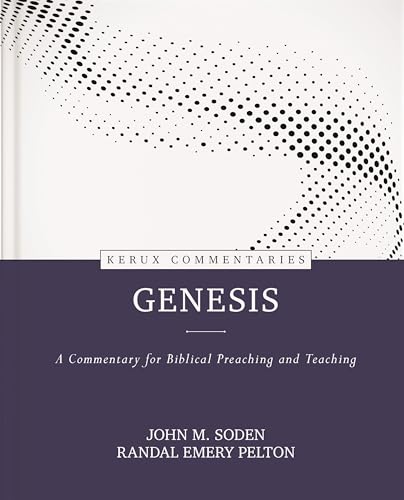
Genesis: A Commentary for Biblical Preaching and Teaching
Written by John M. Soden and Randal Emery Pelton Reviewed By Dustin BurletThough written millennia ago in a different language to a different people, the book of Genesis stands as Scripture’s historical, literary, and theological ground floor—effectively establishing God’s promise for blessing and salvation in a world marred and broken by Adam’s sin. Genesis: A Commentary for Biblical Preaching and Teaching, part of the Kerux Commentaries series, is written by both an expert in biblical exegesis (John M. Soden) and an experienced homiletician (Randal Emery Pelton). Based on the “Big Idea” approach, Kerux guides the reader through a well-tested sequence: exegetical analysis, theological focus, preaching and teaching strategies.
While there are nearly fifty “preaching passages” within this commentary, it is divided into four main sections: (1) Primeval Narratives (Gen 1:1—11:9); (2) Abraham Narratives (Gen 11:10—25:11); (3) Jacob Narratives (Gen 25:19—37:1), including the History of Ishmael (Gen 25:12–18); and (4) The Fourth-Generation Narratives (Gen 37:2—50:26).
The “Introduction” (pp. 53–77) is informative and engaging. Historically speaking, while affirming Mosaic authorship of the Pentateuch (cf. pp. 81, 99–100) Soden and Pelton also accept the “Late Date” for the Exodus and the implications of “Setting” and “Context” for Genesis (see pp. 54–55). Literarily, they show astute sensitivity to the various ways that the Hebrew scribes communicated their rhetorical (world-view formative) message, such as attending to discourse markers, repetition, dialogue, and narrator evaluations (p. 57). Theologically, “God’s Sovereignty and Goodness,” “Faith,” “Worship,” “Blessing,” “Sin,” “Rest,” “Humanity as God’s Image(s),” “Cursing,” and “Good versus Evil” are all noted among a few other key themes.
Lexically, each of the different Hebrew stems (e.g., Qal, Piel, Hiphil, and Hithpael) are treated independently. Users will also appreciate the generous references to many of the standard sources, such as BDB, TLOT, TDOT, TWOT, NIDOTTE, and HALOT. Regrettably, while Louw and Nida was (relatively speaking) well-leveraged for Greek, among other tools, I could not find Lust or Muraoka, specifically, for Septuagint references. At the risk of being too trenchant, the term “literal” (see pp. 166, 181, 197, 227, 238, 368, etc.) remains problematic and is, perhaps, best avoided altogether (see Stanley E. Porter’s James Barr Assessed: Evaluating His Legacy over the Last Sixty Years [Leiden: Brill, 2021] and Douglas J. Moo’s We Still Don’t Get It: Evangelicals and Bible Translation Fifty Years after James Barr [Grand Rapids: Zondervan, 2014]) among other scholars).
Syntactically, GKC, Joüon, Lambdin, Waltke and O’ Connor (WOC), in particular, were each judiciously applied (sans any LXX grammars, like Muraoka, for instance). One example should suffice. Concerning Genesis 15:6a, Soden and Pelton insightfully assert (pp. 296–97):
The Hebrew text … indicates this is not sequential. Rather than the normal narrative sequences of the waw on a preterit, indicating continuing sequence, verse 6 begins with a waw on a perfect, indicating disjunction or background information (WOC, §32.3e., 541), which they translate, “Now he trusted YHWH and he counted it to him as righteousness” (as a parenthetical idea, WOC, §16.4f, 305). The construction presents a summary statement of Abram’s faith … a typical or frequentative use of how Abram has responded … or, more specifically, a “habitual-iterative past” that should be translated “he kept believing Yahweh”…. GKC calls it “a longer or constant continuance in a past state” (§112 ss).
Typographically, the volume is exceptionally well done. Although I could not find many direct references to how the MT accents might affect exegesis (cf. p. 109), the Hebrew pointing is clear. The ample white space, extra shading, sidebars, and numerous headings/subheadings are extremely helpful. It was also easy to appreciate the different references to culture at large, such as Caravaggio’s painting, “Sacrifice of Isaac,” or Pink’s “What About Us.” There are also quite a few maps, tables, graphs, and charts alongside other graphics, such as a picture of the Shabak stone (p. 84), a representation of the “three-tiered universe” (p. 128), Ziggurat Dūr Untash (p. 229), a well at the gate to ancient Beersheba (p. 382), Autumn Mandrakes (p. 504), and some cylinder seals (p. 610). Anyone familiar with In the Beginning … We Misunderstood: Interpreting Genesis 1 in Its Original Context (Grand Rapids: Kregel, 2012) by Johnny V. Miller and John M. Soden, which I used as a textbook for “Primeval History,” will not be disappointed!
Because Kerux is intentionally designed to guide preaching/teaching, the value of its discussion questions (provided at the end of each chapter) is best shown by an extended example (p. 216):
Noah’s Line: Exposing Heart Issues (Genesis 9:18–29): (1) Do we expect perfection of the righteous? How should we view someone who sins? (2) How do we respond to God when we recognize sin in our lives or roots of flesh in our own hearts? (3) Considering Shem and Japheth going to extreme lengths to protect their father and avoid any impropriety, how should believers today view their responsibilities to avoid evil in either act or appearance? (4) Define carefully what it means to be cursed or blessed? (5) What does it mean in practical ways to call Jesus your God and Savior? If I identify with him, what expectation does that require of me for my actions and for my heart response to him? (6) How does my honoring of authority in my life bring honor to Christ? What authority structures do I need to honor, and what will that look like?
My main quibbles are series related rather than volume specific. The complete lack of indices (Scripture, Author, Subject) hampers the overall utility of the book as a reference tool. Also, a translation of Genesis would have allayed some of my concerns about the use of the term “literal.” Irrespective of these, this book does an excellent job of integrating key components of character, relationships, and life skills with Bible knowledge (a truly integrated model). Its primary audience will likely be pastors, preachers, and Christian ministry leaders, including those leading Bible study groups. Students from Christian universities, seminaries, and Bible colleges will also benefit immensely. Highly recommended!
Dustin Burlet
Millar College of the Bible
Winnipeg, Manitoba, Canada
Other Reviews in this Issue