
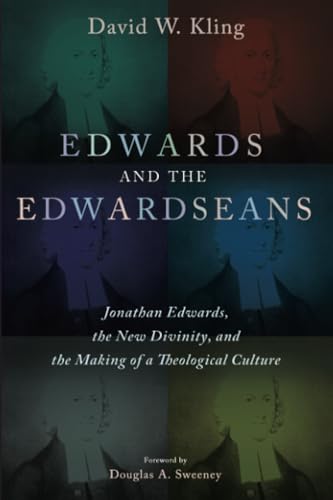
Edwards and the Edwardseans: Jonathan Edwards, the New Divinity, and the Making of a Theological Culture
Written by David W. Kling Reviewed By Nathan A. FinnScholarly interest in Jonathan Edwards remains high. However, over the past generation, a closely related topic has attracted considerable attention from historians (and sometimes theologians): the wider Edwardsean tradition that developed in the three generations following Edwards’s death in 1758. Many scholars argue for a “New England Theology” that encompassed a range of theological and philosophical views that, to varying degrees and with various adjustments, drew upon insights and instincts found in Edwards’s writings.
Over the past three decades, David Kling has distinguished himself as a historian of the New Divinity, the name given to second-generation Edwardsean theologians such as Samuel Hopkins, Joseph Bellamy, and Jonathan Edwards Jr. Kling’s monograph, A Field of Divine Wonders: New Divinity and Village Revivals in Northwestern Connecticut, 1791–1822 (Pennsylvania State University Press, 1993), was an early contribution to the literature related to the wider Edwardsean tradition. Since then, his further scholarship has been published in refereed journals and collections of essays. In Edwards and the Edwardseans, Kling brings together lightly updated versions of his shorter writings.
Some might wonder the value in publishing an anthology of essays that are all readily available elsewhere, at least to those with access to a good research library. Doug Sweeney offers one answer in his foreword: Kling is a “field-changing” scholar (p. xvi). In his own introduction, Kling adds that this collection offers an accessible and coherent introduction to Edwards and his theological legacy, which continued (especially in New England) well into the 1830s. I agree on both counts, with one exception to Kling’s claim of coherence.
The book is divided into two parts, each with four chapters. Part 1 focuses on Edwards himself. The key themes include Edwards’s theology of conversion, his bibliology, his understanding of prayer, and his role in contributing to the rise of the modern missions movement. Edwards was a central figure in the transition from the older Puritanism to the ascendant evangelicalism, the latter of which linked conversion with assurance and championed cross-cultural missions. But these chapters include one outlier that belies Kling’s attempt at coherence.
Chapter 3, on “Edwards, Petitionary Prayer, and the Cognitive Science of Religion,” is different from the other chapters in the book. Kling puts Edwards’s views in dialogue with theories among cognitive scientists, then raises questions for pastoral application. Kling suggests a disconnect, especially among laypersons, between Reformed theology, which emphasizes God’s absolute sovereignty, and the practice of petitionary prayer, wherein believers seek to influence God to act in particular ways. Regardless of what one might think of Kling’s theological assumptions, the interdisciplinary nature of the essay, as well as its more prescriptive turn, does not fit neatly with the rest of the chapters.
Part 2 focuses on the New Divinity. Kling introduces Edward Dorr Griffin and Asahel Nettleton as lesser-known figures who were key Edwardsean revivalists during the Second Great Awakening. He argues the New Divinity provided the theological context for both the rise of the modern mission movement in New England and evangelical education in that region, and the two overlapped considerably. In the case of the latter, New Divinity thought was passed down primarily through informal “Schools of the Prophets,” household seminaries where a seasoned pastor mentored a small number of younger men who aspired to pastoral ministry. The model closely followed the example of Edwards himself, who trained Hopkins and Bellamy in this manner. Williams College, to which Kling devotes his final chapter, became a hotbed for both New Divinity thought and missionary fervor.
Kling ably demonstrates that the same notes sounded, or at least suggested, by Edwards during his own lifetime, especially the intersection of Calvinism, revival, education, and missions, reached a later crescendo among his successors during the next generation. There was considerable continuity between Edwards and the Edwardseans. Of course, there was also discontinuity at times, especially in doctrinal matters such as the nature of original sin, the imputation of Christ’s righteousness, and the intent of the atonement. While Kling gives minimal attention to these matters, those discontinuities account for why many modern Reformed theologians continue to regard the New Divinity with suspicion.
Because of the nature of Kling’s book, scholars will find little here that is new. They have either already read earlier versions of these chapters, or they have read the works of other scholars who have been shaped by Kling’s arguments. But students of Edwards and his legacy—whether they are enrolled in graduate programs or are learning for their own benefit in the pastor’s study—will find Kling’s book an essential resource in orienting them to some key themes in Edwards’s thought and their legacies among his successors.
Nathan A. Finn
Nathan A. Finn is Professor of Faith and Culture at North Greenville University in Greenville, South Carolina.
Other Articles in this Issue
Main-Point-Driven: A Clear Methodology for Implementing the Christ-Centered Hermeneutic
by Dan AllenThis article addresses the need for a clear methodology for implementing the Christ-centered interpretation...
LaMaster considers Elizabeth Castelli’s contention that Paul’s use of imitative language reinforces power in authority relationships...
Cameron Schweitzer argues that Drew Hunter’s earlier work on Jonathan Edwards’s understanding of typology is too narrowly christological...
This essay argues that evangelical retrieval of the Christian tradition finds a particularly fruitful interlocutor in Athanasius of Alexandria, whose “ruled readings” of Scripture and trinitarian exegesis model a canonically-coherent theological hermeneutic...
Wisdom and Folly in Laodicea: Revelation’s Message to the Laodiceans as Wisdom Discourse
by Joel MacInnesThis article examines Christ’s message to Laodicea as “wisdom discourse,” arguing that it employs “wisdom forms,” “allusions to wisdom literature,” and addresses “wisdom concerns...
Other Reviews in this Issue