
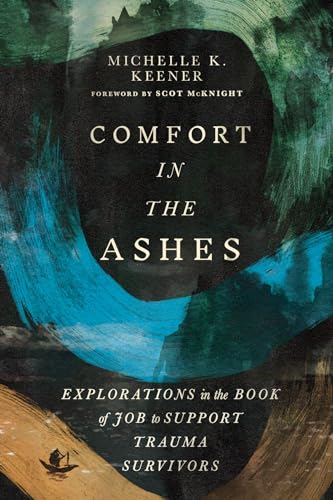
Comfort in the Ashes: Explorations in the Book of Job to Support Trauma Survivors
Written by Michelle K. Keener Reviewed By Kirk R. PatstonPractical theology self-consciously arises from lived experience and then asks questions of the Bible or a particular theological tradition. Often, the foray into the Bible or theology is disappointing in its simplicity. Michelle Keener is to be commended for offering the world of practical theology a work that is simple but not simplistic. Comfort in the Ashes: Explorations in the Book of Job to Support Trauma Survivors is an accessible work of practical theology that provides an informed account of trauma in a fruitful conversation with an equally informed account of the book of Job.
The book of Job has been subjected to all kinds of readings that assume a particular diagnosis of Job’s bodily condition, psychological state, or social experience. It is methodologically fraught to assume that the portrayal of a character in an ancient text can ever validate such diagnoses. Keener seems aware of this and is rightly modest in her claims. Her work is offered as a set of “explorations,” not decisive conclusions. The connections she proposes between the experience of trauma and the character of Job are presented tentatively, with a sense that they are like analogies or correlations, not facts. That is, the man Job is like a trauma survivor, and the book of Job has literary features that resonate with how a trauma survivor may engage with language.
This approach has real pastoral value. One can imagine recommending Keener’s book to a person processing trauma who perhaps feels disconnected from Scripture and the things of God. Keener offers trauma survivors empathic descriptions of what trauma might feel like and invites them into the book of Job in a way that is appealing and hopeful. Readers whose worlds have been ruptured will find a valuable companion in the man Job, thanks to Keener’s insightful portrayal of him.
Keener’s interaction with the book of Job is thorough but does not attempt to provide a comprehensive reading of the book. Indeed, her observations of the text are often general in nature. Keener self-consciously skips over many of the book’s details. Her engagement with the text walks a delicate line between interpretative complexity and pastoral clarity. I appreciated the reporting of debates about whether the divine speeches have a bullying or nurturing function; the wide-ranging discussions of the symbolism and rhetorical use of behemoth and leviathan; and the surveying of possible translations and readings of Job’s final words. To advance her proposals, however, Keener does have to make interpretive choices. Her preferences serve her pastoral reading, but she does not always defend them. The thoughtful reader might want fuller evidence. (Pleasingly, Keener has also published a more comprehensive and technically exacting work, A Trauma Theory Reading of the Book of Job [London: T&T Clark, 2025].)
One of Keener’s most intriguing claims is that trauma healing involves meaning making, not the finding of the meaning of an experience or one’s reactions to it. She proposes that the author or Job portrays a man who has sufficiently engaged in meaning making to return to his roles and relationships with God, society, friends, and family in the book’s epilogues. Job does not actually voice the meaning he found. His brief and ambiguous words in Job 42:1–6 leave us to keep exploring what the book was about and what the divine speeches achieved. This is a helpful and important contribution to Joban scholarship, providing a good reason not to try to resolve the puzzling realities of the Hebrew text. As a practical theologian, Keener helps us see that the purposeful elusiveness of the book of Job can inform similarly open-ended pastoral conversations.
On a few occasions, I wished that Keener had entertained another reading of the book of Job. For example, the proposal that Job’s friends were wise in their ministry of presence and silence is not the only possibility. David Clines has postulated that their silence is indicative of a cutting-off of association from Job who is now dead to them. It is noteworthy that even before Bildad and Zophar speak, Job feels forsaken and disappointed with them (Job 6:14–30). Later in the work, Keener is attentive to the gracious engagement of Yahweh with Job and makes connections to the imminence and grace of the incarnation in Christ. This is valuable but needs to be held in tension with the grand sense of divine otherness present in the Yahweh speeches. In a similar vein, Keener rightly identifies the reclaiming of creational order in the Yahweh speeches but without comment on the violence that is at work in Yahweh’s ordered world. This seems a significant omission for a work on trauma.
My strongest reservation came in Keener’s argument that the doubling of Job’s property conveyed a sense of Yahweh making himself accountable for Job’s suffering. Understandably, she connected this with the shattering admission by Yahweh that he has acted harmfully toward Job for no reason (Job 2:3). Many readers have found these words traumatizing. It would have been good to explore ways of incorporating these ideas into a healing, meaning-making process. I will need to explore whether Keener’s larger work provides further resolution.
To conclude her book, Keener moves beyond Job, providing a most readable account of ways pastors and churches might engage with people experiencing trauma. She consistently sounds a warning that the pastoral care of people processing trauma may not be an appealing calling to individuals and churches who are looking for efficient strategies to achieve measurable success. This is an uncomfortable, honest, and compelling criticism and adds to the book’s significant contribution to contemporary pastoral theology.
Comfort in the Ashes is a clearly written, empathic, warm-hearted invitation to turn to the book of Job in the process of understanding and healing trauma. This is wise, if complex, pastoral advice.
Kirk R. Patston
Sydney Missionary and Bible College
Croydon, New South Wales, Australia
Other Reviews in this Issue