
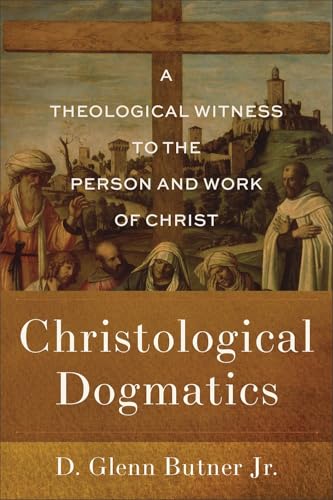
Christological Dogmatics: A Theological Witness to the Person and Work of Christ
Written by D. Glenn Butner Jr Reviewed By Randall K. JohnsonD. Glenn Butner Jr.’s Christological Dogmatics is a graduate-level work of dogmatic theology engaging the full scope of christological doctrine. Butner is an associate professor of theology at Gordon-Conwell Theological Seminary and the author of Trinitarian Dogmatics: Exploring the Grammar of the Christian Doctrine of God (Baker Academic, 2022).
The last ten years have seen the release of numerous high-quality publications concerning the doctrine of Christ, though Christological Dogmatics stands apart from contemporary christologies in its methodological approach and organization. A key distinction of Butner’s book, in contrast to similar studies, is its focus on christological loci over historical progression. Christological Dogmatics does not follow the typical diachronic order: from Scripture, through tradition, to contemporary debates. Instead, it involves a synchronic analysis of christological loci, drawing upon a diverse collection of global and historical biblical scholars and theologians.
Christological Dogmatics is “a work of dogmatics” insofar as it “seeks to fulfill the threefold task of navigating theological disputes, training Christians in theology, and synthesizing the teachings of Christ in Scripture” (p. 3). Butner explains that the triad of orthodoxy, orthopraxy, and orthopathy provides the framework for his dogmatic approach. He writes, “Such an account ought to clarify the truth of who Christ is and what he has accomplished (orthodoxy), compel us to moral action in line with his teaching and to follow his example as empowered by the Spirit he sends his church (orthopraxis), while recognizing the necessary spiritual transformation that accompanies our conversion to Christ (orthopathy)” (p. 8). In each chapter, Butner introduces a topic in Christology, investigates various positions regarding disputes on that topic, and often concludes with a dogmatic summary.
Christological Dogmatics is also unique in the way that its chapters weave the person and work of Christ together. Many recent works treat either the person of Christ or the work of Christ, and those that treat both do so sequentially. Butner’s organization and treatment of these doctrines remind the reader how closely they are connected. Indeed, the author argues that they are inseparable. Butner also frequently connects issues in Christology to broader issues in theology and practice. He always has a mind for the whole, not merely the parts. Butner writes, “The various doctrines of the Christian faith are connected to one another like strands in a web; move one strand, and the entire web shifts” (p. 7).
One of the various strengths of Christological Dogmatics is that it interacts with a wide range of theological disciplines, traditions, and eras. The book has a clear ecumenical appeal; Butner wants to hear from all the members of Christ’s body, so he engages with sources outside of typical conservative evangelical theology. But as a work of dogmatics, Butner is not afraid to draw boundaries between acceptable and unacceptable doctrine. Although Butner is charitable and irenic with his interlocutors, he never strays from biblical fidelity, creedal orthodoxy, or his Reformed heritage. Another strength is his commitment to the gospel, the Great Commission, and the Christian moral life. He argues that this dogmatic theology is profoundly relevant to our lives. Life’s deepest questions about happiness and meaning “have comforting answers only if Christ is the incarnate God-man, two natures in one person, with each nature working and willing what is proper to it” (p. 277).
Christological Dogmatics has a couple of limitations. First, although the synchronic organization has a novel appeal, it makes the sequential reading of the book more demanding. The author often introduces an idea in one chapter but postpones discussion of it until a later chapter. Conversely, situations arise where the conventional order is inverted, leading the author to analyze a subject before the essential christological foundations are established. For example, the third chapter, “Two Natures,” discusses Christ’s sinlessness, impeccability, and temptation, but it is not until the seventh chapter, “Dyothelitism,” that the number of wills in Christ is settled. Because temptation and sin are especially concerned with acts of the will, it would be preferable to establish an understanding of the number and nature of Christ’s wills beforehand. This disadvantage is also evident in the interlacing of chapters on Christ’s person and work. Butner argues that dividing person and work “can lend conceptual clarity, but it can also result in a doctrine of the person and natures of Christ detached from any saving significance” or a study of the work of Christ prone to error (p. 43). However, the author could have improved clarity without minimizing their interconnectedness by treating the person and work sequentially rather than in alternation. Second, some readers may wish that the author argued more forcefully for certain theological positions. Butner explains that his book “will at times describe disputes with several possible positions from which the reader can choose without fearing heresy” (p. 3). For example, although he has dogmatic reasons to reject a Pelagian account of original sin, he declines to bind the reader on the mode of transmission or its entailments, including original guilt. Likewise, within his treatment of satisfaction, he leaves open whether the reversal of original guilt and propitiation are integral to the doctrine. He certainly offers reasons to affirm both but stops short of treating them as dogmatically binding. These reservations notwithstanding, they do not significantly diminish the value of the book as a rigorous and constructive contribution to the field of Christology.
I definitely recommend Christological Dogmatics to students and scholars of Christology. Though the book is explicitly designed for advanced seminary curricula, its utility extends to advanced undergraduates, pastors, and professional theologians. Students and scholars will find Christological Dogmatics to be a useful resource. Besides Butner’s clear and insightful prose are various aids to the reader, including copious footnotes, annotated lists of sources for further reading at the end of each chapter, and a lengthy back matter comprising a glossary, dates for historical figures, a bibliography, and three indices. Christological Dogmatics is not an introduction to Christology, nor is it the final word on the matter; rather, it is a guardrail and springboard to further christological studies.
Randall K. Johnson
Randall Johnson completed a PhD at the Southern Baptist Theological Seminary and teaches at Scholé Christian Tradition in Louisville, Kentucky.
Other Articles in this Issue
Main-Point-Driven: A Clear Methodology for Implementing the Christ-Centered Hermeneutic
by Dan AllenThis article addresses the need for a clear methodology for implementing the Christ-centered interpretation...
LaMaster considers Elizabeth Castelli’s contention that Paul’s use of imitative language reinforces power in authority relationships...
Cameron Schweitzer argues that Drew Hunter’s earlier work on Jonathan Edwards’s understanding of typology is too narrowly christological...
This essay argues that evangelical retrieval of the Christian tradition finds a particularly fruitful interlocutor in Athanasius of Alexandria, whose “ruled readings” of Scripture and trinitarian exegesis model a canonically-coherent theological hermeneutic...
Wisdom and Folly in Laodicea: Revelation’s Message to the Laodiceans as Wisdom Discourse
by Joel MacInnesThis article examines Christ’s message to Laodicea as “wisdom discourse,” arguing that it employs “wisdom forms,” “allusions to wisdom literature,” and addresses “wisdom concerns...
Other Reviews in this Issue