
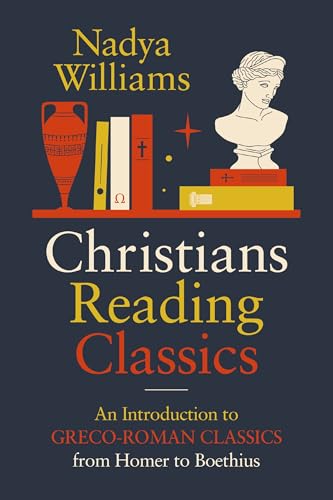
Christians Reading Classics: An Introduction to Greco-Roman Classics from Homer to Boethius
Written by Nadya Williams Reviewed By Isaac D. BloisJesus once chided the religious leaders of his day for their faulty reading practices, since, despite diligently searching the Scriptures, they failed to see how those texts bore witness to him (John 5:40). Such a Christ-seeking reading habit—one that listens for witness to him in the books being read—is similar to what Williams advocates in her book Christians Reading Classics. Of course, hers is the harder task of helping Christian readers find witness about Christ in pagan books rather than in the inspired corpus of the canonical Jewish Scriptures.
Williams intends the book to be “a survey of Greco-Roman classics” (p. 273), and she accomplishes the daunting task of addressing upwards of thirty-seven ancient authors in just 270 pages. Along with her rich analyses of the most well-known authors, Williams does an outstanding job of bringing lesser-known figures into the conversation, especially women (for instance, the Christian imitator of Vergil’s poetry, Faltonia Betitia Proba). After a helpful and visually appealing timeline of authors, followed by a ten-page introduction, the book has five parts. Part 1 focuses on the “Longing for Eternity,” analyzing Homer and Greek historians. Part 2 focuses on the “Formation of Virtuous Citizens,” engaging Aeschylus, Greek playwrights, and philosophers. Part 3 focuses on rhetoric, tackling speechwriters, Greek manuals, and Roman poets. Part 4 focuses on “Heroes and Role Models,” covering Roman poets and biographers. Part 5 focuses on “Virtues and Vices,” merging Roman philosophers with Christian theologians. She then concludes the book with a discussion of the virtue of re-reading.
Williams navigates the difficulty of such broad inclusion by providing a twofold organizational approach: both chronologically linear (for the most part) and thematically grouped. She is wise to adopt a chronological approach because it helps her ensure her readers are “oriented in time,” thereby seeing “the influence of ideas over time” (p. xvii). Her second strategy, organizing the chapters into thematic units, is a little less helpful. While she is perceptive about these themes, and while many of the texts/authors surveyed do touch on them at various points, they become a little constraining. I wonder if Williams might have done better simply to list off in the introduction the main themes that would arise at various points throughout the chapters, and then allow each text to tap into whichever theme—or themes—that might fit it. Then again, since Williams is seeking to reach an audience with little to no background in reading these ancient classical texts, perhaps the thematically grouped approach is appropriate, ensuring that readers don’t get overwhelmed by the sheer number of authors.
The biggest asset of Williams’s book is the way that she situates her discussion of these ancient texts in conversation with the Christian tradition. Her approach uses the Christian framework to guide readers in discerning what’s valuable in these ancient texts without being put off by the non-Christian aspects therein. She claims that the “virtues, as presented in the pagan texts, do not reflect the complete picture that is only fully visible to those equipped with gospel eyes” (p. xv). One instance where Williams brings Christian aspects into conversation with these pagan texts is her intriguing suggestion that Mary’s Magnificat offers a “response to the pagan women of Greek tragedy and comedy” (p. 99). While she does not develop this idea, Williams is here prompting Christian readers to set out and hunt down these possible connections (or others like it that the readers discover on their own) in order to draw out the benefit that comes from thinking about how the biblical stories might handle things differently from—albeit in conversation with—their pagan interlocutors.
Overall, I think that Williams has done an excellent service to the Christian reading community, particularly for educators who desire to help (young) Christian readers foray into the world of classical literature. She has offered discerning and exciting treatments of countless classical texts. Furthermore, she has provided a thematic overview to hold together those many works, all while reminding readers to reflect on their own Christian tradition as they read.
Isaac D. Blois
Biola University
La Mirada, California, USA
Other Reviews in this Issue