
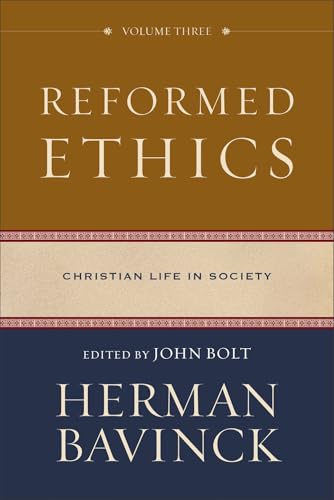
Christian Life in Society. Vol. 3 of Reformed Ethics
Written by Herman Bavinck Reviewed By Andrew SpencerThe wait for the final volume of Herman Bavinck’s Reformed Ethics is over. The contents of this third volume, which focuses on Christian life in society, was largely unavailable in any language, until this edition hit the shelves. As a result, a treasure trove of Dutch Reformed moral reasoning is now widely available.
As John Bolt notes in his preface, the final volume of Reformed Ethics is incomplete because Bavinck never finished the manuscript. The editors considered fleshing out the remainder of Bavinck’s outline from his other essays, but instead they elected to publish that content in a separate volume: Reformed Social Ethics: Perspectives on Society, Culture, State, Church, and the Kingdom of God (Grand Rapids: Baker Academic, 2025). Consequently, the third volume of Bavinck’s Reformed Ethics is limited to a translation of a single (but lengthy) chapter on the family, and two appendices, which include his lecture notes on philosophical ethics and the manuscript of a public lecture on contemporary morality.
As such, it is a volume that is primarily useful for scholars seeking to understand aspects of Bavinck’s thinking, rather than a polished approach to ethics. While Reformed Dogmatics is a magnificent gateway into Reformed orthodoxy, Reformed Ethics is a look at the unfinished moral reasoning of an excellent theologian. There are raw edges in his rhetoric and nuances left unexplored.
Nevertheless, the content presented in this volume is worth exploring. The extent of Bavinck’s bibliographic work is always startling, as he seems to have read widely and deeply. He consistently digs into ancient philosophical texts as well as volumes from a range of competing religious perspectives, including Buddhist sources. The relative comprehensiveness of Bavinck’s research is impressive, especially given the challenge that accessing resources must have presented in the age before the internet. That said, at points what we have in his drafted chapter on the family feels more like bibliographic notes than a completed essay. There are sections that are somewhat tedious, such as his detailed exploration of the different degrees of cousin marriage that have been approved or disallowed by various theologians throughout church history.
Yet the most provoking aspect of this third volume of Reformed Ethics isn’t who can marry whom—a question that had fewer variables in Bavinck’s day when agreement on gendered complementarity in marriage was assumed; rather, it concerns his views of women and marriage. Most of the content of the first two volumes has a fairly timeless quality which generally follows a theological outline. Bavinck’s thinking on marriage and the family in this volume reflects many of the cultural prejudices of his day.
For example, Bavinck argues that “except for [a few] special reasons, everyone is duty bound to marry” (p. 23). That is a statement that will quickly cause a row on social media today, but it was the accepted wisdom in the early nineteenth century. His polemic has more to do with resistance toward Roman Catholicism than our contemporary debates about the vocation of singleness. It also captures a cultural moment when, due to the limited legal standing of women, marriage was a main source of female protection and financial stability.
More provocatively, Bavinck’s descriptions of women fall along stereotypical lines that have potential to serve as rage-bait in contemporary online discourse and may threaten Bavinck’s broader legacy with some readers. For example, he generalizes, “A man analyzes and gets to the bottom of phenomena, a woman dislikes analysis and apprehends (as by intuition) the whole in its immediate value and beauty” (p. 24). And, as he continues to highlight the psychological differences between men and women, “For the man, one word of loyalty is enough; the woman demands a host of small confirmation and trifles” (p. 25). It is no wonder the editors issue a word of caution about the contents in their preface. But as they also acknowledge, this is far from Bavinck’s final version of the text, so there is no way to know what might have changed in subsequent drafts.
Still, there is no question that Bavinck’s social ethics were shaped by the contours of his culture. Yet the points of discontinuity between Bavinck’s cultural context and ours can lead us to question our own cultural assumptions. Reading historical sources well requires attentiveness to the prevalent assumptions of both present and past cultures. Bavinck may have overgeneralized the categorical differences between men and women, but these passages strike us primarily because of our culture’s emphasis on the lack of distinction between the sexes. Part of the value in reading old books is having our unidentified prejudices highlighted so we can reconsider them. Reformed Ethics provides ample opportunity for that reconsideration.
Furthermore, there is value in the appendices to this short volume. Bavinck’s essay on philosophical ethics reflects his willingness to leave no stone unturned. Readers get a time capsule look at early evaluations of positivism, utilitarianism, and Darwinism that show the continuity of Christian concerns about these schools of thought. His lecture on contemporary morality offers a window into his apologetic approach, which begins with the belief that “even in the most glaring [moral] aberration still lurks an element of truth that sustains it and makes it appealing” (p. 359). This cultural apologetic listens for the resonance with truth and then highlights the deeper fulfillment that is found in Christianity.
Unlike Reformed Dogmatics, which was prepared for publication during his lifetime, Bavinck never completed the systematic exposition of his moral reasoning. This means that all three volumes of Reformed Ethics should be read with awareness of their incompleteness. Nevertheless, there is much gold to be mined as Bavinck applies his Reformed ethics to a rapidly evolving world.
Andrew Spencer
The Gospel Coalition
Monroe, Michigan, USA
Other Reviews in this Issue