
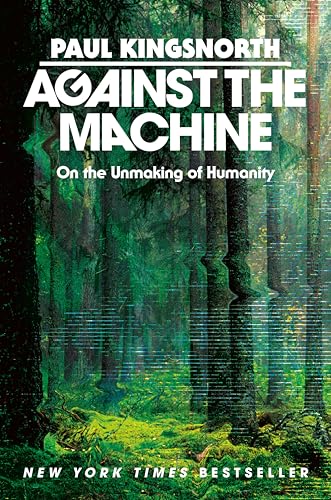
Against the Machine: On the Unmaking of Humanity
Written by Paul Kingsnorth Reviewed By Stephen McAlpineThere are times in Trent Dalton’s award-winning Boy Swallows Universe (London: 4th Estate, 2018) where the gritty, 1980s setting of Brisbane’s hardscrabble back-blocks jars with the magical realism Dalton weaves throughout his coming-of-age story. The novel’s central character, Eli, ekes out life between dreamy spell and dreary suburbia. The same gear crunch is not as apparent in Gabriel Garcia Marquez’s One Hundred Years of Solitude (London: Penguin, 2014), set as it is in the steamy Columbian hinterlands. That was, after all, a liminal, exotic space, always threatened by modern encroachment, yet always promising magic.
There is a certain grinding of metal on metal in Paul Kingsnorth’s latest work, Against the Machine: On the Unmaking of Humanity, though I have yet to decide whether it is more Marquez or Dalton. Not that Kingsnorth tabs the spot where reality ends and magic begins. Why would he? The former Wiccan/New Age Green activist, now Romanian Orthodox believer, has existed within the enchanted frame for some time. All he has done is switch allegiances. But perhaps that’s the point of the book. Kingsnorth did not come from materialism to mysticism. He was already there when he was converted.
Aside from being a public testament to his mystical experience of Christ that led to his conversion, which he unpacks in this work, Kingsnorth picks up—eventually—the “technique” themes of the French philosopher-theologian, Jacques Ellul. Ellul was convinced that the modern world had been subsumed by a dominant technological imaginary that flattens out creativity, deadens spirituality and independent thinking, and kills off our freedoms as a byproduct. The problem is that we are blind to this loss of freedom and groupthink. Why? Because the technology mechanistically creates the chains that bind us and blind us, and we empower it to do so because it offers us freedom. It is a veritable Mobius strip of slavery!
This is familiar territory. So even as I sit reading, chirping constantly under my breath, “Ellul, Ellul, Ellul,” his apparition takes some 115 pages to manifest. But then it does. Ellul’s Technological Society is Kingsnorth’s “Machine,” but with some extra add-ons just for us.
And who is the “us”? First quarter twenty-first century hyper-moderns who, whether reluctantly or ineluctably, have come around to an acknowledgement of transcendence in the six enervating decades since the 1964 English translation of Ellul’s work. Kingsnorth, a late convert and prolific secular writer, knows his audience.
So if you have read Ellul, or Neil Postman for that matter, you now have the language to name, and the cultural spectacles to see, the creeping soft totalitarianism that promises to smooth out the bumps and provide the personal satisfactions we so desperately crave—all at a price of course. Instant wealth and influence is yours if you can hit the right algorithm. You can gain academic footholds and better job prospects by outsourcing the hard work to AI. You can maintain bodily autonomy and reach your full identity through unfettered access to reproductive rights, physical augmentations, and genetic testing of embryos. And Kingsnorth is refreshingly honest. As a Christian, he assumes Chesterton’s “I am, yours truly” when the question is asked “What is wrong with the world?” We are all simultaneously victims and perpetrators. I enjoyed the tussle he has within his own head, as he beavers away at his peculiar way of doing non-Machine sanctification.
Kingsnorth unpacks his own journey towards a far simpler lifestyle in rural Ireland, cutting peat for the fire, doing without TV or motor car (for a time), and living in a thatched cottage. Sounds idyllic. Sounds like the kind of life I want, at least now that I am living large atop Maslow’s hierarchy of needs.
Yes, that’s also a gear crunch moment for me, and a recurring theme in so many modernity-porn books. Cutting peat is cute. Refusing auto-transport is noble. As such, texts that offer this are great sells for those stuck in a traffic jam on a particularly wet Wednesday morning. Yet not so much for those for whom peat is the only source of fuel and who walk hours for water every day.
Kingsnorth eschews the modern medical world also, to a degree. At the very least he circles it warily, empowered and emboldened as it is by the Machine. Yet I could not help thinking that when he cancelled a recent book tour due to illness, mandrake root was not his Plan A for recovery. However, Kingsnorth’s target is neither Left nor Right, Luddite or Tech-bro. He sees with gimlet-eyed clarity that the progressive movement he so endorsed in the past has paid for, and party to, the very Machine that gave rise to the capitalist system he once so heartily and heatedly fought against.
A bit like the Epstein files, too late do we realize that the social, economic, and political differences between Noam Chomsky and Prince Andrew are mere chimeras, vanishing in the chemtrails of a Lear jet winging its way to a pleasure island of sex and debauchery. For every capitalist Mar-a-Lago in Florida, there is a Socialist dacha by the Black Sea. The Machine is not fussy. It will capture and captivate all. It will give us the desires of our hearts and bring leanness to our conservative and progressive souls alike.
Kingsnorth has his own unredacted Epstein files. The usual suspects are named and found guilty, notably the Western deviation from the mystical realm as the second millennium gathered pace. He traces the rise of this malaise across the planet, locating it in historical spaces and places, with the Reformation taking a particular, and all too assumptive, beating. Indeed, the brevity with which he announces that seismic shift in European history as a significant falling domino with devastating effect jarred me. Yet it aligns with his theology. Like his more hard-headed contemporary, Rod Dreher (Living With Wonder: Finding Mystery and Meaning in a Secular Age [London: Hodder & Stoughton, 2024]), Kingsnorth challenges the functional immanence of Western Protestantism.
As converts to Eastern Orthodoxy, both men assume that icons are thin spaces, liminal portals that access the divine, rather than idolatrous pictures that reduce and refute it. And so what is true of good must also be true of evil. This makes the Machine begin to sound like it has a mind of its own. At what point did we move from realism to magic? That is the allure of this book. Yet also what makes it slightly hard to pin down. Is there something behind the Machine? A ghost? A demon? Does it matter? To think it does shows how completely subservient to the Machine we are.
The further you delve into Kingsnorth’s book, the more suburban Brisbane becomes Columbian jungle. Or the fur coats become Narnia. In true magical-realist style, Kingsnorth keeps crunching the gears. Is the Machine a form of sentience so malevolent that it would seduce us into thinking that the hope (or terror) we have begun to place in AI to totalize our human existence is itself merely a mere bit-player in a grander, darker narrative? Perhaps AI is merely the bait. So allured are we that we don’t see the shadow of the fisherman standing on the banks. Hence the more deeply I pondered this book the more disquieted I became! Shadows became ghouls.
But maybe that is the point. Kingsnorth offers no strong solutions; he is more interested in alerting us to the danger. And that gives him a hall pass when it comes to application, or at least it makes us want to give him a hall pass. So there are no six steps to a deeper, more robust Christian experience in which we make do with less stuff and get off the internet on Sundays. No study guide at the end. Mystical he began, and mystical he remains. And while the gospel is presented as personally liberating for Kingsnorth, a portal to true transcendence and meaning, Against the Machine does not particularly carve out suggestions as to how we can practically live differently in community.
That makes the book slightly unsatisfying—although I suspect Kingsnorth would be satisfied that Reformed, linear types such as myself, find it so. You are supposed to feel something visceral rather than simply arrive at chartered conclusions. Kingsnorth aims to hit you in “the feels,” and he finds his target. But perhaps that is his role from here on in. Perhaps he is in step with Ezekiel’s initial vision of God in his exilic text. Kingsnorth presents an “appearance of the likeness of the horror” of the Machine rather than the Machine itself, the unmediated presentation of which would likely destroy us.
And so, in the end that’s about enough. This gut-response highlights the importance of Kingsnorth’s book. If it simply raises our awareness of the quiet dis-ease within us that we struggle to articulate, providing it with a handle, then so be it. “The Machine” is not the only label that could have been attached, but it encapsulates enough of our angst to work. It resonates with our existential, societal, and theological heartbeat. And it draws out of us the exclamation: “Aha, I recognize that!”
Or to put it in a way that Kingsnorth might approve, for every theo-political book pointing out how to solve the world’s problems, we need a dusty prophet lying on his side for 390 days, hiding his beard hair in his cloak, and eating his bread cooked on, if not animal dung, then at the very least baking his sour dough on a peat fire cut from an ancient Irish bog.
Stephen McAlpine
Summer Hill Church
Summer Hill, New South Wales, Australia
Other Reviews in this Issue