
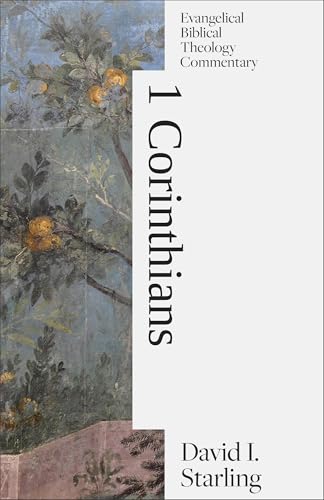
1 Corinthians, Evangelical Biblical Theology Commentary
Written by David I. Starling Reviewed By Paul S. JeonFirst Corinthians presents interpreters with an unusual challenge. Few New Testament letters combine such a diverse range of theological, ethical, ecclesial, and pastoral questions or have generated such an extensive history of interpretation. David Starling proves to be a wise guide through this complex terrain. Marked by sound exegetical judgment, broad engagement with contemporary scholarship, and a consistent concern to interpret individual passages within Paul’s larger theological argument, this volume is a valuable guide for pastors, students, and scholars alike.
One of the commentary’s greatest strengths is its balance between breadth and depth. Starling moves confidently through the letter’s major interpretive issues without allowing the discussion to become either superficial or unwieldy. Particularly valuable is the substantial 60-page introduction. Beyond surveying the historical setting and social world of Corinth, Starling explores the letter’s occasion, literary coherence, and principal theological themes, including wisdom, Christology, ecclesiology, salvation, and eschatology. These opening chapters establish the conceptual framework that governs the exposition, enabling readers to understand each passage within Paul’s larger theological and pastoral argument.
Equally commendable is Starling’s engagement with contemporary scholarship. He demonstrates extensive familiarity with the major conversations in Pauline studies while exercising admirable restraint in their use. Scholarly discussions are introduced not to display erudition but to illuminate genuine exegetical questions. His treatment of the meaning of “head” in 1 Corinthians 11 illustrates this approach well. Competing interpretations are represented fairly before Starling offers a measured defense of his own conclusions. Even readers who disagree with particular judgments will appreciate the integrity and generosity with which opposing views are handled.
The commentary is especially successful in fulfilling the distinctive aims of the Evangelical Biblical Theology Commentary series. Rather than treating Paul’s use of Israel’s Scriptures as a collection of isolated citations, Starling consistently demonstrates how they advance the theological logic of the letter as a whole. Whether discussing the Deuteronomic background and Passover imagery of chapter 5, Israel’s wilderness experience in chapters 8–10, or the Adam-Christ theology that climaxes in chapter 15, he shows that Paul’s ethical exhortations and pastoral instruction emerge from the larger story of God’s saving work fulfilled in Christ. Biblical theology therefore remains an integral feature of the exposition rather than an occasional aside, making this volume a fitting contribution to the series.
The volume’s commitment to accessibility necessarily limits the amount of space devoted to sustained interaction with some technical debates. Readers seeking exhaustive treatment of every grammatical, rhetorical, or text-critical issue will still need to consult larger commentaries such as those by Thiselton, Fee, Garland, or Ciampa and Rosner. Likewise, although the “Bridge” sections consistently connect Paul’s argument to broader theological concerns, some readers may wish they ventured further into concrete pastoral and homiletical application. These are less shortcomings than the inevitable tradeoffs of a commentary designed to remain both academically responsible and genuinely useful for the church.
One final theological observation may be offered. Starling rightly appeals to creation in several pivotal discussions—notably Paul’s treatment of food offered to idols (chs. 8–10), gender and worship (ch. 11), and the resurrection (ch. 15)—and perceptively argues that redemption restores rather than abolishes God’s created order. Readers may nevertheless wonder whether this creation–new creation framework could have been developed more explicitly as one of the principal theological threads unifying Paul’s diverse pastoral concerns. Throughout 1 Corinthians, questions of worship, sexuality, authority, ecclesial life, and eschatological hope repeatedly find their theological grounding in God’s creational purposes as renewed through the gospel of Christ. Bringing this pattern into sharper focus would have further illuminated the coherence of Paul’s argument and reinforced the commentary’s already strong biblical-theological orientation.
These observations, however, do little to diminish the commentary’s considerable strengths. Starling has produced a balanced, reliable, and theologically rich exposition of one of Paul’s most demanding letters. His combination of exegetical judgment, fair engagement with competing interpretations, theological sensitivity, and biblical-theological insight makes this commentary a worthy contribution to the Evangelical Biblical Theology Commentary series. It deserves a wide readership among pastors, teachers, students, and scholars seeking a commentary that combines exegetical rigor, theological depth, and pastoral usefulness.
Paul S. Jeon
Paul S. Jeon is assistant professor of New Testament and Pastoral Theology at Reformed Theological Seminary in Washington, DC, and senior pastor at NewCity Church in Vienna, Virginia.
Other Articles in this Issue
Main-Point-Driven: A Clear Methodology for Implementing the Christ-Centered Hermeneutic
by Dan AllenThis article addresses the need for a clear methodology for implementing the Christ-centered interpretation...
LaMaster considers Elizabeth Castelli’s contention that Paul’s use of imitative language reinforces power in authority relationships...
Cameron Schweitzer argues that Drew Hunter’s earlier work on Jonathan Edwards’s understanding of typology is too narrowly christological...
This essay argues that evangelical retrieval of the Christian tradition finds a particularly fruitful interlocutor in Athanasius of Alexandria, whose “ruled readings” of Scripture and trinitarian exegesis model a canonically-coherent theological hermeneutic...
Wisdom and Folly in Laodicea: Revelation’s Message to the Laodiceans as Wisdom Discourse
by Joel MacInnesThis article examines Christ’s message to Laodicea as “wisdom discourse,” arguing that it employs “wisdom forms,” “allusions to wisdom literature,” and addresses “wisdom concerns...
Other Reviews in this Issue