
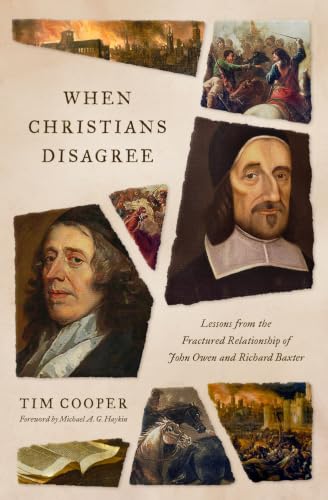
When Christians Disagree: Lessons from the Fractured Relationship of John Owen and Richard Baxter
Written by Tim Cooper Reviewed By Bernard WesterveldThis book is a must-read. I have read it twice, in less than three months, because I am experiencing exactly what the subtitle describes: a fractured relationship with Christian brothers. Who among us has not or will not (again!) need to navigate the stormy waters when Christians disagree? Tim Cooper, professor of church history at the University of Otago in New Zealand, has drawn sobering lessons about brotherly love from the fractured relationship between two giants of the English Second Reformation, John Owen and Richard Baxter. While many serious Christian leaders will readily identify their key theological works (e.g., The Mortification of Sin, The Reformed Pastor), few are aware of their acrimonious relationship.
Profiting from the historical and emotional distance that separates today’s leaders from Owen and Baxter—they lived nearly 400 years ago—Cooper unfolds their tragic story. After a brief historical review of the life and ministries of these “Two Good Men” (pp. 9–28), Cooper successively explores three contributing elements to the intensification of all church disagreements: experience, personality, and theology.
Both Owen and Baxter experienced the English Civil War (1642–1651), but they experienced it in very different ways due to their geographical proximity (Baxter) or distance (Owen) from the bloody fighting. “In sum,” writes Cooper, “Owen saw the war as a blessing from God, while Baxter viewed it as God’s judgment on a sinful people” (p. 37).
The same intensity could be felt in their personality clash (p. 41). Owen was known for “his tendency to respond with anger when others stood in his way” (p. 48). Baxter was not shy to stand in someone’s way with “his tendency to come across as magisterial, haughty, arrogant, impervious to correction, blind to his own weakness, incapable of self-doubt, and personally disdainful of others” (pp. 50–51).
Theologically, the two pastors were in wholehearted agreement, except on some questions which “may seem extremely technical to us.” Their different answers were articulated “in large part because each was driven by a different set of concerns” (p. 58). While Baxter warned against the waywardness of antinomianism, Owen feared the insecurity of Arminianism. “The particular concerns of each man,” notes Cooper, “led them to focus on different issues and talk past each other” (p. 70).
Having identified their differences, Cooper develops the explosive nature of their exchanges. Their “accidental animosity” began in written form in 1649 when Baxter reluctantly criticized Owen’s book The Death of Death in the Death of Christ (pp. 74–75). Owen’s reply “may have been brief, but it was heated and pointed” (p. 80).
The loss of mutual trust played out when the two men did finally meet in 1654 to serve a government-appointed subcommittee on church unity. Cooper’s summary of their acrimonious relationship is insightful:
It did not, and it rarely does. Today, many ministry leaders can recount how a meeting went terribly wrong, tearing brothers apart. However, they were often unaware that these fissures existed before the meeting began, or at least they were unable to identify them. Drawing lessons from the Owen-Baxter disagreements, Cooper directs our eyes to see and know ourselves.
Each chapter helpfully concludes with questions for personal reflection. While Cooper suggests that the reader may ponder these questions “either by yourself or in a small group” (p. 5), the emphasis is on individual analysis. However, the real benefit will be revealed when we engage in this discussion with fellow leaders who can see us better than we understand ourselves. If we have the courage to engage this discussion before a conflict rears its ugly head, we may have the humility to listen and to learn in the midst of the controversial storm.
When Christians Disagree should be required reading for all seminary students. (I’m proposing it for translation into French for my students in Quebec.) Young men training for the ministry often naïvely assume their ability to elude leadership conflict. Their foolishness increases as they read the great works of theological giants. Cooper’s book opens their eyes to the reality that solid theologians need to be personally sanctified.
Pastors, elders, and ministry leaders would benefit greatly from reading and rereading When Christians Disagree. Because of their service within the church, they will certainly experience fractured relationships. Some pastors become crusty combatants. Like Owen and Baxter, they shut themselves off and comfort themselves with self-justification. Wise pastors will recognize the need for “openness and self-awareness” (p. 126). Regularly reflecting upon When Christians Disagree will enable us to develop a fresh reading of our own personal conflicts. By God’s grace, may we develop the wisdom, patience, and gentleness necessary for peaceful reconciliation.
Bernard Westerveld
Farel, Institut de théologie réformée
Other Articles in this Issue
This essay develops a distinctly Christian theology of free speech in response to mounting threats of censorship across Western societies...
In every generation and in every place, there is a need to identify, equip, and encourage new leaders for Christ’s church...
Missio Trinitatis: Theological Reflections on the Origin, Plan, and Purpose of God’s Mission
by Brian A. DeVriesTrinitarian theology provides the basis for understanding missio Dei...
This essay argues that monogamous sexually-differentiated marriage (MSDM) is uniquely revealed through Christ’s relationship with the church in Ephesians 5:30–32...
Other Reviews in this Issue

Genesis
Reviewed by Dustin Burlet