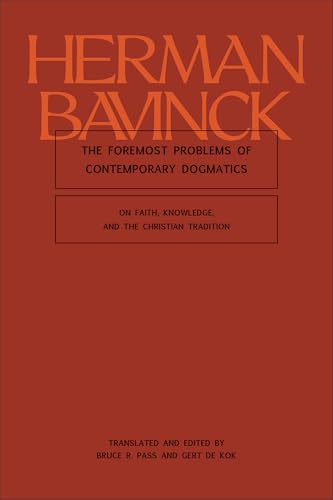

The Foremost Problems of Contemporary Dogmatics: On Faith, Knowledge, and the Christian Tradition
Written by Herman Bavinck Reviewed By Samuel G. ParkisonLexham Press’s publication of The Foremost Problems of Contemporary Dogmatics: On Faith, Knowledge, and the Christian Tradition represents something of a triumph in Bavinck studies. This is not to say that this volume boasts anything particularly surprising or ground-breaking in Bavinck studies, only that such a publication signifies the wild success of an area of interest. That a modern publishing house would see these partially completed lectures as a fruitful publishing venture is a testament to Bavinck’s increasing popularity in recent decades.
This book is the historical section of a series of lectures Herman Bavinck delivered towards the beginning of his time at the Free University in Amsterdam. In them, Bavinck sought to address the key ideas and figures that were shaping the theological landscape of his day. In this way, The Foremost Problems includes several analyses that may seem irrelevant to the reader today. The theologians covered in the last two chapters are not likely to ring a familiar bell for an English-speaking audience today. But this should not take the reader by surprise, since Bavinck made his agenda quite clear at the start: “anyone who may soon have to lead their people must be at home in his own era. He must be a child of his own time, understanding his own time” (p. 2).
So, the dated discussions of some of the later portions of the book are not an intrinsic mark against Bavinck. Indeed, the content in these sections is not only surprisingly instructive, but it models the patient, methodical manner in which Bavinck engages with competing systems of thought. In contrast to much of the modern Church that was “actually afraid of scholarship” and had—in his words—“allowed itself to be intimidated and terrorized by it, humbly begging for a small place somewhere in the intellectual inner sanctum” (p. 219), Bavinck respected no sacred cows: no figure, however tall they stood by way of influence—be it Kant or Schleiermacher or Hegel or Harnack—was beyond critique.
As the subtitle suggests, Bavinck is concerned in these lectures with the metaphysics of epistemology. The Enlightenment brought an unhealthy separation between faith and knowledge. Therefore, he sought to rehabilitate a distinctly Christian view of faith. Faith, for Bavinck, is not strictly trust but is rather a kind of knowledge. In agreement with classical Protestant commitments, Bavinck supports faith as being comprised of knowledge, assent, and trust. What makes Bavinck unique is that he brings these classical commitments into contemporary conversations of epistemology and the nature of knowledge. In other words, faith cannot be treated as one topic among many, as if it were a mere expression of the mystical and spiritual side of man. Rather, it is irreducibly consequential on the whole matrix of knowledge and reality itself. Faith has epistemological consequences, and the tendency to abstract faith from knowledge can only result in the death of faith. But such a separation also results in the death of knowledge. And in this way, Bavinck—even early on during his time at the Free University—is unambiguously committed to Christian worldview thinking.
The benefit of this outlook, of course, is that it gives the Christian permission—indeed, the command—to view all of life and reality in the light of the Christian story. This worldview thinking is what provides Bavinck with the rationale to explore his polymathic interest in explicitly theological terms. But the danger of this kind of framework is the temptation of reductionism. If all doctrines and beliefs are to be the product of—and contribution to—one’s overall worldview, and if the goal is to praise the supremacy of the Protestant (and, more specifically, the Reformed) worldview over and against all others, reducing those other “worldviews” to some central ideas, simplistically construed, will always be a temptation. Some will no doubt accuse Bavinck of succumbing to such a temptation with his uncharacteristically brief analysis of Roman Catholicism in general, and Thomas Aquinas in particular.
Bavinck’s reason for engaging in the medieval theology of Aquinas is right, insofar as it goes. He argues that those forces that have conspired to result in the “foremost problems of dogmatics” in his own day trace back to before the time of the Reformation. But Bavinck’s analysis of those philosophical headwaters is not as nuanced as his analysis of his contemporaries. Bavinck describes the starkest expression of the Nature and Grace distinction and attributes Pure Nature theology unquestioningly to Aquinas, and monolithically to Roman Catholicism as a whole (pp. 17–32). This brief analysis is what informs Bavinck’s criticism of later Reformed Orthodox theologians for critically appropriating Aristotle via Aquinas in their metaphysical commitments (pp. 75–76). He goes on to accuse the Protestant Scholastics of making “ratio (‘reason’) and fides [‘faith’] … stand dualistically side by side on the scientific domain as they do in Thomas” (p. 76). According to this “dualistic” portrait of Roman Catholicism in general, and Aquinas in particular, Bavinck can likewise casually describe the “philosophy of Descartes” as “Roman Catholic” (p. 77).
This reviewer will leave it to others more capable to render the judgment on whether Bavinck is guilty of reductionism for the convenience of worldview analysis, but we can at least highlight the contrast of sweeping characterizations of Aquinas and the Roman Catholic tradition in the first half of the book with the patient and charitable analysis of modern liberal theologians in the latter half. The imbalance is discernable at the sheer level of page count. If he is guilty of reductionism, the need would surely not be to somehow express less charity and patience toward modern liberal thinkers but rather to receive our Lord’s correction in this reappropriated context: “These you ought to have done, without neglecting the others” (Matt 23:23b).
In any case, this book is a good illustration of what makes Bavinck so formidable a thinker. In this book, Bavinck puts on full display the power and purpose of the neo-Calvinist project. One cannot help but be impressed with his command of the depth and breadth of material covered in this volume. This reviewer suspects that The Foremost Problems of Contemporary Dogmatics will be something of a “deep track” for fans of Bavinck. Those who simply want to become more acquainted with Bavinck’s thought would do much better to explore other works (such as The Wonderful Works of God, his Reformed Dogmatics, his Essays on Religion, Science, and Society, or even his more devotional The Sacrifice of Praise) before turning to these lectures.
Samuel G. Parkison
Gulf Theological Seminary
Abu Dhabi, UAE
Other Articles in this Issue
This essay develops a distinctly Christian theology of free speech in response to mounting threats of censorship across Western societies...
In every generation and in every place, there is a need to identify, equip, and encourage new leaders for Christ’s church...
Missio Trinitatis: Theological Reflections on the Origin, Plan, and Purpose of God’s Mission
by Brian A. DeVriesTrinitarian theology provides the basis for understanding missio Dei...
This essay argues that monogamous sexually-differentiated marriage (MSDM) is uniquely revealed through Christ’s relationship with the church in Ephesians 5:30–32...
Other Reviews in this Issue
Genesis
Reviewed by Dustin Burlet