
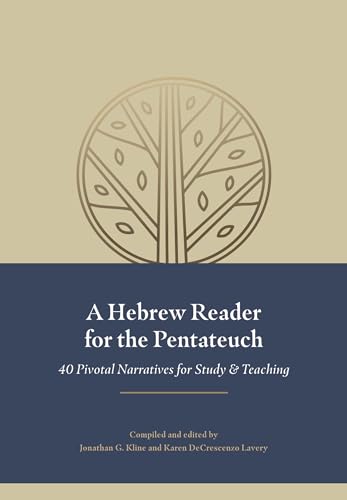
A Hebrew Reader for the Pentateuch: 40 Pivotal Narratives for Study and Teaching
Written by Jonathan G. Kline and Karen DeCrescenzo Lavery, eds. Reviewed By Dustin BurletThe extreme importance of the Pentateuch for cultivating a biblical worldview can hardly be overstated. It provides the theological scaffolding and narrative framework that undergirds the entirety of Scripture. However, every interpreter (exegete) must ultimately grapple with the text at the level of language. For some specialists, this necessarily entails an intimate familiarity with Biblical (Classical) Hebrew. Enter A Hebrew Reader for the Pentateuch: 40 Pivotal Narratives for Study and Teaching compiled and edited by Jonathan G. Kline and Karen DeCrescenzo Lavery.
This book is organized in five main sections, each with eight readings. The first section outlines select passages from primeval history, Genesis 1—11, which (arguably) has its own unique character. This is followed by four sections reflecting the different locations in which Israel—or their ancestors—find themselves, namely Canaan, Egypt, Sinai, and the Wilderness. One notes, of course, that during section three (Israel in Egypt), the Israelites flee from Egypt, cross the Red Sea/Sea of Reeds—i.e., Yam Suph (sec. 3.6)—and enter the wilderness (secs. 3.7 and 3.8). Thus, a more precise title might be “Israel in Egypt and on the way to Sinai” (p. x).
Kline and Lavery chose these narrative texts to help readers appreciate “the trajectory of the grand story of Israel’s origins anew and see afresh how these stories, despite their diversity and often complex redactional history, can be seen to work together to form a narrative whole” (p. x; cf. p. ix). While some may quibble that there are no texts from Leviticus and only one from Deuteronomy (the death of Moses), the authors judiciously argue: “from the standpoint of genre [narratives] these two books effectively fall outside the scope of this volume” (p. x).
The Hebrew used within this book is drawn from the Westminster Leningrad Codex (WLC), or more officially, the Michigan-Claremont-Westminster Electronic Hebrew Bible—a popular (public domain) electronic version that is based on the BHS. Importantly, though, Kline and Lavery have made one small formatting change to the WLC (see p. xi): for ketiv-qere pairs, they present the ketiv first (with no vowels) followed by the qere in superscript.
Typographically, the text of each passage is often broken up into (very) short paragraphs, being guided, first, by the presence of the Masoretic paragraph markers setumah and petukhah (marked in the left-hand margin) and then the editors’ “subjective judgments about the presence in the text of discrete thought units, shifts in speaker, or (typically small-scale) narratival transitions” (p. xi). Additional line breaks, indents, and larger-than-normal spacing divide the text further into prosodic units based on the Masoretic syntax. Kline and Lavery state:
After each paragraph, Kline and Lavery have included an apparatus that focuses on key words and their morphology. This apparatus (cf. p. xi) typically consists of two parts: verbs (with root and binyan) and morphologically difficult non-verbs. For ease of use, common personal and/or geographical names including gentilics are also included.
The book closes with a glossary of verbs and a glossary of non-verbs (in each case, words that occur fewer than fifty times in the Hebrew Bible/Old Testament [HB/OT] are marked in bold). However, some glosses seem to lack nuance or precision. For instance, אֶלֶף is simply “thousand,” and both הִנֵּה and הֵן are only rendered as “look, behold!”
While a ribbon marker would have been nice, this is a gem of a book that is otherwise hard to critique. While it might not offer the same syntactical and/or morphological “tips” that certain other books available on the market provide (e.g., Miles V. Van Pelt and Gary D. Pratico’s Graded Reader of Biblical Hebrew: A Guide to Reading the Hebrew Bible, 2nd ed. [Grand Rapids: Zondervan, 2020]; Ehud Ben Zvi et al., Readings in Biblical Hebrew: An Intermediate Textbook [New Haven: Yale University Press, 1993]; Robert B. Chisholm Jr.’s A Workbook for Intermediate Hebrew: Grammar, Exegesis, and Commentary on Jonah and Ruth [Grand Rapids: Kregel Academic, 2006]), it is still a valuable asset for those seeking a more meditative and tactile engagement with the HB/OT.
Its primary users are likely to be second-year Hebrew language students within a specific reading course on the Pentateuch, but it can also effectively be used for self-study. Readers moving through one “shorter” passage (twenty verses or less) a week and devoting two weeks to the “longer” ones (over twenty verses) can complete the entire volume in about one year. Lovers of Scripture can rejoice at the superb editorial work made available by Kline and Lavery!
Dustin Burlet
Millar College of the Bible
Winnipeg, Manitoba, Canada
Other Articles in this Issue
This essay develops a distinctly Christian theology of free speech in response to mounting threats of censorship across Western societies...
In every generation and in every place, there is a need to identify, equip, and encourage new leaders for Christ’s church...
Missio Trinitatis: Theological Reflections on the Origin, Plan, and Purpose of God’s Mission
by Brian A. DeVriesTrinitarian theology provides the basis for understanding missio Dei...
This essay argues that monogamous sexually-differentiated marriage (MSDM) is uniquely revealed through Christ’s relationship with the church in Ephesians 5:30–32...
Other Reviews in this Issue
Genesis
Reviewed by Dustin Burlet