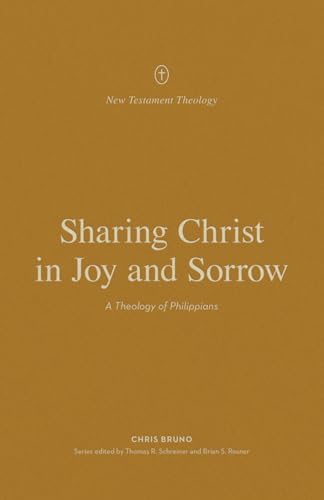

Sharing Christ in Joy and Sorrow: A Theology of Philippians
Written by Chris Bruno Reviewed By Mark J. TurnerIn this recent volume in Crossway’s New Testament Theology series, Chris Bruno, president and professor of New Testament and biblical theology at Oahu Theological Seminary, offers a compact, pastorally warm, and theologically rich exploration of Paul’s letter to the Philippians. Bruno argues that the undergirding theme is the believer’s union with Christ, particularly in the context of sorrow and joy, suffering and glory (p. 1). In six concise chapters (plus an introduction and conclusion), Bruno structures his theology around this union. He unpacks its implications across a range of Pauline themes: Christology, ecclesiology, eschatology, mission, and perseverance.
Bruno grounds his understanding of the letter in the Carmen Christi, which he reads as its theological center (p. 7). Christ’s humiliation and exaltation become paradigmatic for the church’s life and mission. Bruno points out how Paul’s gospel logic proves that exaltation always comes through suffering (p. 12). The following chapter elaborates his controlling theme of union with Christ, a theme that undergirds the letter’s exhortations (p. 20). Repeated phrases such as “in Christ” and “in the Lord” permeate Philippians (pp. 24–25). Chapters 3–5expand this union across the life of the church (focusing on shared humility, gospel advance, and eschatological hope), with the final chapter bringing the full emotional weight of Bruno’s thesis to bear in a reflection on joy amid suffering. His closing pages are marked by poignant autobiographical resonance, written beside his dying father’s hospital bed, a fitting conclusion to a theology of joy in sorrow.
Several strengths stand out. Bruno writes with personal warmth, pastoral clarity, and theological depth, and his familiarity with Pauline theology is evident throughout. Readers will appreciate the integration of biblical theology, particularly the Adam/Christ typology and echoes of Isaiah’s suffering servant. In a letter sometimes argued to be devoid of Hebrew Bible allusions and references, he highlights Paul’s rich use of the Hebrew Bible in Philippians. One only wishes he pressed further, not only to the Isaianic servant texts he highlights but also to the Psalms, where vindication language resonates with Paul’s framing of suffering and exaltation. He integrates Pauline theology from more expansive letters, with concise attention to background, rhetorical structure, and the christological significance of Paul’s language. While avoiding unnecessary technicalities, Bruno’s exegesis is especially strong in passages like 2:5–11, where his unpacking of Christ’s “self-emptying” (2:7) as an adding, not subtracting, of humanity is both clear and careful.
Moreover, this book is refreshingly accessible for pastors and students alike. The brevity of each chapter makes it digestible, and Bruno resists the temptation to chase every scholarly tangent. He is aware of the limits of his scope, especially regarding Old Testament allusions, and states this up front.
That said, the book’s strengths are also its limitations. In attempting to write a brief biblical theology, Bruno occasionally mutes the distinct voice of Philippians in favor of familiar Pauline categories. One wishes for greater attention to the unique literary and rhetorical features of the letter as they add dimension and weight to Paul’s theology. For instance, Bruno does not discuss the linguistic prevalence of the συν– prefix (cf. Phil 1:7, 27; 2:2, 25; 3:17, 10; 4:3), though it bolsters his discussion for unity and mutual participation in Christ (pp. 16, 31–34). Additionally, there is no mention of the rhetorical movement of φρονέωlanguage (cf. Phil 1:7; 2:2, 3, 5; 3:15, 19; 4:2, 10), especially as it informs Paul’s concrete exhortations around unity and humility. Being of the “same mind” (2:2) requires “lowliness of mind” (2:3), which reflects the very “mind” of Christ shared by believers (2:5). Unfortunately, Bruno offers little sustained engagement with 1:1–11, a section that sets the tone and theological trajectory for the letter. These linguistic markers serve as scaffolding around which the theological argument is constructed.
Most notably, Bruno does not offer sustained discussion of Philippians 1:27–30, arguably the thesis of the epistle (cf. David Alan Black, “The Discourse Structure of Philippians: A Study in Textlinguistics,” NovT 37 [1995]: 16–49). While the Carmen Christi is surely significant, its use is primarily paradigmatic and illustrative in the flow of Paul’s argument in 1:27–2:11 (cf. Gordon D. Fee, Paul’s Letter to the Philippians, NICNT [Grand Rapids: Eerdmans, 1995]). To skim over 1:27 is to risk bypassing the letter’s stated telos of a gospel-shaped unity, underscored by Paul’s own vocabulary (i.e., “μόνον” in 1:27). Greater textual attentiveness at this point could have sharpened the theological clarity of the work, especially given Bruno’s ability to connect christological themes to ecclesial realities.
Still, Bruno’s work offers a valuable resource. Pastors preaching through Philippians will find encouragement, theological connections, and devotional clarity. In sum, Sharing Christ in Joy and Sorrow is a faithful and helpful introduction to the theology of Philippians. While it does not fully capture the distinct resonance of the letter, it succeeds in showing how Paul’s hope in Christ enables believers to hold joy and sorrow together.
Mark J. Turner
Southeastern Baptist Theological Seminary
Wake Forest, North Carolina, USA
Other Articles in this Issue
This essay develops a distinctly Christian theology of free speech in response to mounting threats of censorship across Western societies...
In every generation and in every place, there is a need to identify, equip, and encourage new leaders for Christ’s church...
Missio Trinitatis: Theological Reflections on the Origin, Plan, and Purpose of God’s Mission
by Brian A. DeVriesTrinitarian theology provides the basis for understanding missio Dei...
This essay argues that monogamous sexually-differentiated marriage (MSDM) is uniquely revealed through Christ’s relationship with the church in Ephesians 5:30–32...
Other Reviews in this Issue
Genesis
Reviewed by Dustin Burlet