
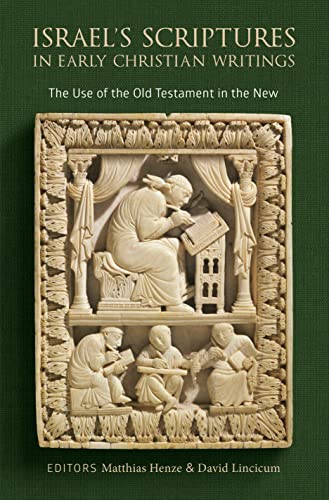
Israel’s Scriptures in Early Christian Writings: The Use of the Old Testament in the New
Written by Matthias Henze and David Lincicum, eds. Reviewed By Benjamin E. CastanedaIn the decades since Richard Hays’s groundbreaking Echoes of Scripture in the Letters of Paul (New Haven: Yale University Press, 1989), there has been a tremendous outpouring of secondary literature on the relationship between the OT and the NT, mostly focusing on the latter’s reuse of the former. This hefty edited volume, comprising a lengthy introduction and forty-two dense chapters, not only outlines the status quaestionis but also aims to advance the scholarly conversation. Toward this end, the editors assemble an international cast of contributors from a variety of theological and ideological perspectives. The editors do not rigidly impose a set structure for each chapter or advance specific criteria for identifying allusions, though they do suggest that each contributor utilize a fourfold taxonomy (marked citation, unmarked citation, verbal allusion, and conceptual allusion) to aid discussion of the various categories of scriptural reuse.
The book is divided into five parts. Part 1 sets the stage with seven chapters that helpfully provide a baseline of comparison. An introductory chapter tackling the tricky question of which books constituted “Scripture” in the first century is followed by six chapters which analyze the reception and patterns of scriptural reuse (1) within the Hebrew Bible itself, (2) in the various Greek translations of the Old Testament, (3) in early Jewish literature (e.g., 1 Enoch and Wisdom of Solomon), (4) in the Dead Sea Scrolls, (5) in the writings of Philo, and (6) in the writings of Josephus. These chapters are particularly helpful from a historical vantage point by positioning the NT authors’ practices of scriptural reuse within a widespread Jewish literary and exegetical tradition.
Part 2 contains seventeen chapters covering every NT book. It should be noted that these chapters do not attempt to crawl through the text and offer analysis on every quotation or probable allusion. The result is a bit impressionistic, with each contributor free to focus on elements they wish to highlight. Despite not being exhaustive, the chapters in this section are generally thorough and routinely offer intertextual insights.
The eight chapters in part 3 attempt a synthetic analysis of a selection of major theological themes (“God,” “Messiah,” “Holy Spirit,” “Covenant,” “Law,” “Wisdom,” “Liturgy and Prayer,” and “Eschatology”) which cut across the OT and are then developed by NT authors. These chapters are more uneven. For instance, J. Thomas Hewitt offers a superb accounting of messianic idioms and images across both testaments. This is followed, though, by John Levison’s chapter on “Holy Spirit,” which includes a heuristic category (“Spirit and Ecstasy”) that he admits lacks support in the OT: “The prominence of an ecstatic experience of the spirit [sic] has only a slim foothold in the Jewish Scriptures” (p. 623). He then makes the odd and unconvincing claim that early Christians “succumbed” to a “swell of ecstasy,” asserting that this was a commonplace feature of Hellenistic Judaism in the Second Temple era (p. 625). The evidence for this, Levison argues, consists in the downplaying of ecstasy in Acts and 1 Corinthians (p. 625). Finally, in the chapter on “Law,” Claudia Setzer rightly dispenses with a number of unhelpful stereotypes and misrepresentations of Israel’s purity laws and legal traditions in biblical studies. But in the process, she unfortunately buys into caricatures of Reformational interpretations of Paul and the law. Setzer instead appears to embrace John Gager’s “two-track system” (p. 691), with covenantal nomism the path to salvation for Jews and faith in Christ the path for Gentiles alone.
Part 4 analyzes five significant OT sources (Deuteronomy, Isaiah, Psalms, Daniel, and famous figures from Israel’s history) and traces their reception in the writings of the NT. Although all these chapters contain useful information, most fascinating is Valérie Nicolet’s chapter concerning “Figures of Ancient Israel in the New Testament.” She traces the reception in early Jewish literature and in the NT of Abraham, Moses, David, Jacob, Joseph, and Elijah, along with “lesser-used female figures” (p. 914) such as Eve, Hagar, Sarah, Tamar, Rahab, Ruth, and Bathsheba, surveying their typological or exemplaristic functions.
Perhaps the most distinctive feature of Israel’s Scriptures in Early Christian Writings lies in part 5, which in five chapters analyzes scriptural reuse in 1) the apocryphal Gospels, 2) the apocryphal Apocalypses, 3) the Adversus Judaeos literature (e.g., Barnabas, Justin Martyr, etc.), 4) Marcion and the “critical tradition” (i.e., heretical writings), and 5) early Christian pictorial art. These corpora are often overlooked and have generally received less attention regarding their use of the OT (aside from a few key studies of Justin Martyr’s use of Scripture).
In sum, Israel’s Scriptures in Early Christian Writings constitutes a significant contribution to scholarship. In terms of situating it among similar studies, this project claims a spot somewhere between G. K. Beale and D. A. Carson’s classic edited work, Commentary on the New Testament Use of the Old Testament (Grand Rapids: Baker Academic, 2007), and the Dictionary of the New Testament Use of the Old Testament (Grand Rapids: Baker Academic, 2023), edited by Beale, Carson, Benjamin L. Gladd, and Andrew David Naselli. Israel’s Scriptures lacks the exhaustive detail of the Commentary but contains more up-to-date discussions. And while the Dictionary devotes much more space to theological themes, Israel’s Scriptures surveys scriptural reuse in a wider array of literature. Its expansive scope, engagement with contemporary scholarship, and diversity of perspectives make this volume required reading for those interested in the relationship between the Old Testament and the New.
Benjamin E. Castaneda
Edinburgh Theological Seminary
Edinburgh, Scotland, UK
Other Articles in this Issue
This essay develops a distinctly Christian theology of free speech in response to mounting threats of censorship across Western societies...
In every generation and in every place, there is a need to identify, equip, and encourage new leaders for Christ’s church...
Missio Trinitatis: Theological Reflections on the Origin, Plan, and Purpose of God’s Mission
by Brian A. DeVriesTrinitarian theology provides the basis for understanding missio Dei...
This essay argues that monogamous sexually-differentiated marriage (MSDM) is uniquely revealed through Christ’s relationship with the church in Ephesians 5:30–32...
Other Reviews in this Issue
Genesis
Reviewed by Dustin Burlet