
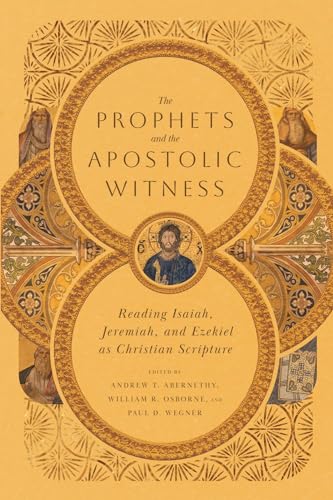
The Prophets and the Apostolic Witness: Reading Isaiah, Jeremiah, and Ezekiel as Christian Scripture
Written by Andrew T. Abernethy, William R. Osborne, and Paul D. Wegner, eds. Reviewed By Drew N. GrumblesAccording to the Apostle Peter, the prophets prophesied about the grace that belongs to the Christian. They searched and inquired carefully, trying to discern even their own Spirit-given prophecies that revealed the future sufferings of Christ (cf. 1 Pet 1:10–11). If the prophets themselves encountered the challenge of understanding their own writings, how much more do Bible readers today meet difficulty when reading the prophets as Christian Scripture? Modern interpreters face many questions: Do direct prophecies only have one (Messianic) fulfillment, or can they have multiple fulfillments? Do the prophets speak only in their historical context, or can they speak beyond it? For example, does “Israel” refer only to the geo-political nation-state, or can the prophets mean something beyond the bare use of the term? Moreover, how do we handle the numerous citations of the prophets in the New Testament, some of which seem to not follow the “literal” hermeneutic of the typical modern reader? Because of these questions, The Prophets and the Apostolic Witness provides interesting grist for the intellectual mill.
This book is more of a work on hermeneutics than on the major prophets. It tackles the long-standing question of how the Hebrew Bible/Old Testament can be read as Christian Scripture but focuses that question on the books of Isaiah, Jeremiah, and Ezekiel. Like many of the “multiple views” books now popular on the market, this one goes through each of the major prophets and presents one scholar’s take on how to interpret the book. In short, for each biblical book the editors appoint one scholar to argue for the typological method, one for the literal-grammatical method, and a third for the “sensus plenior” method. In these respective essays, the writers examine a text as a case study for their method (Isa 42:1–4; Jer 31:31–34; Ezek 37:1–14). Finally, for each book another scholar presents a history of interpretation, and another writes on how to preach that book as Christian Scripture. While certainly each essay contains interesting nuances on the prophetic works themselves, the larger interpretive issues are often in view. Unlike the “multiple views” books, in this volume the editors do not write direct responses to each other, though there are a few instances of interactions.
The book is helpful when it delineates the different approaches to the three prophetic books. In other words, one can benefit from seeing “side-by-side” how one scholar interprets a book like Jeremiah in contrast to another. On the other hand, some of the essays focused too much on the case study. For example, the first three essays on Jeremiah explain in extensive detail the authors’ views of the new covenant in Jeremiah. There is some exploration of less explicit prophecies or allusions in Jeremiah, such as Jeremiah 31:15, Rachel weeping for her children (pp. 107–10). This reader wishes more of such soundings were included in this volume. Also, the last two essays on each prophetic book, the history of interpretation and “how to preach” chapters, are interesting but not as valuable. The essays on history of interpretation provide interest but essentially cover the same ground of the different hermeneutical approaches already discussed. Similarly, the essays on preaching reflect much of the same methods already described. This reader is unsure how the preaching essays uniquely contribute to volume, since how one preaches a text depends on one’s prior interpretive approach.
This work can be a help to students who are first delving into hermeneutics of the prophetic corpus, or even as an introduction to the basic interpretive issue of understanding the Old Testament in light of the New. In the latter respect, this work is easy to understand, as opposed to some of the more complex hermeneutics textbooks. At the same time, the book can also be used for hermeneutical classes and discussions, not just for teaching on the prophets. Pastors may also gain help from this work as they begin a preaching series through one of the Major Prophets. If this book can encourage Bible readers and teachers to see Christ in the Major Prophets, the editors have accomplished a worthy task.
Drew N. Grumbles
Albany Baptist Church
Albany, New York, USA
Other Articles in this Issue
This essay develops a distinctly Christian theology of free speech in response to mounting threats of censorship across Western societies...
In every generation and in every place, there is a need to identify, equip, and encourage new leaders for Christ’s church...
Missio Trinitatis: Theological Reflections on the Origin, Plan, and Purpose of God’s Mission
by Brian A. DeVriesTrinitarian theology provides the basis for understanding missio Dei...
This essay argues that monogamous sexually-differentiated marriage (MSDM) is uniquely revealed through Christ’s relationship with the church in Ephesians 5:30–32...
Other Reviews in this Issue
Genesis
Reviewed by Dustin Burlet