
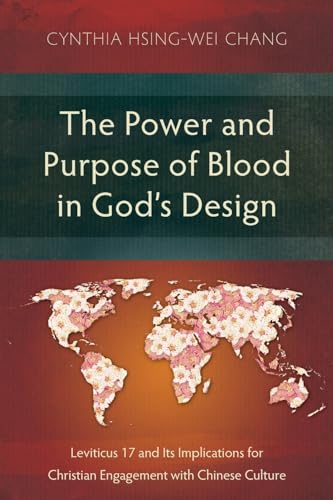
The Power and Purpose of Blood in God’s Design: Leviticus 17 and Its Implications for Christian Engagement with Chinese Culture
Written by Cynthia Hsing-Wei Chang Reviewed By Paul BarkerIt was only in my first semester living and teaching in Asia that a student asked, “Sir, can Christians eat blood?” It was a class on the Pentateuch, but the student added, “I ask because at lunch today in the dining room we have blood.” Though I had thought vaguely about this issue already, I had never been confronted with blood on the menu. Thankfully, I discovered there was a bloodless option. Coagulated blood jelly is not appealing to my Western palate.
That example occurred when I was teaching in Thailand, but I have had the same questions and class discussions in Malaysia, Myanmar, and the Philippines, and it is a live issue in China.
During my time living in Asia, I read and reviewed Jay Sklar’s wonderful Tyndale commentary on Leviticus (Downers Grove, IL: InterVarsity Press, 2014) and noted that, on the issue of blood, he only has a brief footnote, referring to Acts 15, that the prohibition is to prevent offending Jews. I also later reviewed Ming Him Ko’s Asia Bible commentary on Leviticus (Carlisle, PA: Langham Global Library, 2018), also for Themelios. Ko addresses the issue but regards blood as simply food that Jesus has now declared clean, and its Acts prohibition is a cultural issue.
So Chang’s monograph is a welcome contribution to this issue, which is important in the Asian world at least. She acknowledges that part of the impetus for this book and study is the common practice of eating cooked blood pudding in Chinese culture. Perhaps Westerners might substitute the English or Spanish black pudding for context. This monograph is based on her PhD dissertation under Professor Richard Averbeck at TEDS in the USA. Chang teaches at Singapore Bible College.
Her thesis is broader than this single issue, as she discusses the structure of Leviticus as a whole and the literary function of chapter 17 within that. She notes the importance of understanding that the ritual texts are “narrativized” and the narratives are “ritualized” (pp. 34–37). She makes comparisons with some Ugaritic ritual texts and then examines the well-being offerings (pp. 69–120) and the prohibition on eating blood (pp. 121–54).
There is little scholarly consensus on how chapter 17 fits in the structure of Leviticus. Chang argues that, while chapter 17 shows significant continuity with chapters 1–16, at the same time it shows thematic and structural connections with chapter 22, and thus 17–22 ought to be regarded as one section. The rituals need to be read in the context of relationship-building between Yahweh and Israel, and the literary context is significant for determining the meaning of rituals.
With this background, Chang then argues that the regulation of well-being offerings highlights the covenantal relationship between the offerer and Yahweh and other Israelites. She finds several similarities with Ugaritic well-being offerings, notably the harmony being expressed between the offerer and the deity or deities. She also demonstrates a progression in strictness from Exodus 20 to Leviticus 17, but which then becomes more lenient in Deuteronomy 12 regarding a central altar (pp. 118–19). Rather than arguing for a chronology that makes Leviticus late, she argues that the shift is due to textual contexts, a fair argument in my opinion.
On the eating of blood, she discusses the similar prohibitions in Genesis 9 and Deuteronomy 12, noting they all occur in a covenantal context (pp. 132–42). The prohibition in Leviticus 17 is tied to blood for atonement on the altar and thus not any blood that is shed.
Finally, Chang applies her findings on the blood prohibition to Chinese practices (pp. 160–65). She argues that blood as a symbol of life is for atonement and within a relationship between the offerer and God. Blood for atonement is fulfilled in Jesus’s death for sin. She also mentions Leviticus 19:26, where the separation of Israelites from Gentiles is behind the prohibition of eating blood. Her reading, not argued in this book, of Acts 15 is that it is about the harmony between Jewish and Gentile Christians. Like with Paul’s argument in 1 Corinthians 10, Christians may eat but may choose not to eat for the sake of harmony with other, weaker Christians. Thus, Chinese Christians can eat cooked blood pudding.
I have not been persuaded by Chang’s argument, though she has given me much pause to think. The prohibitions in Acts 15 seem stronger than merely maintaining harmony between Jewish and Gentile Christians. Richard Bauckham (“James and the Gentiles (Acts 15.13–21),” in History, Literature and Society in the Book of Acts, ed. Ben Witherington III [Cambridge: Cambridge University Press, 1996], 154–84) and others are more persuasive on Acts 15, I suggest. The prohibition in Genesis 9 applies to all humanity and not only Israel, so Chang’s argument that this prohibition is covenantal is unconvincing for me.
Nonetheless, Chang’s monograph is stimulating, and I highly commend it. Especially given the multicultural nature of much of the Western church, we need to have a higher understanding of Asian cultural contexts and issues.
Paul Barker
Paul Barker
Anglican Diocese of Melbourne
Melbourne, Australia
Other Articles in this Issue
This essay develops a distinctly Christian theology of free speech in response to mounting threats of censorship across Western societies...
In every generation and in every place, there is a need to identify, equip, and encourage new leaders for Christ’s church...
Missio Trinitatis: Theological Reflections on the Origin, Plan, and Purpose of God’s Mission
by Brian A. DeVriesTrinitarian theology provides the basis for understanding missio Dei...
This essay argues that monogamous sexually-differentiated marriage (MSDM) is uniquely revealed through Christ’s relationship with the church in Ephesians 5:30–32...
Other Reviews in this Issue
Genesis
Reviewed by Dustin Burlet