
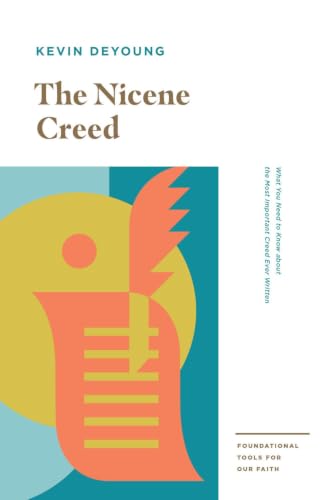
The Nicene Creed: What You Need to Know about the Most Important Creed Ever Written
Written by Kevin DeYoung Reviewed By Nathaniel ParkerKevin DeYoung has written an accessible introduction and overview of the Nicene Creed, particularly for readers unfamiliar with the creed or its historical background. This succinct work emerges at a critical juncture for evangelicalism, marked by a renewed focus on the creed and proposals to integrate it as a confessional statement within mainstream evangelical denominations, including the Southern Baptist Convention. DeYoung begins his work underscoring the importance of the creed: “After the Bible, the Nicene Creed may be the most important Christian text ever written…. Without exaggeration it can be said that every church and every Christian ought to know the Nicene Creed” (p. 9). The creed is analyzed through historical, theological, and devotional lenses, though a substantial portion of the text is dedicated to detailing the significance of its constituent parts and the heresies it was designed to counter.
The work begins with a summary of the historical context preceding the Council of Nicaea. It delves deeply into the topic of Arianism, a belief that contested the divinity of Jesus Christ and was a significant point of contention in the early church that ultimately influenced the formation of the creed. DeYoung elaborates on the revisions of the creed that occurred at the Council of Constantinople so that readers will understand the doctrinal development that took place concerning the final form of the Nicene symbol recited in the modern church. The rest of the work analyzes the text of the creed itself. The exposition starts by grounding the creed in Scripture and proceeds to illustrate the utilization of another widely recognized Christian article of faith, the Apostle’s Creed, as a baptismal formula by the church.
Chapter 2 (“only begotten”) is a theologically rich exposition concerning the distinction between God the Father and Son while still affirming the full deity of the Son. DeYoung elaborates on the term monogenes (“only begotten”) to refer to the eternal generation of the Son as “very God of very God” (p. 39), not as one created at a point in time (refuting Arianism). Chapter 3 (“one substance”) unpacks the debate concerning homoousios (“same substance”) and the importance that the Son shares the same essence of the Father while being distinct from the Father (p. 50). Chapter 4 (“for us and for our salvation”) elaborates on the work of Christ in his humiliation and exaltation as vital for our salvation (including comparisons to the Apostles’ Creed). Chapter 5 (“who proceeds from the Father and Son”) is an in-depth treatment concerning the double procession debate between the Eastern and Western church with the addition of the filioque clause, with arguments for and against the addition of the filioque and mediating positions proposed by modern scholars. DeYoung ultimately sides with the inclusion of the filioque: “The double procession underscores the critical and biblical truth that the Holy Spirit is the Spirit of Christ” (p. 69). Chapter 6 (“one holy catholic and apostolic church”) elaborates on the attributes of the church (while clarifying to readers that the term catholic means universal church and is not limited to the Roman Catholic Church), and Chapter 7 (“one baptism for the remission of sins”) argues that baptism for the remission of sins is a spiritual reality and not an efficacious/sacerdotal baptism (p. 81). DeYoung summarizes his position as: “The physical act of baptism points to these spiritual realities. In the same way, to be baptized eis [in] the remission of sins means that baptism points to the forgiveness of sins. Baptism identifies us as God’s beloved people…. We do not put confidence in the sign as such or in the act that the minister performs. We trust in God; we confess our baptism” (p. 82). He also argues from a paedobaptist, not credobaptist, perspective. He concludes the work with a summary of the Nicene Creed and practical applications of the creed for Christians.
DeYoung’s work was published at an opportune moment within evangelicalism. With evangelicals needing a solid understanding of essential doctrines of the faith (the Trinity, the Person of Jesus Christ, etc.), and with the resurgence of interest in and the potential incorporation of the Nicene Creed as a statement of faith in mainstream evangelical denominations, it is vital that Christians have a solid understanding of the creed. It would be tragic if the adoption of the creed became a statement Christians merely agreed to without fully understanding the importance and richness of the creed. DeYoung offers the average church member or Bible college student who may be new to the creed a clear understanding of the historical background, theological understanding, and practical applications of the creed. It is accessible and digestible and can easily be read in a single sitting or easily used in a church Sunday School, small group Bible study, or as recommended reading for a Bible college course. Non-Reformed readers will take issue with DeYoung’s paedobaptist position supporting infant baptism versus believer’s baptism, but most evangelicals will be generally comfortable concerning how DeYoung views the relationship between baptism and faith. Many evangelicals will also agree with DeYoung’s acceptance of the filioque clause and his position on double procession. However, DeYoung discusses various mediating positions (such as the procession from the Father through the Son) that are acquiring traction within evangelical scholarship, and he interacts well with those mediating positions.
A solid introduction to the creed, this book is a vital read for contemporary lay Christians and a constructive step in equipping the church with a richer understanding of its tenets. DeYoung is correct in his affirmation that every Christian should know the Nicene Creed. It has been a pivotal statement throughout church history and one that should see a revival of interest and adoption in the church today. The Nicene Creed is one of the most useful introductions to the creed that will ensure Christians can know and understand this theologically rich statement of faith.
Nathaniel Parker
Nathaniel Parker serves at Southwestern Baptist Theological Seminary, Fort Worth, Texas.
Other Reviews in this Issue