
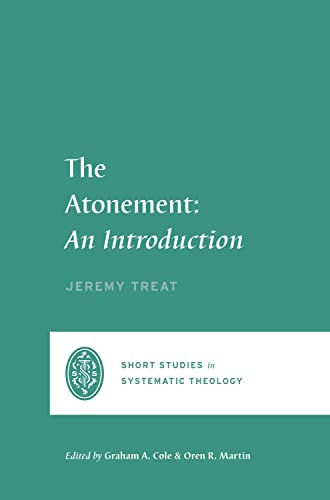
The Atonement: An Introduction
Written by Jeremy Treat Reviewed By Noah M. PetersonThe atonement—the way Jesus reconciles us to God—is central to Christianity yet difficult to explain. “A good many different theories have been held as to how it works,” C. S. Lewis observed; “what all Christians are agreed on is that it does work” (Mere Christianity [San Francisco: HarperOne, 2023], 54). Jeremy Treat, pastor and theologian, takes up this puzzle in The Atonement: An Introduction, exploring not just the what or the why of the doctrine but also the how.
Readers hoping for an adjudication between competing theories, however, will be disappointed. In fact, Treat is decidedly anti-theory—at least the exclusionary ones that elevate one aspect of the atonement at the expense of the others. As he points out, it is not “as if Christ either bore our punishment (penal substitution) or conquered evil (Christus Victor) or demonstrated his love as an example (moral exemplarism)” (p. 62). The main thrust of his argument is that Jesus’s life, death, and resurrection is a comprehensive, multi-dimensional accomplishment irreducible to a singular explanation. At the same time, Treat rejects “disconnected plurality,” which affirms all of the theories without integrating them. What is needed is an account that is comprehensive and coherent.
Much of Treat’s scholarship to date has involved elucidating the connection between two dominant themes in Christianity: the cross and the kingdom (defined as “God’s reign through God’s people over God’s place” [p. 19]). This book continues that thread. In fact, Treat argues these are complementary, not competing, themes, and that the story of the kingdom is an appropriate framework for comprehending the cross. The kingdom is established through the cross, bringing God’s rule on earth. The cross does this by solving the complex problem of sin, which, among other things, separates humanity from God and earth from heaven. Unsurprisingly, a solution that can reunite both produces a multitude of effects.
To demonstrate just how wide-ranging this achievement is, Treat surveys twenty “dimensions” of the atonement, including propitiation, victory over the “powers,” adoption, healing, and more. Each receives a concise explanation and scriptural support. What emerges is a mosaic that speaks to nearly every human need, leading Treat to call this doctrine, “a medicine cabinet for weary souls” (p. 93). There is a remedy for maladies as diverse as shame, guilt, oppression, sickness, divine wrath, and mortality.
Though Treat’s study of the biblical data yields a composite view of the atonement, it all hinges on substitution—that what happened on the cross was in our place and for our sins. He begins by examining the Old Testament and finds that the narrative pattern, sacrificial system, and messianic prophecies all gesture toward substitution. The New Testament furthers this idea. There are several allusions to the suffering servant in Isaiah 53 (one of the primary substitutionary texts), and Jesus identifies himself with the unblemished lamb in the exodus story. Moreover, throughout the New Testament, Jesus’s death is said to be “for” us (e.g., Rom 5:6; 1 Pet 3:18; 1 John 3:16; Mark 10:45; etc.). Thus, the atonement may be more than substitution, but it is not less.
Undergirding the logic of substitution is the biblical authors’ affirmation that sin comes with a penalty. As Treat highlights, sin warrants “judgment (2 Cor 5:10), punishment (2 Thess 1:9), wrath (John 3:36), a curse (Deut 11:28), exile (2 Kings 17:6–7), and ultimately death (Rom 6:23)” (p. 49). Jesus suffers all these in our place, exchanging our sinfulness for his righteousness. That is the how of the atonement. That is the way we are made right with God.
Yet questions remain. For instance, is substitution just? How are our sins imputed to Christ? If sin’s full penalty is eternal separation, how did Jesus bear it? Such questions call for exegetical, theological, and philosophical exploration beyond the scope of this book.
Still, Treat offers helpful correctives. His emphasis on the Trinitarian nature of the atonement guards against the “cosmic child abuse” caricature: it is God himself, in the person of Jesus, who willingly bears judgment, not a coerced third party. And though much is made of God’s wrath in discussions of substitutionary atonement, Treat argues this concept is often misunderstood. Wrath is not an essential attribute of God but rather a consequence of his love and holiness (p. 111). Anger at sin is love’s necessary response to evil.
As an introduction, the book avoids deep philosophical debates, but it succeeds in framing the doctrine biblically, integrating diverse themes, and pointing toward practical implications. Treat reminds readers that theology is not solely an academic endeavor: our doctrine of the atonement should shape our identity, community, and mission as we live toward the realization of God’s heavenly kingdom on earth.
Noah M. Peterson
University of Birmingham
Other Articles in this Issue
This essay develops a distinctly Christian theology of free speech in response to mounting threats of censorship across Western societies...
In every generation and in every place, there is a need to identify, equip, and encourage new leaders for Christ’s church...
Missio Trinitatis: Theological Reflections on the Origin, Plan, and Purpose of God’s Mission
by Brian A. DeVriesTrinitarian theology provides the basis for understanding missio Dei...
This essay argues that monogamous sexually-differentiated marriage (MSDM) is uniquely revealed through Christ’s relationship with the church in Ephesians 5:30–32...
Other Reviews in this Issue
Genesis
Reviewed by Dustin Burlet