
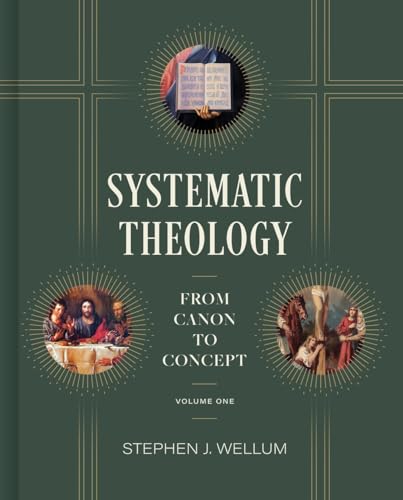
Systematic Theology, Volume 1: From Canon to Concept
Written by Stephen J. Wellum Reviewed By Torey J. S. TeerStephen Wellum, a longtime professor of Christian theology at The Southern Baptist Theological Seminary, has delivered the first volume of his three-part Systematic Theology. What is the justification for another systematic theology? First, Wellum offers a Calvinistic, Baptist, progressive covenantalist, and whole-Bible (intra-textual) perspective. Second, he is responding to the “collective identity crisis” that many evangelicals today are experiencing because of “the waning conviction that theology is an objective discipline grounded in the triune God who is truly there and who has authoritatively made himself known to us,” particularly in Scripture (pp. xv–xvi). Wellum also applies his extensive experience in theological method and Christology to bear in this work.
The volume unfolds in four parts. Part 1 lays a lengthy foundation for faithful doing theology. One notable feature is Wellum’s articulation of the relationship between systematic theology and other disciplines (esp. biblical theology). Another is his extended review of the Enlightenment and post-Enlightenment developments that challenge the traditional plausibility structures of historic Christian theology and therefore reject a normative theology “from above” (i.e., a revelational epistemology). Further, Wellum’s discussion of typology sets the stage for understanding his vision for progressive covenantalism.
Part 2 covers the doctrine of revelation, focusing most attention on the doctrine of Scripture (authority, inspiration, infallibility, sufficiency, perspicuity, and canonicity). Significant here is a discussion of the God-Word/Scripture-world relationship: “Scripture is located within a specific view of theology proper and providence in which the latter is understood as the product of God’s gracious, sovereign, supernatural agency, and as such, it has his authority” (p. 179). Also noteworthy is the author’s engagement with neo-orthodox (à la Karl Barth), post-liberal, post-conservative, and classic liberal and postmodern challenges to the “received view” of Scripture (i.e., the historic orthodox position).
Part 3 particularly represents Wellum’s characteristic approach to theology. He accentuates the importance of understanding “the Bible’s overall framework and worldview” (p. 413)—its “own content, categories, and intra-systematic structures” (p. 484)—out of which arises the grand metanarrative of Scripture: creation, fall, redemption, and new creation. As this metanarrative serves as the foundation for doctrinal formulation, Wellum’s survey of its major plot movements highlights key aspects of several theological loci (e.g., theology proper, creation, sin, salvation) that await fuller treatment later in this and the forthcoming volumes. Wellum here also formally introduces progressive covenantalism (PC) as “the best way of making sense of the Bible’s own terms”: “Scripture presents a plurality of covenants … that progressively reveal our triune God’s one redemptive plan for his one people, which reaches its fulfillment, telos, and terminus in Christ and the new covenant.… ‘Kingdom through the progression of the covenants’ captures the fundamental dynamic at work as God’s redemptive plan unfolds, which starts with Adam and creation and culminates in Christ” (pp. 431–32). Further, in his comparison of PC and the varieties of dispensationalism and covenant theology, the author highlights the issues at stake between the competing theological systems as well as the commonalities between them. Also, a notable feature reflecting Wellum’s Baptist perspective is his engagement with 1689 Federalism, which bears some similarities to PC.
Part 4 represents the turn to theological formulation; it covers theology proper, the Trinity, the divine decree, creation, and providence. Wellum contextualizes the discussion by engaging various contemporary rejections and reductions of a classical understanding of the nature of God and God-world relations (e.g., open theism). As such, issues related to the doctrine of providence appear several chapters earlier than the full treatment. Also, in order to “present the ‘big picture’ of who God is across the entire canon,” the author offers a theological overview of the “triune Creator-covenant Lord” (pp. 570–71) before digging into the divine attributes and the Trinity in the subsequent two chapters. Wellum’s unpacking of the one God and the three persons represents a strong commitment to pro-Nicene trinitarianism and the Reformed tradition (e.g., simplicity, immutability, impassibility, eternal subsisting relations, inseparable operations, the nature-will paradigm). He rejects social views of the Trinity and theories involving subordination among the divine persons within the Trinity, as in the Eternal Relations of Authority and Submission scheme. Finally, his treatment of the decree, creation, and providence represents clear Calvinist commitments (e.g., determinism, dual agency, compatibilism) and includes engagement with process theism, Calvinist-Arminian debates, the pactum salutis, non-Christian views of origins, evolution, and the problem of evil.
Wellum is off to a strong start with the first volume of his Systematic Theology. Although he is committed to “classic, orthodox theology” and as such is “saying nothing new” (p. xvi), he offers readers much by positioning his work as a response to various competing modern/postmodern visions of reality. It all comes down to worldview—a subject that pervades Wellum’s work. Is God really there, and is knowledge of God possible? Yes, and yes. As Wellum shows, the foundation for a normative theology (i.e., “an objective science that yields true knowledge of God”) is “our triune Creator-covenant Lord,” who “has made himself known to us in creation, the incarnate Word, and Scripture” (pp. 30–31). In addition, this volume truly reflects, as advertised, a progressive covenantalist approach to theology. PC is not merely the subject of one or two chapters; it permeates the entire work (see, e.g., pp. 8, 23, 120). Baptist distinctives are present but few, understandably so given the subjects covered thus far. I imagine these will become more conspicuous in the later volumes. Prominent or recurring features throughout this work include a strong Christocentric emphasis, frequent appeals to typological patterns (especially the first Adam-second Adam motif), pushback against “constructivist” views of knowledge and panentheistic views of God-world relations, and fidelity to classical trinitarianism and Reformed theology. I find these final two features especially beneficial. More than judging Wellum’s presentation to be compelling, I believe it is most advantageous for readers. That is, while not everyone will agree with his conclusions, they will know exactly what to expect from his work.
Overall, Wellum’s Systematic Theology is a careful, thorough execution of how to faithfully move from the biblical text (canon) to theological formulation (concept), given that God and his Word are the foundation for our theology.
Torey J. S. Teer
Dallas Theological Seminary
Other Articles in this Issue
This essay develops a distinctly Christian theology of free speech in response to mounting threats of censorship across Western societies...
In every generation and in every place, there is a need to identify, equip, and encourage new leaders for Christ’s church...
Missio Trinitatis: Theological Reflections on the Origin, Plan, and Purpose of God’s Mission
by Brian A. DeVriesTrinitarian theology provides the basis for understanding missio Dei...
This essay argues that monogamous sexually-differentiated marriage (MSDM) is uniquely revealed through Christ’s relationship with the church in Ephesians 5:30–32...
Other Reviews in this Issue
Genesis
Reviewed by Dustin Burlet