
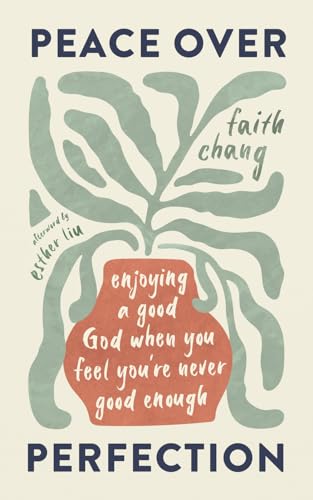
Peace Over Perfection: Enjoying a Good God When You Feel You’re Never Good Enough
Written by Faith Chang Reviewed By Fleur LetcherWhile pastors often need to exhort their flock to take sin more seriously, many may not be aware that some of their flock are hyperfocused on their own sinfulness; a condition known as “Christian perfectionism.” Not to be confused with sinless perfectionism, Christian perfectionists are so painfully aware of their failures that they fear God will withdraw his favor from them. Through careful biblical analysis, personal testimony, and encouragement, Faith Chang’s Peace Over Perfection: Enjoying a Good God When You Feel You’re Never Good Enough helps to demystify and remedy this strange affliction that plagues many Christians.
In chapter 1, “The Perfectionist’s Ache,” Chang insists that the desire for spiritual perfection “is not wrong” but is rather “a mournful look at our Edenic past” and a yearning “for a future that was meant to be ours” (p. 23). She helpfully refutes the common misunderstanding that Christian perfectionists are proud, legalistic, people-pleasers, or that they simply misunderstand the gospel (p. 19). To the contrary, she argues that they are rightly “longing for a perfection commanded by God himself” (p. 19).
In tackling spiritual perfectionism, Chang believes that the place to begin is with an appreciation of God’s comprehensive knowledge of ourselves. In chapter 2, “Knowledge,” she targets the perfectionist’s fear of disappointing God and losing his favour by pointing out that, unlike us, God has no “false illusions of our goodness” (p. 39). Because God truly knows us inside out, and nothing we do takes him by surprise, “God’s knowledge of us rewrites the scenes of exposure that we dread; because, though our sins grieve God, he is never disappointed in us as if he’s only discovered who we really are after calling us to follow him” (p. 40).
In chapter 3, “Mercy,” Chang brings famous Christian perfectionists such as Martin Luther, John Bunyan, and especially John Newton into the discussion, asking why God sometimes answers prayers for Christlikeness “in a way that just about drives us to despair” (p. 50). Her own experience is that “God opens our eyes in new ways to our sinfulness so that we may know more deeply—an experiential, down-to-our-bones kind of knowing—the great grace of having been declared forgiven and righteous in Christ” (p. 55). Chang reassures us that “inward affliction” is not necessarily “evidence of God’s disfavour or damnation but proof of a holy work being done in [the] heart” (p. 57).
In chapter 4, “Law,” Chang notes that Christian perfectionists can feel like they are “walking on a tightrope” due to having “weak” or “overly sensitive” consciences (p. 72). But she comforts us that “our good Shepherd leads us safely off our tightropes” by speaking to us and showing us his character, not that of a harsh taskmaster but more like “a kindergarten teacher who rejoices in her students’ successes and deeply desires that they’d flourish in her classroom” (p. 70). She reminds us that “life with Jesus is about more than just not messing up. It is a wholehearted pursuit of truth, goodness, and beauty” (p. 71).
Christian perfectionists struggle daily with the tension between believing that God loves them and that he is constantly “unhappy” with them because of their “failing and falling” (p. 84). Chapter 5, “Peace,” addresses this problem. Drawing on the parable of the Prodigal Son, Chang argues that “with God, there is no cold-shouldering, no record of wrongs kept, no subtle demand that you ‘earn it,’ no demeaning reminders of our failures” (p. 88). She cites Ed Welch’s insight that “obedience … is not our ultimate goal” but that obedience facilitates our objective of “progressive nearness” to God (p. 89).
In chapter 6, “Patience,” Chang observes that Christian perfectionists perpetually lament the fact that their “progress toward Christ-likeness is painfully slow” and assume that God is similarly impatient with them (p. 99). Therefore, she reminds us that many Bible characters were not only “full of faith but also of cowardice, unbelief, and swindling,” showing us that “the rich vein of God’s patience runs through our story as his people” (p. 101). Even with the Gospels’ portrayal of the stumbling, bumbling disciples, “You never get the feeling that Jesus is losing it with them” (p. 102). Instead, it is in our slow, painful sanctification that God’s “wonderful patience” is displayed, “so that through our brokenness, another child of God might look at us and say, ‘If God was so patient with her, and if he has changed her and is changing her, there is hope for me yet’” (p. 111).
In chapter 7, “Providence,” Chang outlines how perfectionists are often “hounded by past regrets, paralyzed by present choices, and afraid about future failures” (p. 119). But she reiterates the fact that “the Christian’s future is not ultimately determined by her own power to always know and do what is right but by the gracious providence of God,” by which he will bring us to our “final destination despite missed turns” (pp. 119–21). The key is understanding God’s “subplots of grace” in our lives; the way “God’s gracious providence means he will not allow our imperfections to harm others in ways he cannot redeem” (pp. 124–25).
In chapter 8, “Love,” Chang exposes a big issue for Christian perfectionists: a struggle to sense God’s delight and good pleasure (p. 139). While perfectionists fear that their sin is blocking God’s love from breaking through, Chang cautions that “sometimes physical or mental illness, past trauma, intense suffering, or burnout,” or perhaps the way God is portrayed in our churches, is the cause (p. 132). She also shows how God’s love is different from ours: “We understand love as affection kindled and sustained because of something in the beloved.… But God’s love is not like that. There is no explanation for God’s love outside of itself because his love for us originates from within himself” (p. 138).
Perhaps more than anything, Christian perfectionists desire an end to their “wrestling with sin, condemnation, and loud consciences” (p. 150). So in chapter 9, “Rest,” Chang reminds us that, since God’s Spirit-wrought change in our lives is permanent, a day is coming when we will “finally love God with all [our] heart, soul, mind, and strength” (p. 157). Christian perfectionists need to keep an eye on this glorious future: “In this hope, we run, walk, fall, get up, muddle, and press on toward the finish—that on that day, he will present us blameless before his presence with great joy” (p. 162).
Chang’s book is an easy read, and her deep thinking, warmth, and humor shine through in touching personal anecdotes and carefully curated quotes. As well as group discussion questions, she thoughtfully includes beautifully crafted prayers at the end of each chapter. Some of the areas she touches on could have benefitted from a little more theological depth, and additional exploration of the causes of Christian perfectionism—such as upbringing, temperament, or life-experience—might have helped the reader further. Nevertheless, as someone in her target audience, I found Peace Over Perfection to be one of the most helpful books I’ve read for my Christian walk. The book will also help pastors to be more nuanced in how they direct the focus of their sermons, realising that this corner of the flock often needs encouragement to turn away from morbid introspection and turn towards the One who has dealt with their sins once and for all.
Fleur Letcher
Summer Hill Church
Summer Hill, New South Wales, Australia
Other Articles in this Issue
This essay develops a distinctly Christian theology of free speech in response to mounting threats of censorship across Western societies...
In every generation and in every place, there is a need to identify, equip, and encourage new leaders for Christ’s church...
Missio Trinitatis: Theological Reflections on the Origin, Plan, and Purpose of God’s Mission
by Brian A. DeVriesTrinitarian theology provides the basis for understanding missio Dei...
This essay argues that monogamous sexually-differentiated marriage (MSDM) is uniquely revealed through Christ’s relationship with the church in Ephesians 5:30–32...
Other Reviews in this Issue

Genesis
Reviewed by Dustin Burlet