
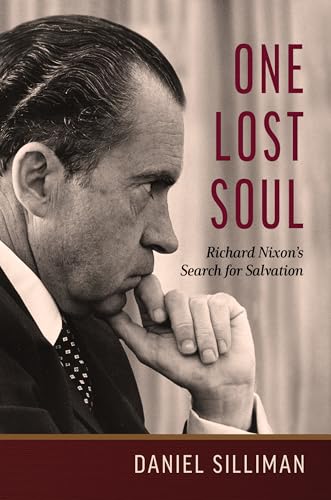
One Lost Soul: Richard Nixon’s Search for Salvation
Written by Daniel Silliman Reviewed By Nathan A. FinnRichard Nixon is one of the most consequential figures in American political history. His legacy is not one of election victories and defeats, major legislative advancements, or foreign policy achievements, though he had plenty of each. Instead, he is best remembered for arguably the greatest political scandal in American history. That scandal is addressed by Daniel Silliman in his new religious biography, One Lost Soul: Richard Nixon’s Search for Salvation. However, it is simply the best-known moment in a public life that intersected in various ways with American religion—especially evangelical religion.
Richard Nixon was not a religious man, at least not in the conventional sense. He was raised a Quaker, a tradition with which he would identify at least nominally for most of his life. But by the time he graduated from Whittier College, he had embraced liberal theology. That liberalism did not translate into politics, however. Nixon entered politics after World War II as a conservative Republican and strident anticommunist. Nixon first made his name as a congressman who worked with the key witness Whitaker Chambers to out the suave diplomat Alger Hiss as a communist spy. Silliman argued that Nixon was a Cold War Christian during these years, embracing a form of civil religion that reinforced his conservative anticommunism.
Nixon was vice president of the United States under Dwight Eisenhower for two terms, then he ran for president in 1960. Nixon had the full support of white Protestant clergy such as Billy Graham and Norman Vincent Peale. But Nixon was not like them. He was not pious. He was not comfortable speaking the language of Zion. He refused to further stoke Protestant fears about John F. Kennedy’s Catholicism. Nixon did not have the support of black Protestant clergy, who were frustrated that the former racial progressive was now courting conservative segregationists. Nixon lost a close race to Kennedy, then lost the gubernatorial race in California in 1962. It seemed like he was done with politics.
In 1968, Nixon forged a remarkable comeback when he was elected president. He won again in 1972, this time by a landslide. In both elections, many of his strongest supporters were again white Protestants, and especially evangelicals. Nixon was famous for his “Southern Strategy” that focused on law and order, but critics believed that it was a barely masked appeal to the racial animus of white southerners. While in office, Nixon continued to court evangelicals, and he was especially chummy with Graham. Nixon also hosted periodic worship services in the White House, which were carefully scripted affairs that allowed Nixon to both cultivate supporters and avoid attending a local church where he might be criticized in a sermon. When Nixon’s political career ended because of Watergate in 1974, his white evangelical allies stood by him until almost the very end—most notably Graham.
Silliman does not offer a comprehensive biography of Nixon but focuses on several key moments: Nixon’s hardscrabble childhood; his entrance into politics in the postwar years; his famously humiliating speech about his personal finances during the 1952 vice presidential campaign; his alliance with evangelicals and white Protestants during the 1960, 1968, and 1972 presidential elections; the White House worship services; the Watergate scandal and its aftermath; and Nixon’s efforts to remake himself into a Republican elder statesman during the final two decades of his life.
Through each of these vignettes, several throughlines remain consistent. Nixon was a natural striver who was never comfortable with traditional Christian ideas like God’s unconditional love or unmerited grace. He was cynical toward individuals who took their religion too seriously, especially when he thought their religion led to weakness or naivete. He was positively disposed towards religion but was never devout. Nixon rarely prayed, except in times of crisis—and then it seemed awkward and unnatural to those around him. He cultivated close strategic relationships with clergy but cursed like a sailor, abused alcohol and other drugs, and lied incessantly. Nixon was never convinced that God could actually be for him. He often feared that ministers might be out to get him.
Silliman is not sympathetic toward his subject. His disagreement with both Nixon’s character flaws and his conservative politics is apparent, though not heavy-handed. At times in the biography, Silliman speculates about what Nixon was thinking in particular situations, but without clearly citing primary sources that would provide evidence for those speculations. Nevertheless, Silliman does an able job of demonstrating the role that religion played throughout Nixon’s life. The portrait is not flattering, but it rings true to the cynicism and resentments that animated Nixon’s life and will forever color his legacy.
Nathan A. Finn
Nathan A. Finn is Professor of Faith and Culture at North Greenville University in Greenville, South Carolina.
Other Articles in this Issue
This essay develops a distinctly Christian theology of free speech in response to mounting threats of censorship across Western societies...
In every generation and in every place, there is a need to identify, equip, and encourage new leaders for Christ’s church...
Missio Trinitatis: Theological Reflections on the Origin, Plan, and Purpose of God’s Mission
by Brian A. DeVriesTrinitarian theology provides the basis for understanding missio Dei...
This essay argues that monogamous sexually-differentiated marriage (MSDM) is uniquely revealed through Christ’s relationship with the church in Ephesians 5:30–32...
Other Reviews in this Issue


Genesis
Reviewed by Dustin Burlet