
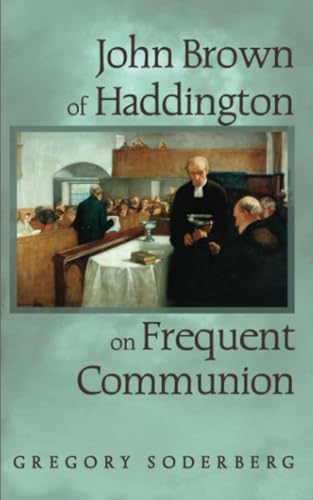
John Brown of Haddington on Frequent Communion
Written by Gregory Soderberg Reviewed By Justin WainscottEvangelical pastors of various denominations seem to be developing a greater appreciation for the Lord’s Supper, accompanied by a growing desire to see it celebrated more regularly in their churches. However, many of them run into obstacles and objections along the way, which discourage them from pursuing more frequent participation at the Lord’s Table. What they may not realize, though, is that previous generations of pastors dealt with this same issue, so there are resources available from the past to help them think through the biblical, theological, and historical rationale for patiently implementing such a change. One such resource is Gregory Soderberg’s John Brown of Haddington on Frequent Communion.
The book consists mainly of a modernized reprint of John Brown’s essay, An Apology for the More Frequent Administration of the Lord’s Supper; With Answers to the Objections Urged Against It, which was originally published in 1804 after his death. Brown, who lived from 1722 to 1787, was one of Scotland’s most significant pastor-theologians and one of its most respected authors. Therefore, a posthumous publication from his pen, especially one that expressed dissatisfaction with his own Scottish Reformed tradition’s practice of infrequent communion, is both intriguing and noteworthy. Moreover, the Lord’s Supper was a subject that held deep, personal interest for Brown, owing to the role it played in his conversion and to the role he believed it should play in the lives of his parishioners. Consequently, reading such an essay is not only instructive historically; it also has the potential to be of immense benefit pastorally and personally.
Like many pastors today, one of the biggest obstacles related to communion frequency that Brown faced was denominational tradition and custom. For his particular tradition, the custom was to administer the Supper only once a year. But he challenged such a blind, unexamined allegiance to custom by stating at the very beginning of his essay that every Christian should test their traditions and customs “by reason and revelation, and to reject or receive the same, according as they abide the test or not” (p. 1). He was convinced that such an examination would prove that more frequent celebration of the Lord’s Supper should take place, and thus his essay was designed to “call to the bar the practice of administering the Lord’s Supper so seldom” (p. 1). His careful and thoughtful reasoning is on full display as he argues his case, making it easy to see why he was such a trusted theologian and revered pastor. And as Soderberg points out, “The Apology was written at the end of [Brown’s] life and demonstrates his settled convictions after years of serious scholarship and practical pastoral labor, not the flights of fancy of a young and idealistic innovator” (p. xi).
Speaking of Soderberg, he provides a helpful “Historical Introduction” at the beginning of the book, giving readers a concise overview of John Brown’s life and ministry, as well as discussing the historical context that motivated Brown’s writing of the Apology. He also includes explanatory footnotes throughout the work to aid in the understanding of specific references and context. Soderberg is well-suited to serve as a guide on this subject since his doctoral research focused on the debates surrounding communion frequency in Scotland in the 1700s and 1800s. Brown’s Apology was one of the main sources he examined in his dissertation.
The Apology itself is divided into eleven brief sections, consisting of three main areas of emphasis: (1) sections 1–7 focus on New Testament practice and arguments from church history, (2) sections 8–10 consider spiritual and practical matters, and (3) section 11 deals with common objections to a more frequent celebration of communion. While each section is insightful and helps to build a compelling case, it is likely that readers will find the last section most helpful. There, Brown answers the most common objections and concerns about frequent communion that existed in his own setting, many of which are still common today and will therefore provide much “food for thought” for pastors wrestling with this issue. For example, he addresses the objection that “if the Lord’s supper were frequently administered, it would become less solemn, and in time, quite contemptible…” (p. 19) by asking why we tend to think this way exclusively about the Supper but not other means of spiritual edification. Somewhat in jest, he inquires, “Why are we not taught that we should seldom pray, read, hear, and meditate, in order to keep up the solemnity of these ordinances, and to avoid the formality in them? Can any reason be assigned, why unfrequency should preserve the honor of the Lord’s supper, and not also preserve the honor and solemnity of these divine ordinances?” (pp 20–21). If frequent praying, frequent reading and meditating on the Scriptures, and frequent hearing of the preached Word are all seen as helpful and valuable, then Brown reasons that the same should be true for Communion.
It should be noted that some of the arguments Brown makes are specific to his era and to his particular tradition, so they may not seem as relevant or helpful. Additionally, some readers may be unaccustomed to the seemingly harsh way that eighteenth-century Reformed evangelicals like Brown often spoke of Roman Catholicism and the papacy. However, neither of these issues should be taken as reasons not to read the book. With a little historical charity and some discernment in application, readers should have no problem gleaning valuable wisdom and assistance from this resource. At only fifty pages total, it can easily be read in just one sitting.
Having newfound access to such a helpful essay on such a pressing topic from such a revered figure is a tremendous blessing, and we owe Gregory Soderberg a debt of gratitude for reintroducing it to us. I gladly commend this book as another welcomed example of what Timothy George refers to as “retrieval for the sake of renewal.”
Justin Wainscott
Union University
Other Articles in this Issue
This essay develops a distinctly Christian theology of free speech in response to mounting threats of censorship across Western societies...
In every generation and in every place, there is a need to identify, equip, and encourage new leaders for Christ’s church...
Missio Trinitatis: Theological Reflections on the Origin, Plan, and Purpose of God’s Mission
by Brian A. DeVriesTrinitarian theology provides the basis for understanding missio Dei...
This essay argues that monogamous sexually-differentiated marriage (MSDM) is uniquely revealed through Christ’s relationship with the church in Ephesians 5:30–32...
Other Reviews in this Issue
Genesis
Reviewed by Dustin Burlet