
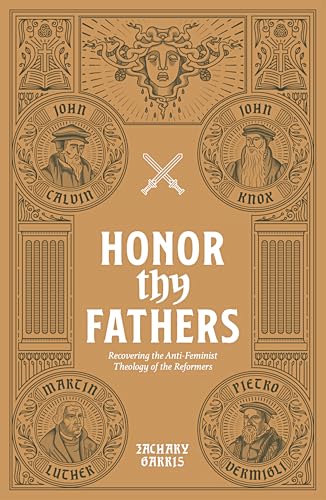
Honor Thy Fathers: Recovering the Anti-Feminist Theology of the Reformers
Written by Zachary M. Garris Reviewed By Josh BlountHonor Thy Fathers is part historical retrieval and part present-day polemic. Following up on his more exegetically based book, Masculine Christianity, pastor and author Zachary Garris sets out to enlist historic Reformed theologians in a contemporary battle over the future of the PCA (and, more broadly, evangelicalism). A reader’s response to the book will largely be determined by where they sit in that contemporary battle—but no matter where you’re perched, you’ll have something to gain (and wrestle with) from this volume.
Part 1 is titled “A Reformed Theology of Male Rule.” In three chapters, Garris assembles a wealth of quotations from early Reformed theologians (Oecolampadius, Musculus, Vermigli, Bullinger, and Calvin), later Reformed orthodox (Zanchi, Cartwright, Perkins, Gouge, and others), and finally the Reformed catechisms on the role of men and women in the family. There is a consistent pattern: all of these theologians taught an ordering of relationships, with men leading and women submitting to their husbands. These teachings were typically grounded in the classic texts that have occupied the complementarian-egalitarian debate but, interestingly, were also commonly rooted in Reformed teaching on the meaning of the fifth commandment.
Next, Garris looks at the role of men and women in the church, drawing on a similar range of theologians to demonstrate that the Reformers believed only men should be pastors and elders. There was also a fairly consistent teaching that women should not lead in public prayers or public worship in any way during the gathering of the church.
The final chapter in Part 1 is entitled, “The Reformed on Male Rule in the Commonwealth.” Here, the debate is about the appropriateness of female rulers in the civil sphere, and while there is general consistency in the teaching (with most theologians against it), the figure of Elizabeth I towers in the background. John Knox’s famous (or infamous) The First Blast of the Trumpet Against the Monstrous Regiment of Women, aimed at Mary Tudor, reverberated with ever-changing harmonics as Mary was succeeded by the more Reformed-leaning Elizabeth. Garris cites enough of the developing debate to show that the appropriateness of female leaders was a complex and nuanced issue for the Reformed, even as, in general, all theologians agreed that such rule was at best an unusual exception to the normal pattern of created order.
Overall, Garris’s work in Part 1 is sound and helpful. Simply surveying the teaching of so many various Reformed figures and demonstrating the consistent exegesis of Scripture helps show how far the discussion of gender identity and roles has moved from the Reformation to the present. That’s a helpful mirror to our own present position. Still, there are some remaining questions. Does the Reformed tradition adequately account for Scripture’s dual insistence that men and women are equal in value and image-bearing status even as they are different in role? At times, earlier theologians seemed to equate functional difference in role (male headship in covenant relationships) with ontological difference (with female nature being inferior to male nature). Is this perhaps a relic of an Aristotelian vision of sex differences, modulated through Thomistic medieval thought? From a scholarly perspective, this would be a worthwhile study (Prudence Allen’s three volumes trace this era from a Roman Catholic perspective, but more work could be done with Reformed presuppositions and firmer exegetical grounding).
Garris has contributed to the discussion of men’s and women’s roles by letting the Reformers speak for themselves. But his goal is not merely historical analysis, which brings us to Part 2: “Abandoning the Reformed View of Male Rule.”
Garris begins with a chapter entitled, “Reformed Feminism?” addressing what he sees as modern departures from the Reformed teaching on male rule in the home, especially the proliferation of egalitarian views in the academy and publishing world. As examples, he deals with Aimee Byrd’s Recovering from Biblical Manhood and Womanhood (Grand Rapids: Zondervan, 2020) and Beth Allison Barr’s The Making of Biblical Womanhood: How the Subjugation of Women Became Gospel Truth (Grand Rapids: Brazos, 2021), and Rachel Green Miller’s Beyond Authority and Submission: Women and Men in Marriage, Church, and Society (Phillipsburg, NJ: P&R, 2019). Each of these books is critical of complementarian teaching on gender roles in marriage and advocates what amounts to egalitarian views. Garris also gives attention to Nancy Pearcey’s implicit egalitarianism in The Toxic War on Masculinity: How Christianity Reconciles the Sexes (Grand Rapids: Baker, 2023). Throughout, he argues that these examples indicate a departure from the Reformed heritage.
Then, chapter 5 addresses “Complementarian Deviations,” focusing especially on what Garris perceives as a drift in Reformed teaching on women’s roles in the church. In view are Tim and Kathy Keller’s “narrow complementarianism,” the PCA Report on Women in Ministry for similar departures, as well as Kevin DeYoung’s exegesis of 1 Corinthians 14:34–35 in his book Men and Women in the Church: A Short, Biblical, Practical Introduction (Wheaton, IL: Crossway, 2021). For Garris, the (now) common complementarian reading that sees this text as a prohibition against women judging prophecy in the public assembly stands at odds with historic views, which held that women should not pray or lead in worship in any way in the public assembly. DeYoung affirms the appropriateness of a woman praying publicly in some circumstances (though not a pastoral prayer) during a Sunday gathering, and Garris treats this as evidence of a deviation from the tradition. Garris then closes his book with an appeal: “Which Way, Christian Man?” “There are only two options before us. Christians can continue to follow the path of feminism, undermining God-ordained authority structures and producing a disordered society. Or Christians can return to the faith of our Reformed forefathers, including their view of male rule in the home, the church, and the commonwealth” (p. 121).
With that, the book ends—but not the discussion. From this reviewer’s perspective, Garris has helpfully held up the mirror of historic teaching to our present-day discussion of gender roles, and it is undeniable that Western evangelicalism’s language, tone, and presuppositions have radically changed. The implicit individualism and gender-neutrality affect our understanding of men’s and women’s roles, even where we distance ourselves from the culture. The first half of Garris’s book can help us see the influence of culture—even if we disagree with precisely how we respond next.
However, I think Garris too quickly assumes that all gender questions are equally clear from Scripture, hence his lumping of “home, church, and the commonwealth” into one tight package, such that even a different opinion about the role of women praying in the Sunday gathering can be interpreted as a deviation or capitulation. I do not think this is fair or faithful to the texts of Scripture. Here, Garris will not win for himself allies in the cause of creating a counter-cultural society in the modern church. Scripture itself is clear and contains clear teaching about men’s and women’s roles, yet not all gender questions and applications are equally clear. It is a mark of maturity and wisdom to know the difference. Honor Thy Fathers would have had a greater impact if it had honored this distinction.
Josh Blount
Living Faith Church
Franklin, West Virginia, USA
Other Articles in this Issue
This essay develops a distinctly Christian theology of free speech in response to mounting threats of censorship across Western societies...
In every generation and in every place, there is a need to identify, equip, and encourage new leaders for Christ’s church...
Missio Trinitatis: Theological Reflections on the Origin, Plan, and Purpose of God’s Mission
by Brian A. DeVriesTrinitarian theology provides the basis for understanding missio Dei...
This essay argues that monogamous sexually-differentiated marriage (MSDM) is uniquely revealed through Christ’s relationship with the church in Ephesians 5:30–32...
Other Reviews in this Issue
Genesis
Reviewed by Dustin Burlet