
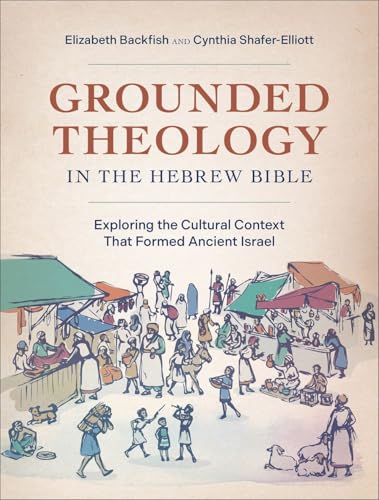
Grounded Theology in the Hebrew Bible: Exploring the Cultural Context That Formed Ancient Israel
Written by Elizabeth Backfish and Cynthia Shafer-Elliott Reviewed By Mark Steven FrancoisGrounded Theology in the Hebrew Bible introduces readers to key elements of Israel’s cultural context and their implications for understanding the theology of the Old Testament. In this review, culture is understood to refer to the beliefs, values, practices, institutions, social organization, and way of life of a particular group of people. Cultural context refers to how these elements shape the language, thinking, expectations, and worldview of people within that culture. As the authors themselves acknowledge, “there is no shortage of books on the cultural context of ancient Israel” (p. xx). What makes this book unique is the connections it draws between cultural context and the theology of the Old Testament.
Each chapter is divided into two main sections. The first section (“Looking Down”), written by Shafer-Elliott, deals with elements from Israelite culture based on the topic of the chapter. This includes material on ancient Israelite households (ch. 1), covenants (ch. 2), the land (ch. 3), holiness and purity (ch. 4), worship (ch. 5), the image of God (ch. 6), kingship (ch. 7), law and wisdom (ch. 8), warfare (ch. 9), and food/hospitality (ch. 10). Depending on the nature of the topic, this material is drawn from parallels in ancient Near Eastern texts, the material culture of ancient Israel (i.e., physical objects, architecture, etc.), and the Old Testament itself. The second section (“Looking Up”), written by Backfish, explores how this material informs our understanding of Old Testament theology. For example, in chapter 1, Backfish shows how Israelite views about the household shaped their descriptions of God (the head of the household), God’s role as Israel’s redeemer, and their communal identity.
Although the material in this volume can be found in other publications, there are several things that make this volume stand out. First, as mentioned earlier, this volume is unique in how it pairs cultural context with Old Testament theology. For readers who struggle to see the relevance of cultural context, the theology portion of each chapter provides immediate payoff that is both theologically rich and relevant for contemporary readers. Second, the presentation of material in this volume is particularly clear. The authors succeed in taking complex material and making it understandable to non-specialist audiences. Finally, this volume helpfully includes a diverse set of material in a single, accessible volume.
Despite these strengths, there are several places where this volume could be improved. First, despite its focus on culture and cultural context, the authors do not provide an explicit definition for either term—hence the definitions provided at the beginning of this review. Clear definitions are important since culture and cultural context can be understood in either a broad or a narrow sense. Readers with a narrow understanding will not be surprised to see discussions about the living arrangements and work distribution of Israelite households (pp. 2–4, 7–10); the arrangement of society into households, clans, tribes, and kingdoms (pp. 4–6); the diet and food preparation of ancient Israelites (pp. 200–6); and rules about hospitality (pp. 206–8). However, they might be surprised to see discussions about holiness and purity (ch. 4) and worship (ch. 5). This volume assumes a broad definition of culture and cultural context in line with the definitions given above.
Second, as with any work dealing with background material, there is a danger of allowing background material to introduce ideas or concerns that, though theologically legitimate, may not have been on the minds of biblical authors. For example, in the conclusion to chapter 6, the authors state that “Israel’s God, however, was not to be represented in physical images or by a select individual because all humans were created to be God’s images” (p. 136). While true theologically, the Old Testament itself never provides this as grounds for why the Israelites should not create or worship images of YHWH.
Finally, there are several significant problems with its chapter on covenants (ch. 2). First, the author states that the word berit (covenant) comes from a root (barah) that means “a cutting” (p. 23). While it is true that Hebrew often uses the language of “cutting a covenant” to express the idea of making a covenant, the idea of “cutting” does not come from the word berit (covenant) but from the verb karat (to cut), the verb used in the idiom. Second, the author includes a quote that is said to come from the Vassal Treaties of Esarhaddon (p. 27). However, the quote comes from a different text, Ashurbanipal’s “Prism A” (RINAP 1, “Ashurbanipal 11,” lines i 8–22). This seems to be based on a misreading of the secondary source used for the quote. Third, the author unhelpfully includes correspondences between ancient Near Eastern treaties and the Decalogue in its discussion of parallels between ancient Near Eastern treaties and Deuteronomy (p. 29). For example, the author identifies the historical prologue with both Deuteronomy 5:6b and 1:1–4:14 (p. 29), without telling the reader that 5:6b is the prologue to the Decalogue rather than Deuteronomy itself.
Fortunately, these shortcomings are rare in this volume. Overall, Grounded Theology is a well-researched and well-written book that will prove useful for students, pastors, and laypeople who want to add depth to their study of the Old Testament.
Mark Steven Francois
Mark Steven Francois
Colorado Christian University
Lakewood, Colorado, USA
Other Reviews in this Issue