
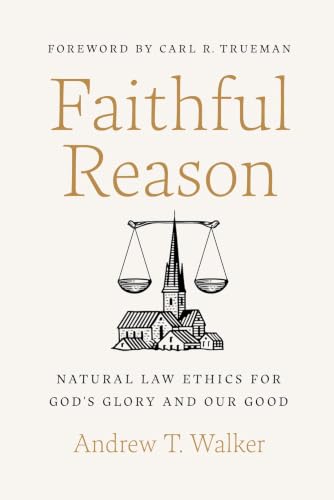
Faithful Reason: Natural Law Ethics for God’s Glory and Our Good
Written by Andrew T. Walker Reviewed By J. Logan ParkerAndrew Walker presents a thorough and compelling argument for the importance of natural law within the tradition of Christian ethics. The essential thesis of the book is as follows: “The primary reason Christians should care about natural law is that it gives us rational, coherent ways of understanding the structure of God’s creation order” (p. 42). Walker goes about making this argument in two parts. Part 1 is an extended development of a framework for natural law. Part 2 is the application of that framework to contemporary moral issues.
The book begins with an argument for the importance of natural law. For Walker, natural law provides believers with a reasoned moral foundation that contributes to their discipleship. He then places his construction of natural law within the context of worldview discussions and the wider natural law debate. Having carefully defined the concept of natural law, in chapter 4, Walker explores the significance of reason and its relationship with faith. This is a key chapter within his argument, as it demonstrates the importance of morality being both reasonable and knowable. The last four chapters of part 1 make philosophical, biblical, and theological arguments for natural law. Part 2 of the book, which is comprised of four chapters, is relatively short and serves as a brief example of how to apply natural law in a way that can then be carried into a wide range of other topics. Walker addresses various moral issues under the categories of the goods of life, relations, and order.
In outlining his argument for natural law, Walker provides several complementary definitions. He begins with a shorter definition to highlight the main aspects of his framework: “That is all the natural law is at its essence—determining moral goods, moral duties, and moral norms as rational creatures and acting in harmony to obtain them” (p. 6). He also gives a considerably more thorough definition that outlines all the various parts of his understanding of natural law:
Walker develops the various aspects of this definition throughout the book. First, natural law is grounded in an objective, God-ordered creation. Thus, as image bearers, all people can perceive moral goods and wrongs through rational engagement with that order. Since natural law is objectively grounded and can be rationally known, it is universal, empirical, and intelligible. At the center of Walker’s definition are the two foundational principles of his ethic: natural law is aimed at natural and supernatural ends, our good and God’s glory. Walker states,
Two particular issues need further attention as they are key to the overall work. The first is the contribution of natural law to Christian discipleship or catechesis. This aspect of the book is crucial, particularly in relation to how Walker understands the role of Scripture. Although he contends that “Christian morality is ratified by the canons of reason” (p. 99), he is equally insistent that reason is subordinate to Scripture. His point, however, is that there is not only no conflict between “what Scripture teaches” and “properly ordered reason” (p. 107), but that both provide “an epistemological foundation for knowledge of the natural law” (p. 100). Proper moral discipleship helps Christians to understand “the intelligibility and cogency of their own ethics for the sake of ethical catechesis” (p. 45) and, in turn, to apply the Bible to “an ever-expanding number of issues that the Bible does not, on its surface, address” (p. 247). While I agree with Walker’s overall point here, I do wonder whether he overemphasizes the problem. Indeed, he spends a significant time addressing it in several chapters. If not read carefully, this emphasis makes it too easy to come away with a sense of Scripture’s insufficiency rather than an encouragement to pursue a more holistic moral catechesis that draws on “a larger field of action from which to understand how the Bible speaks ethically” (p. 247).
Second, the relationship between Christian ethics and natural law is important to the book. Unfortunately, the relationship is, at least at times, confusing. Walker rightly presses his readers to see the harmony between Christian ethics at large and natural law. Natural law provides a baseline moral ontology by supplying a creational and rational grammar that undergirds moral reasoning. Christian ethics serves as a broader category, including the authoritative witness of special revelation and the redemptive realities of the gospel. While I greatly appreciate the relationship between natural law and Christian ethics that he develops, it is not always clear within the book. Sometimes it seems as if those terms, or ideas, have collapsed into one another. This is not in fact the case, but the reader must be careful to track how Walker frames these two categories in harmony alongside each other. Nonetheless, in my view, it would have been helpful if this distinction were more prominent throughout the book.
Two aspects from part 2 of the book stood out as particularly valuable and significant. First, there is an excellent section on whether it is ever permissible for the moral good of life to be forfeited. Often, people jump to the idea that abortion or euthanasia is wrong without doing the background work on the issue of the loss of life. Walker does an excellent job working through a complex topic within his natural law framework. Second, he places his extended discussion of the family within his chapter on order and the natural law. A common assumption is that this would fit within the construct of relationships, which it does. However, Walker makes a very compelling case for understanding the role of the family within the structure of the natural order of creation. In my view, this perspective is not only insightful but also biblical.
Faithful Reason is a highly informative book on natural law that is well worth the time it takes to read for anyone interested in the specific subject or the field of ethics more broadly.
J. Logan Parker
Celebration Baptist Church
Other Articles in this Issue
This essay develops a distinctly Christian theology of free speech in response to mounting threats of censorship across Western societies...
In every generation and in every place, there is a need to identify, equip, and encourage new leaders for Christ’s church...
Missio Trinitatis: Theological Reflections on the Origin, Plan, and Purpose of God’s Mission
by Brian A. DeVriesTrinitarian theology provides the basis for understanding missio Dei...
This essay argues that monogamous sexually-differentiated marriage (MSDM) is uniquely revealed through Christ’s relationship with the church in Ephesians 5:30–32...
Other Reviews in this Issue
Genesis
Reviewed by Dustin Burlet