
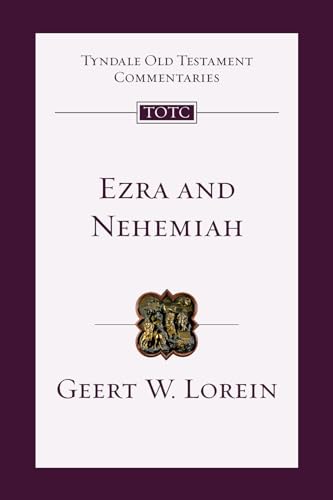
Ezra and Nehemiah: An Introduction and Commentary
Written by Geert W. Lorein Reviewed By Timothy R. EscottGeert Lorein’s commentary on Ezra and Nehemiah replaces Derek Kidner’s 1979 volume in the series. Kidner’s slim volume is something of a standard, brief commentary on Ezra and Nehemiah, but its age meant it was in need of an update. The updated Tyndale series seeks to provide an “up-to-date reading of the text,” continuing the series’ emphasis on exegesis, which is what Lorein seeks to provide.
Lorein provides an extensive introduction that primarily situates Ezra–Nehemiah within its textual and historical context. Lorein comments briefly on the genre of the text before focusing on the historical background: dates, distances, geography, along with notes on the Persian empire and Jerusalem’s place in it, and details about the lives of Ezra and Nehemiah. He then considers authorship, text, and language.
Throughout the introduction, Lorein considers key critical issues raised in Ezra and Nehemiah studies over the last one hundred and fifty years: the chronological relationship between Ezra and Nehemiah; the reliability of the purported documents in the books; the identity of Ezra’s law and its relationship to Persian authorization; and the unity of the books and their relationship to Chronicles. Lorein’s generally conservative positions will be appreciated by readers looking for a solid foundation amid scholarly debate. The introduction closes with an interesting discussion of “the afterlife of Ezra–Neh. in Antiquity,” followed by an outline of the books’ theological themes.
The structure that Lorein discerns resembles most other standard structures of Ezra–Nehemiah. However, while most other structures see Ezra 1–6, 7–10, and Nehemiah 1:1–7:3 as three returns followed by a conclusion in Nehemiah 7:4–12:47, Lorein takes a slightly different tack. He sees a parallel between Ezra 1–6 (building the temple) and Nehemiah 1–7 (building the walls), as each is followed by parallel sections on building the community (Ezra 1–6 and Nehemiah 7:4–12:47). Nehemiah 13 then forms a coda, recounting the “recalcitrant reality.” The strength of this reading lies in its attention to the thematic parallels between Ezra and Nehemiah. However, even though taking Nehemiah 13 as a “coda” is a common way to read the chapter, it does leave it slightly disjointed from the rest of Nehemiah. Unfortunately, Lorein does not discuss the rationale for his structure, which leaves the reader without a clear sense of how Ezra–Nehemiah fits together as a narrative whole.
The commentary itself mostly focuses on verse-by-verse exegesis. According to the general editors, the revised commentaries aim to provide an “up-to-date reading of the text,” continuing the series’ emphasis on exegesis (p. vii). However, as they note, “emphases in exegesis have changed markedly.” While they do not spell out what this means for the current series of updated commentaries, they do highlight a change in format that recognises that “texts communicate in larger blocks rather than in shorter segments such as individual verses” (p. viii). This is reflected in the new three-part format: “Context,” where literary and historical setting are considered; “Comment,” offering close exegesis of the passage; and “Meaning,” summarizing the contribution of the passage at hand to the book as a whole along with its theological themes.
In his commentary, Lorein frequently comments on historical and material details behind and in the text, such as socio-political background, likely dates of events, and the identities of key figures, places, and musical instruments. He also notes likely authorial intertextual connections to other parts of the Old Testament and frequently references Hebrew grammar and syntax to clarify complex sentences. Lorein also pays careful attention to often-overlooked elements, such as the names in the census lists and the locations mentioned, demonstrating a commitment to reading the whole text with care.
Despite the strengths of Lorein’s approach, there are shortcomings. Lorein’s attention to the world behind and in the text and to the details of the text leaves many important avenues unexplored. First, the commentary does not give sufficient attention to the dynamics of Ezra–Nehemiah as narrative, even at the level of plot and themes, let alone narrative art. For example, his discussion on Ezra 3:12–13 notes the mixed response of weeping and joy (pp. 88–89), but it does not consider what this response might mean in the context of the story. In the world of the text, it is intriguing whether the weeping is a result of an incomplete restoration from exile or memories of a long-lost past. The mixed responses raise a significant narrative tension: what will come of these mixed feelings, especially if and when the temple is complete?
Second, each section ends with a few paragraphs discussing the “meaning” of that part of the text. These sections are concise and accessible, offering brief reflections often framed in general moral terms. While this may help certain readers apply the text to life, more theological depth and attention to the story’s inner dynamics would have strengthened these conclusions. To draw on his comments on Ezra 3:12–13, Lorein simply comments that this reflects the reality of mixed feelings in life (pp. 89–90). A stronger application might have considered the role of mixed responses in the context of the return from exile and how this might translate to, say, the modern experience of a Christian living in a kingdom that is both now and not yet.
Third, more generally, theological and ethical reflection tends to be brief and superficial. Lorein does have a special interest in the relationship between church and state, and Ezra–Nehemiah is certainly a fruitful text in this regard. He is to be commended for exploring how Ezra–Nehemiah urges readers to participate in a mixed society at a critical distance, trusting in God’s sovereignty over all things. However, his comments are all-too brief, and he does not attempt to read Ezra–Nehemiah’s political theology in any conversation with other canonical texts or the broader political-theological tradition. Similarly, although Lorein offers an apology for the divorces in Ezra 9–10, he does so primarily from a sociological perspective and argues that the position taken here does not materially differ from other parts of the Bible (pp. 152–54). The discussion would have benefited from a discussion of theological issues around Israel’s election, holiness, and covenant in relation to foreign nations and their practices and to their precarious situation after the exile.
Related to the thin theological and ethical reflection is a lack of canonical contextualization. Standing as they do at the end of Israel’s story, Ezra and Nehemiah reflect patterns from Israel’s past and fulfill promises from their prophets. In a theological-canonical frame of reference, these books stand in Israel’s story that moves towards and climaxes in the gospel of Jesus Christ. It might be argued that this kind of reading is outside the scope of the Tyndale commentaries. However, according to the general editors, their prayer is “that these new volumes will continue the rich heritage of the Tyndale Old Testament Commentaries and that they will continue to witness to the God who is made known in the text” (p. vii). Any Christian reading that is committed to reading “the Bible as Scripture,” seeks to “engage with a full range of interpretive issues,” and aims to “witness to the God who is made known in the text” must wrestle with—or at least gesture to—the way Ezra–Nehemiah can be understood in this canonical context. Furthermore, the revised Tyndale commentaries aim to provide an “up-to-date reading of the text.” Since Kidner’s volume in 1979, significant works have been published on Ezra–Nehemiah as literature (cf., e.g., Tamara C. Eskenazi, In an Age of Prose: A Literary Approach to Ezra-Nehemiah [Atlanta: Scholars, 1988]) and theology (Matthew Levering, Ezra and Nehemiah [Grand Rapids: Brazos, 2007], and David J. Shepherd and Christopher J. H. Wright, Ezra and Nehemiah, THOTC [Grand Rapids: Eerdmans, 2018]). Curiously, none of these significant studies appear in the bibliography, which is a missed opportunity to engage with recent literary and theological developments and so provide a truly up-to-date reading.
All of this, of course, raises the question of audience: Who is this commentary written for? The general preface does not say, but the preface to the old series specifies “the student of the Bible.” What “students of the Bible” need today is very different from fifty years ago. The old Tyndale series reflected the reading culture of mid-twentieth century biblical scholarship with its primary focus on the world behind the text and the philological details on the Hebrew text. The British university student studying undergraduate theology in the mid-twentieth century may have benefited from a portable handbook on the text that briefly outlined critical issues. Today, students can easily find such information from a Google search and can access a multitude of commentaries at a keystroke. What they need most is a reliable guide to the interpretation of the text in the context of the rest of Scripture and the world today.
In sum, Lorein offers a careful and textually focused commentary that continues the strengths of the Tyndale tradition. Readers seeking a close reading of the Hebrew text within its historical and philological context will find this volume a helpful companion. Those looking for close narrative reading, theological reflection, or canonical integration may wish to supplement it with other recent works. Nonetheless, Lorein’s commentary represents a steady contribution to the updated TOTC series and reminds us of the ongoing importance of attending closely to the biblical text.
Timothy R. Escott
St Mark’s Anglican Church
Darling Point, New South Wales, Australia
Other Articles in this Issue
This essay develops a distinctly Christian theology of free speech in response to mounting threats of censorship across Western societies...
In every generation and in every place, there is a need to identify, equip, and encourage new leaders for Christ’s church...
Missio Trinitatis: Theological Reflections on the Origin, Plan, and Purpose of God’s Mission
by Brian A. DeVriesTrinitarian theology provides the basis for understanding missio Dei...
This essay argues that monogamous sexually-differentiated marriage (MSDM) is uniquely revealed through Christ’s relationship with the church in Ephesians 5:30–32...
Other Reviews in this Issue
Genesis
Reviewed by Dustin Burlet