
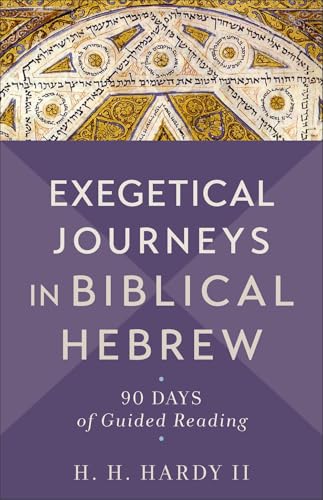
Exegetical Journeys in Biblical Hebrew: 90 Days of Guided Reading
Written by H. H. Hardy II Reviewed By Foong Chan Fai and Peter H. W. LauYou have completed the introductory textbook, perhaps even passed the final exam, and are now wondering how to sustain your newfound grasp of Biblical Hebrew. You recognise that if you stop here, much of the grammar will fade within months, a familiar frustration for many who have taken a basic course. H. H. Hardy II’s Exegetical Journeys in Biblical Hebrew: 90 Days of Guided Reading is written precisely for those who want to press on (or return after a long hiatus) and who desire to cultivate the habit of reading the Hebrew Bible regularly and meaningfully.
The workbook is structured into three progressive journeys: Beginning, Continuing, and Expanding. Each journey is designed to span 30 days and is subdivided into three to five “routes” (i.e., biblical passages), each of which unfolds over several days. Daily assignments consist of one to three verses to read, words to parse, grammatical questions to engage with, vocabulary to review, and translation exercises to complete. Then, each lesson offers exegetical insights rooted in the day’s grammatical work and concludes with a devotional reflection, aptly named “For the Journey.”
There is much to commend about this workbook. Most significantly, it delivers on its promise: to lead post-introductory learners into a daily rhythm of engaging with the Hebrew Scriptures. Each day’s work can typically be completed in about fifteen minutes, although learners who are still developing fluency may need more time. The level of difficulty increases at a measured and manageable pace. The selected passages are familiar, often overlapping with those encountered in an introductory course, which offers the learner a sense of confidence and continuity.
The parsing exercises are particularly valuable. They help reinforce grammatical awareness, a skill often neglected by readers who, having attained some reading fluency, may prefer to “just read” and bypass the more technical aspects of the language. Long-term neglect of practicing parsing inevitably weakens one’s ability to engage in close exegesis. The grammatical questions, too, are well-crafted, prompting learners not only to recognise forms but to explain them clearly. This certainly helps learners to retain grammatical sensitivity.
Perhaps the most vital contribution of the workbook is the exegetical insights provided towards the end of each day’s assignment. Take, for instance, its comment on זָכוֹר in Exodus 20:8: “The infinitive absolute acts like a command…, they are not the typical imperative form (זְכֹר ‘remember’)” (p. 74). Having parsed a series of second-person yiqtol commands over the past three days, the learner is now alerted to the emphatic nature of the Sabbath command through the infinitive absolute. Insights such as this concretely demonstrate the value of engaging with the Hebrew text directly. They show how the grammatical and lexical work of the day can yield interpretive richness that is often obscured or flattened in translation (“Remember the Sabbath”). For many learners, this payoff is crucial. The study of Biblical Hebrew can be labour-intensive, and without a clear sense of exegetical gain, it is easy to become disheartened and wonder whether the effort is worth it. By rooting exegetical insights directly in Hebrew grammar and syntax, the book helps sustain learner motivation and encourages long-term perseverance in Hebrew reading.
While the workbook has many strengths, there are a couple of decisions Hardy made that this reviewer finds surprising. One notable concern lies in the English translations provided in the “Answer Key” section. Regardless of one’s stance on formal versus dynamic equivalence, the primary function of an answer key in a language-learning context is to help learners assess whether their translation is serviceable and faithful to the original text. It is therefore puzzling that the author often opts for renderings that verge on over-translation. Consider, for example, the workbook’s translation of Genesis 1:1–3: “In the beginning when God created the whole cosmos and the world—at once the land was a muddled mess, dark covered the deep abyss, and the Spirit of God lingered expectantly upon the watery surface—God proclaimed, ‘Let light be!’ And light dawned” (p. 20). In another context, this expansive and evocative rendering might be defensible, even illuminating. But as part of an answer key, it risks confusing learners about what the Hebrew text actually says. It may also inadvertently discourage them from carefully attending to the nuances of Hebrew syntax and vocabulary, since the workbook answer is often supplied in a paraphrased form. For pedagogical purposes, a more restrained and textually grounded translation would be far more appropriate in this context.
Another noteworthy concern involves the grammatical terminology used in the parsing exercises. The book refers to the qatal and yiqtol forms as “SC” (Suffix Conjugation) and “PC” (Prefix Conjugation), respectively. The use of SC and PC highlights the morphological structure of the verbs. However, the same workbook also uses the labels wayyiqtol and wəqatal, terms that focus more on the aspectual or functional characteristics of the verbs. This mixing of terminological frameworks—form-based for the base conjugations and function-based for the waw-consecutive forms—introduces an inconsistency that could confuse learners. If the author wishes to maintain a form-based framework (SC and PC), it would be more consistent to notate the waw-consecutive forms as “w-SC” and “w-PC.” Conversely, if the author prefers the aspectual/functional terminology (e.g., wayyiqtol, wəqatal), then it would be clearer to describe the base conjugations as qatal and yiqtol. Either system can be pedagogically justified, but mixing frameworks in this way risks hampering the learners’ ability to integrate and consolidate grammatical categories.
Despite these minor concerns, Exegetical Journeys in Biblical Hebrew remains an outstanding contribution to the field of Biblical Hebrew pedagogy. It fills a crucial and often overlooked gap between introductory grammar and sustained reading. It succeeds in providing learners with a structured, accessible, and spiritually enriching path forward. The workbook not only reinforces foundational grammar but also demonstrates, day after day, the exegetical rewards of engaging the Hebrew Bible in its original language. For anyone who has completed an introductory course and is seeking a way to build fluency and sharpen exegetical skill, this workbook is highly recommended. One can only hope that the author will continue producing additional workbooks, perhaps even developing a full series, to help learners grow into consistent, confident, and joyful readers of the Hebrew Bible.
Foong Chan Fai and Peter H. W. Lau
Seminari Theoloji Malaysia
Other Articles in this Issue
This essay develops a distinctly Christian theology of free speech in response to mounting threats of censorship across Western societies...
In every generation and in every place, there is a need to identify, equip, and encourage new leaders for Christ’s church...
Missio Trinitatis: Theological Reflections on the Origin, Plan, and Purpose of God’s Mission
by Brian A. DeVriesTrinitarian theology provides the basis for understanding missio Dei...
This essay argues that monogamous sexually-differentiated marriage (MSDM) is uniquely revealed through Christ’s relationship with the church in Ephesians 5:30–32...
Other Reviews in this Issue
Genesis
Reviewed by Dustin Burlet