
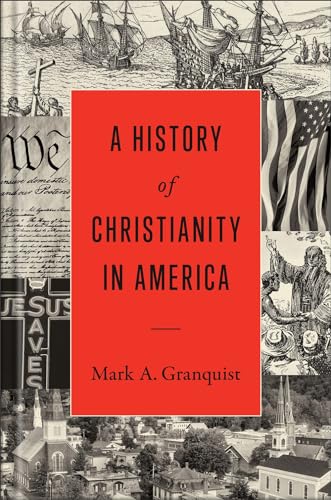
A History of Christianity in America
Written by Mark A. Granquist Reviewed By Kenneth J. StewartThemelios readers who have already taken courses in church history have likely seen this discipline as a division of theology. Church history is frequently understood to be the study of great theologians, their controversies, and their epoch-making books. Consequently, teachers of church history today are often located within departments of systematic and historical theology, with some instructors teaching both disciplines. Such was the reviewer’s own exposure to church history half a century ago, and this pattern—if anything—has grown more prevalent. In the reviewer’s mind, this long-established pattern demonstrates church history’s vulnerability; it is one of the first disciplines to be cut back in the face of the ever-present curricular push to compress degree programs. Under such duress, the teaching of church history will frequently be assigned to systematic theologians.
Mark A. Granquist’s A History of Christianity in America is decidedly not church history located at the periphery of theology. It is a substantial work with a distinctive approach. It could fairly be titled A Social Science History of Christianity in America. It aligns the study of church history more with pastoral disciplines (for example, social ethics or public theology) than with the theological disciplines.
In it, one finds the story of Christianity in what would become the USA, told from the era of Spanish conquest to the present, the successive waves of immigration in their various epochs, and even how later waves of immigrants within one faith tradition (in his own case, Lutheran) found themselves at variance with Lutherans who had arrived generations before them. Granquist is clearly fascinated by American Christian attitudes towards immigrants in all eras; immigrants, more often than not, faced attitudes of resistance, especially if the immigrants were non-Protestant.
From a vantage point in St. Paul, MN, where Granquist is a faculty member within Luther Seminary, the author takes special interest in the populating of inland America and the steady westward expansion of the population through territorial purchase, military conflict, and migration—whether in search of gold or religious freedom not obtainable in longer-settled eastern regions. Concurrently, he shows a detailed interest in the displacement of native peoples by this westward expansion, as well as the massive importation of African slaves, which followed the post-Revolution territorial expansion into the Southeast. He notes the many obstacles put in the path of the evangelization of these peoples, as well as some successes. He details both the abuses that followed the US government’s entrusting of native education to Christian residential schools and the obstacles placed in the way of the evangelization of African Americans (which nevertheless proceeded).
Granquist is very interested in numbers: the respective numbers of citizens represented by the various branches of the Christian family and the changing ratio of Catholics to Protestants and of non-religious citizens to church members. We find to our surprise that America was at its least religious phase immediately following the Revolutionary War and was most religious in the post-World War II era. Granquist has been assiduous in utilizing data unearthed by social scientists such as the late Rodney Stark, who, with Roger Finke, produced the important The Churching of America 1776–1990: Winners and Losers in Our Religious Economy (New Brunswick, NJ: Rutgers University Press, 1992), as well as the periodic surveys conducted by the Pew Charitable Trusts.
Readers of Themelios will naturally want to know how Granquist approaches the question of the advance of the gospel in the America he describes. Here, the results are mixed. Consistent with his strong orientation to social science, he is generally reluctant to explore theological questions bearing on the fortunes of Christianity. While he readily recognizes that the European Enlightenment wrought harm once it reached American shores in the Revolutionary period, he is less certain than modern evangelicals that religious revivals (whether pre- or post-Revolution) were indeed a mighty force in reorienting America to Christ and the Bible. Notably, for Granquist, revivals were always arranged, staged, and planned, whether the evangelist in question was Jonathan Edwards or D. L. Moody. He discloses strong sympathy for the New Haven theologians such as Nathaniel Taylor and Horace Bushnell, who recast Christianity in the early post-Revolutionary period, while recognizing that liberalizing trends have weakened Christianity’s role in society. He admires the Niebuhr brothers (H. Richard and Reinhold) and also Karl Barth, whose “theological realism” in the inter-war period recoiled against the now-admitted excesses of liberal theology. Billy Graham is recognized as but one contributing force in an already advancing post-World War II religious resurgence. But recall that this is a social history of Christianity in America.
Granquist attempts to write an account that is current. He is unafraid to tackle the question of the precipitous decline of the mainline Protestant denominations (including his own), the current leveling off of evangelical growth, and the very active participation of Christians in the current political polarization that now characterizes the USA. He can show that both American Catholicism and evangelical Protestantism have been numerically strengthened (rather than the reverse) by the influx of Hispanic and Asian immigrants; many came to America just because of its Christian heritage. He helpfully describes the profoundly negative consequences of the Covid epidemic on churches of all kinds.
The reviewer has profited from and respects the labors of Granquist, who has been known mostly for his Luther scholarship. He has not provided us with the history of theology, or historical theology, which we have come to assume that church history texts exist to provide. But he has provided us with a much-needed supplement, without the use of which our customary tendency to view church history as chiefly about theology and theologians will leave us with numerous ill-formed judgments.
Granquist’s volume cannot displace the standard texts which our colleges and seminaries currently rely on. Its determination to treat all denominational traditions as equally worthy of attention and its tendency to downplay the question of the teaching and development of theology means that it will not cover the territory as a stand-alone volume. A Baptist or a Presbyterian will want more detail than is on offer here. But this volume will make a wonderful supplement to textbooks that make the history of the church chiefly a narrative about theology and theological conflict. I happily commend it in that capacity.
Kenneth J. Stewart
Ken Stewart is emeritus professor of theological studies at Covenant College in Lookout Mountain, Georgia.
Other Articles in this Issue
This essay develops a distinctly Christian theology of free speech in response to mounting threats of censorship across Western societies...
In every generation and in every place, there is a need to identify, equip, and encourage new leaders for Christ’s church...
Missio Trinitatis: Theological Reflections on the Origin, Plan, and Purpose of God’s Mission
by Brian A. DeVriesTrinitarian theology provides the basis for understanding missio Dei...
This essay argues that monogamous sexually-differentiated marriage (MSDM) is uniquely revealed through Christ’s relationship with the church in Ephesians 5:30–32...
Other Reviews in this Issue

Genesis
Reviewed by Dustin Burlet