

Volume 50 - Issue 3
Toward a Christian-Household Philosophy of Technology
By Nicholas J. WeyrensAbstract
Internet-connected digital technologies are having deleterious effects on children. In a world shaped by the digital, Christian parents have a moral duty to have an intentional philosophy of technology—a set of principles and practices—that will help their children flourish in Christ. In this essay, I propose four principles for a Christian-Household Philosophy of Technology to help parents understand how and why technologies shape children. By establishing the idea that we are what we attend to, I will connect the deformative effects of internet-based digital technologies with the spiritual deforming language of idols in Scripture. This highlights the importance for parents to protect their children’s attention and cultivate their children’s ability to attend, most notably to God, by integrating proposed practices into their own contextualized Christian-Household Philosophy of Technology.
In the 2006 film Idiocracy, Joe Bowers (Luke Wilson) participates in a military hibernation experiment gone wrong, finding himself waking up 500 years later in a dystopian future where the inundation of entertainment has made everybody idiots. Through a series of calamitous events, Bowers is arrested and is required to take an IQ test as part of the prison intake process. His IQ score is the highest in the world, which earns him a seat on the Cabinet of President Camacho (Terry Crews), a former wrestler turned Commander-in-Chief. To receive a pardon for his prison sentence, Joe Bowers promises to solve the worldwide crop failure. Bower’s proposed solution to the Cabinet is to stop watering the crops with Brawndo, “The Thirst Mutilator,” as the slogan says. In a comical depiction of capitalism run amok, Brawndo (a Gatorade-like substance) has replaced water for everything, the lone exception being the toilet.
JOE: For the last time, I’m pretty sure all that Brawndo stuff might be what’s killing the crops.
SECRETARY OF STATE: But Brawndo’s got what plants crave. It’s got electrolytes.
ATTORNEY GENERAL: (thinking painfully hard) So wait a minute.… You’re saying you want us to put water on the crops? Water? Like out the toilet?
JOE: Well, I mean, it doesn’t have to be out of the toilet, but, yeah, that’s the idea.
SECRETARY OF STATE: But Brawndo’s got what plants crave.
ATTORNEY GENERAL: It’s got electrolytes.
JOE: Okay, look, the plants aren’t growing. So I’m pretty sure the Brawndo’s not working. Now I’m no botanist, but I do know that if you put water on plants they grow.
14-YEAR-OLD: Well, I’ve never seen no plants grow out of no toilet …
JOE: You wanna solve this problem, I wanna get my pardon. So why don’t we just try it, okay, and not worry about what plants crave?
ATTORNEY GENERAL: Brawndo’s got what plants crave.
14-YEAR-OLD: Ya, it’s got electrolytes.
(Joe’s about to lose it.)
JOE: What are electrolytes? Does anyone even know?!
SECRETARY OF STATE: It’s what they use to make Brawndo.
JOE: Ya, but why do they use them to make Brawndo?
SECRETARY OF DEFENSE: Cuz Brawndo’s got electrolytes.
The plants dying at the hand of a technological innovation serves as an apt metaphor for the primary problem this essay seeks to address. Just as Brawndo replacing water—a fundamental element of life—killed the plants in the apocalyptic Idiocracy, so too are internet-connected digital technologies—which are replacing fundamental virtue-forming habits—reaping harmful consequences on children.
I argue that because internet-connected digital technologies are having disastrous impacts on children today, Christian parents have a moral duty to develop an intentional household philosophy of technology to foster an environment for their children to be formed into Christlikeness.
I begin by drawing from the fields of Media Ecology1The most helpful definition of this multidisciplinarian field comes from the constitution of the Media Ecology Association: “Media ecology is defined as the study of the complex set of relationships or interrelationships among symbols, media and culture.” Cited by Lance Strate, Media Ecology: An Approach to Understanding the Human Condition, Understanding Media Ecology 1 (New York: Lang, 2017), 24. For a robust definition of the field see chs. 1–2 of Strate, Media Ecology. and theology to propose four undergirding principles that should guide a Christian-Household Philosophy of Technology (CHPoT). Then, reframing the work of G. K. Beale, I argue that we are what we attend to, and because the average child is attending to screens more than ever, that they are being deeply deformed by internet-connected digital technologies. Next, by showing the importance of (1) protecting children’s attention from being captured and (2) cultivating their ability to attend, I argue for the moral imperative for Christian parents to have an intentional household philosophy of technology. Finally, I propose practices for Christian parents to consider for their own CHPoT.
1. Defining Technology and Internet-Connected Digital Technologies
In modern parlance, technology has come to mean items that are electrical or have screens, but technology properly defined is much broader than that. Technology can be defined as anything that is used by a human to extend their abilities beyond their human limitations. Put more simply, technology is any extension of humanity. The cup extends the human capacity to hold liquid for one’s own consumption; the bicycle extends the speed at which a human can travel; the computer extends the human capacity to learn, create, and entertain in ways unparalleled in history.
Andy Crouch argues all technology is borne on the wings of two promises: “now you’ll be able to” and “now you’ll no longer have to.”2Andy Crouch, The Life We’re Looking For (New York: Convergent, 2022), 139. With a microwave, now you’ll be able to eat popcorn in less than 4 minutes, and now you’ll no longer have to wait long to have a hot meal. With a car, now you’ll be able to drive longer distances in shorter amounts of time, and now you’ll no longer have to use physical exertion to get from one place to another. All technologies promise an extension of our human capacities—they take us beyond ourselves.
Internet-connected digital technologies are a subset of technology proper. For the sake of this paper, the purview of this category is wide, including things like: mobile devices (smartphones, iPads), social media (Facebook, Instagram, Snapchat), algorithmic video platforms (TikTok, YouTube), and games (PokemonGo, Roblox, Call of Duty). All of these technologies to varying degrees use behavioral techniques responsive to instantaneous feedback loops to hook users into more use, pinging them to come back when they’re not using them.
With these shared definitions, I now propose four principles that will serve as a foundation for our CHPoT, three from the field of Media Ecology and one from theology.
2. Principles of a Christian-Household Philosophy of Technology
To lay the groundwork for our CHPoT we must understand a handful of philosophical and theological principles of technology. In this section, I first highlight three key principles from the field of Media Ecology. Summarizing the work of key thinkers in the field, I show that technologies (1) create new environments, (2) shape us, and (3) are biased. Then, from a theological position, I present a case that God is tool-agnostic.
2.1. Technologies Create New Environments
One key principle to undergird any CHPoT is to understand that technologies create new environments. In a lecture delivered in 1998, Postman argued, “Technological change is not additive; it is ecological.… A new medium does not add something; it changes everything. In the year 1500, after the printing press was invented, you did not have old Europe plus the printing press. You had a different Europe.”3Neil Postman, “Five Things We Need to Know About Technological Change,” 28 March, 1998, https://web.cs.ucdavis.edu/~rogaway/classes/188/materials/postman.pdf. Another pioneer of the field, Marshall McLuhan, writes, “Any technology gradually creates a totally new human environment. Environments are not passive wrappings but active processes.”4Marshall McLuhan, Understanding Media: The Extensions of Man, Routledge Classics (London: Routledge, 2010), 12. Though there is variability in degree, every piece of technology creates a new environment. From the clock,5Lewis Mumford, Technics and Civilization (Chicago: The University of Chicago Press, 2010). to the saddle,6Lynn White, Medieval Technology and Social Change (1966; repr., London: Oxford University Press, 1980). to the printing press,7Marshall McLuhan et al., The Gutenberg Galaxy: The Making of Typographic Man (Toronto: University of Toronto Press, 2011). to the smartphone,8Jonathan Haidt, The Anxious Generation: How the Great Rewiring of Childhood Is Causing an Epidemic of Mental Illness (New York: Penguin, 2024). cultures, peoples, and kingdoms are completely transformed by new technologies.
This does not mean that a hinge-point in history has occurred, such that a culture is changed by people because of the arrival of the new technology. When the advent of a new technology occurs, the technology itself creates a new culture which humans now interact within. Strate adds, “Cultures are produced by or emerge out of media environments, and as media environments change, so do the cultures that they contain; cultures in turn can influence the media environment, but it is the media environment that is primary.”9Strate, Media Ecology, 26. The contemporary reader may find it difficult to cede this world-shaping power to impersonal objects, yet the same contemporary reader would be hard pressed to argue that the internet, for example, has not fashioned a completely new world.10In his 2010 book, author Nicholas G. Carr teases out the effects of the Internet on our brains. He writes, “Calm, focused, undistracted, the linear mind is being pushed aside by a new kind of mind that wants and needs to take in and dole out information in short, disjointed, often overlapping bursts—the faster, the better.… What we’re experiencing is, in a metaphorical sense, a reversal of the early trajectory of civilization: we are evolving from being cultivators of personal knowledge to being hunters and gatherers in the electronic data forest.” As the internet rewires how we think, it rewires how we relate to the world. In some sense, Carr is arguing that the Internet, for its virtually limitless storehouses of information, is regressing our society. The Internet has created an entirely new world (quite literally in the age of globalization) that trades breadth for depth. Nicholas G. Carr, The Shallows: What the Internet Is Doing to Our Brains (London: Atlantic, 2011), 21, 181.
2.2. Technologies Shape Us
Because we inhabit new environments borne to us by new technologies, our technologies inevitably shape us. French philosopher Jacques Ellul highlights this interplay that the new technological environment has on man:
The machine tends not only to create a new human environment, but also to modify man’s very essence. The milieu in which he lives is no longer his. He must adapt himself, as though the world were new, to a universe for which he was not created. He was made to go six kilometers an hour, and he goes a thousand. He was made to eat when he was hungry and to sleep when he was sleepy; instead, he obeys a clock. He was made to have contact with living things, and he lives in a world of stone. He was created with a certain essential unity, and he is fragmented by all the forces of the modern world.11Jacques Ellul, The Technological Society (New York: Doubleday, 2021), 325.
Philosopher Hannah Arendt expresses a similar idea: “The things that owe their existence exclusively to men nevertheless constantly condition their human makers.”12Hannah Arendt, The Human Condition, 2nd ed. (Chicago: University of Chicago Press, 1998), 9. A key principle in our CHPoT is understanding that we shape our tools, and our tools shape us.
We have already said that every technology is an extension, but with every extension there is also an amputation. As we depend on technology for one thing, we usually get worse at doing that thing, because we no longer have to. Andy Crouch notes that just as technologies promise expanded capabilities and reduced burdens, they also bring about two consequences: “restricted capabilities and enforced burdens.”13Italics original. One of the most prominent examples of technology’s formative power comes from Socrates, who argues that the invention of writing denigrates the ability of man to remember things. Crouch helpfully buttresses his argument with this example from Phaedrus. He concludes, “(1) Now you’ll be able to write down stories and information, meaning (2) you’ll no longer have to remember them.… But (3) you’ll no longer be able to exercise the human capacity for oral memory, and (4) now you’ll have to write something down in order to remember it.” Crouch, The Life We’re Looking For, 139–41.
With every technology there is an extension, but there is also an amputation. Both extension and amputation shape humans. Sometimes this shaping is physical—like the significantly higher rates of back problems in the Western-world shaped by the chair14Kelly Starrett, Built to Move: The Ten Essential Habits to Help You Move Freely and Live Fully (New York: Doubleday, 2023), 35–38.—and other times it is emotional—like the unprecedented rates of loneliness in a world shaped by the smartphone. Whatever the effect, it bears repeating that all technologies shape us.
2.3. Technologies Are Biased
Our third principle is that technologies are biased, or put negatively, technologies are not neutral. To say technologies are biased is not a statement on morality. Rather, it means every technology has a telos—an end. Every technology is created with a purpose to achieve a certain job.
For the Christian, this reality squares with a theological worldview, because the Creator God creates with purpose—with intentionality. He created all things with a telos. As those that bear his image, mankind also creates technologies teleologically. A hammer is created for hitting (preferably nails). A chair is created for sitting. All these technologies were created with a purpose—an end—in mind.
Because a technology has an inherent bias does not mean that it can only be used in a certain way, but rather that the path of least resistance is that it be used in accordance with its bias.15“A bias does not represent absolute command over us … but rather a path of least resistance. We can always choose to move against the pull of the prevailing bias, and there is also the possibility of reinvention, as an alternate use of a technology that in effect transforms it into a different technology. The concern … is the degree to which we cede control to the biases of technology.” Strate, Media Ecology, 36. That’s why it’s easier to use a pencil for writing than for roasting marshmallows. Or it’s easier to use a hammer for hitting a nail than for raking leaves.
We need to know and understand that each technology imbibes the intent of its creator(s), but also that it can morph beyond the created intent. For instance, the iPhone was imagined by Steve Jobs to be an iPod and a phone rolled into one device. Over a decade later, the iPhone can still play music and make calls (original intent), but now it can hail a ride, order groceries, entertain for endless hours, and much more.
Understanding technological bias is a vital principle for the Christian parent. Too often, technology is viewed like a bicycle. The rider sits on the bicycle, and it only moves and goes at the pace and direction of the rider. Technology, however, is much more like a car; even when the driver is not accelerating the car is always idling forward unless the brake is pressed. All technologies are created by fallible people, and as such, they often have fallible biases. Understanding this reality allows the Christian parent to have an appropriate awareness that any technology created by mankind may not take them or their children towards the same ends that they—or God—desire to go.
2.4. God Is Tool-Agnostic
Our final undergirding principle is theological in nature; to establish a CHPoT, we must consider: What does God think about technology (or tools)?
We see technology (or tools) used all throughout Scripture, both explicitly and implicitly: Cain built a city (Gen 4:17), Tubal-Cain made things out of bronze and iron (Gen 4:22), Noah built an ark (Gen 6), people built the Tower of Babel (Gen 11:1–9), God gave his Spirit in Exodus to allow some craftsmen to use tools better than others (Exod 31), King Solomon built a temple (1 Kgs 6), Jesus used tools as a carpenter (Mark 6:3), and Paul used letters to spread the gospel around the world (2 Thess 3:17). A survey of Scripture would draw one to conclude that God is tool-agnostic. He does not care about the tools or technology but cares greatly about how humans relate to their technology.
Psalm 33:16–18 illustrates this reality:
A king is not saved by a large army;
a warrior will not be rescued by great strength.
The horse is a false hope for safety;
it provides no escape by its great power.
But look, the LORD keeps his eye on those who fear him—
those who depend on his faithful love.
The text notes two technologies here: a king’s army and a warrior’s horse. Though both “objects” are living beings, they become tools in the hands of their subjects. God does not prohibit the use of the army or the horse but warns against putting ultimate dependence upon them. A king’s massive army is not ultimately what saves, nor is the immense strength of a thoroughbred horse a true source of safety. The Lord is the ultimate protector (“he keeps his eyes on those who fear him”) and he protects those who “depend on his faithful love” (emphasis added). God is tool-agnostic; the real issue is whether one’s ultimate trust and dependence is placed in a technology or in him.
The fourth undergirding principle of a CHPoT propels us forward into the next section of this paper.
3. We Are What We Attend To
If God is tool-agnostic—caring less about what tool is used than the intent behind it—we may rightfully wonder, why should Christians care about our use of technology at all as long as our “heart” is in the right place? It is here that I reframe the work of G. K. Beale to show that we are what we attend to. This truth enables us to make sense of the argument that internet-connected digital technologies are having severely deformative effects on our children.
3.1. We Become What We Worship
In his seminal work, We Become What We Worship, G. K. Beale argues that “we resemble what we revere, either for ruin or restoration.”16G. K. Beale, We Become What We Worship: A Biblical Theology of Idolatry (Downers Grove, IL: IVP Academic, 2008), 49. Beale’s work maps out Scripture’s warnings about the dangers and effects of idolatry. Expanding on Martin Luther’s larger catechism, Beale defines idolatry as, “whatever your heart clings to or relies on for ultimate security.”17Beale, We Become What We Worship, 17. Italics original. This idea connects to what we noted earlier about God’s tool-agnosticism; it is if our hearts cling to our phones, our social media accounts, or our computers for ultimate security that make their use problematic in God’s eyes.
Psalm 115 is a text that Christian media ecologists use as theological evidence for the formative power of our technology.18“The psalm is more than a criticism of one type of symbolic form, however, but also represents a warning about the effects of technology, the work of men’s hands. And the key phrase is, they that make them shall be like unto them, which suggests that our technology feeds back into us, reshaping us in their image.” Strate, Media Ecology*, 52. Verses 2–8 read as follows,
Why should the nations say,
“Where is their God?”
Our God is in the heavens;
he does all that he pleases.
Their idols are silver and gold,
the work of human hands.
They have mouths, but do not speak;
eyes, but do not see.
They have ears, but do not hear;
noses, but do not smell.
They have hands, but do not feel;
feet, but do not walk;
and they do not make a sound in their throat.
Those who make them become like them;
so do all who trust in them. (Ps 115:2–8)
This same text is covered in Beale’s biblical theology of idolatry. He writes, “The principle is this: if we worship idols, we will become like the idols, and that likeness will ruin us.”19Beale, We Become What We Worship, 46.
One of the ruinous effects of idolatry according to texts like Psalm 115 can be seen in its “sensory-organ-malfunction language.”20Beale,* We Become What We Worship*, 41. Idols have physical mouths, yet they are not able to speak; they have physical ears, but they do not hear. When trust is given to idols, the same fate befalls the one trusting in the idol and their spiritual senses become deadened.21“Thus the idols have eyes and ears but cannot really see or hear either physically or spiritually, and their worshipers’ sensory organs are also described as malfunctioning, which reveals that they have become spiritually blind and deaf like their false objects of worship.” Beale, We Become What We Worship, 49.
Because of the spiritual aspect of idols in Scripture, it is easy to forget that idols are tools—objects made by human hands to extend humans beyond their limitations. These inanimate objects shape those that make them and those that trust in them, as the Psalmist says. Just as Scripture’s idols are tools, our tools can be idols. Because of the power of internet-connected technologies, which can provide a person with food (Door Dash), money (Bitcoin), sex (Tinder), and community (Facebook), modern tools are more likely to elicit ultimate security than the idols of Scripture. Furthermore, because our internet-connected digital technologies demand so much of our attention, we become more and more like them.
3.2. Time is Formation
Throughout history, time has become progressively commodified, the fullest expression of this reality being the aphorism, “time is money.”22For a good treatment on the development of the idea, “time is money,” see Jenny Odell, Saving Time: Discovering a Life beyond the Clock (New York: Random House, 2023), 11–17. A phrase that was once used by managers to eke out more efficient production from employees is now an operant principle for digital technology and media companies worldwide.
For some of the largest companies in the world—Google (Ads and YouTube), Meta (Facebook and Instagram), Byte Dance (TikTok)—the more time a user spends on their products, the more money they make. In today’s attention economy— “the market where consumers’ attention is exchanged for goods and services”23Tim Aylsworth and Clinton Castro, “On the Duty to Be an Attention Ecologist,” Philosophy & Technology 35.1 (2022), https://doi.org/10.1007/s13347-022-00514-6.—time is money. The companies that traffic in the attention economy employ thousands of the brightest minds in the world to create products that capture users’ attention. It is often said that if the product is free, then you are the product. Shoshana Zuboff, however, warns that this does not quite capture the exploitative nature of what’s taking place. It is not that smartphone users are the product, they are the metaphorical ore mine being stripped bare of their attention.24Shoshana Zuboff, The Age of Surveillance Capitalism: The Fight for a Human Future at the New Frontier of Power (New York: PublicAffairs, 2020), 69–70: “People often say that the user is the ‘product.’ This is also misleading.… For now let’s say that users are not products, but rather we are the sources of raw-material supply.” Later, Zuboff writes, “Forget the cliché that if it’s free, ‘You are the product.’ You are not the product; you are the abandoned carcass. The ‘product’ derives from the surplus that is ripped from your life” (p. 377). The throngs of engineers and designers employed by Meta, Snapchat, and Google are extremely skilled at their jobs. In 2022 alone, Google’s ad revenue was $224 billion; in 2023, Meta (formerly Facebook) made 95% of its $135 billion from ads.25Derek Saul, “Meta Earnings: Record Profits, Sales As Ads Stay Robust During Zuckerberg’s ‘Year Of Efficiency,’” Forbes, 25 October 2023, https://www.forbes.com/sites/dereksaul/2023/10/25/meta-earnings-record-profits-sales-as-ads-stay-robust-during-zuckerbergs-year-of-efficiency/. For these companies (and others like it), time is money.
Nicholas G. Carr, writing a decade before 91% of Americans owned a smartphone,26ConsumerAffairs. “Cell Phone Statistics 2024,” ConsumerAffairs, 2 Dec 2024, https://www.consumeraffairs.com/cell_phones/cell-phone-statistics.html. prophetically proclaimed, “The Internet doesn’t change our intellectual habits against our will. But change them it does. Our use of the Net will only grow, and its impact on us will only strengthen, as it becomes ever more present in our lives.”27Carr, The Shallows, 170. As the proliferation of internet-connected digital technologies has continued, daily screen use has astronomically increased alongside it. How could it not? Aside from their intentionally addictive design, these devices are where we do just about everything needed in daily life.
The average American spends five hours per day on their phone,28Trevor Wheelwright, “Cell Phone Usage Stats 2024: Americans Check Their Phones 205 Times a Day,” Reviews.Org, 16 December 2024, https://www.reviews.org/mobile/cell-phone-addiction/. which means the average American spends seventy-six days per year on their phone. A recent article from the American Psychology Association says approximately half of US teens spend over five hours per day on social media alone.29Tori DeAngelis, “Teens Are Spending Nearly 5 Hours Daily on Social Media. Here Are the Mental Health Outcomes,” Monitor on Psychology 55.3 (2024), https://www.apa.org/monitor/2024/04/teen-social-use-mental-health. Again, that equates to more than two full months per year that US teens are immersed in the environment of social media. To make those numbers more staggering, five hours per day spent on a phone or immersed in social media equates to spending one entire year every five years on that activity. Because people are spending so much time on internet-connected digital technologies—adults and children alike—they are being formed, or better said deformed, in unprecedented ways. For the Christian, time is not money, time is formation.
Or put differently, we are what we attend to.
3.3. The Deformation of Our Children
Like Joe Bowers in the dystopian Idiocracy who dared to say, “I think the Brawndo is killing the plants,” in 2017, two brave voices, Jean Twenge and Jonathan Haidt, began to raise concerns about smartphones and social media use having detrimental effects on entire generations.30Jean M. Twenge, “Have Smartphones Destroyed a Generation?” The Atlantic, September 2017, https://www.theatlantic.com/magazine/archive/2017/09/has-the-smartphone-destroyed-a-generation/534198/. Until recently, these claims were largely dismissed.31Sarah Rose Cavanagh, “No, Smartphones Are Not Destroying a Generation,” Psychology Today, 6 August, 2017, https://www.psychologytoday.com/us/blog/once-more-feeling/201708/no-smartphones-are-not-destroying-generation.
In their work with university students, Twenge and Haidt began to see the mental health of young adults precipitously decline around 2012.32Jonathan Haidt, Zach Rausch, and Jean M. Twenge, “Social Media and Mental Health: A Collaborative Review. (Ongoing),” tinyurl.com/SocialMediaMentalHealthReview. Their hypothesis was that this was directly related to smartphone and social media use.
Figure 1
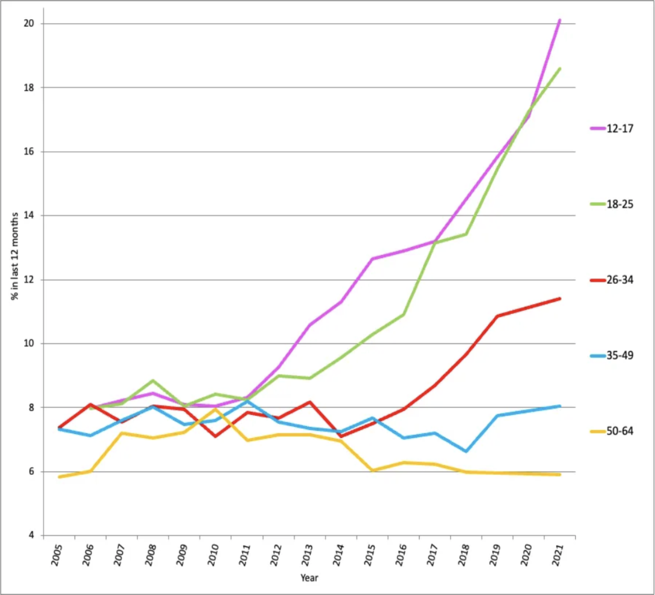
Figure 1 shows the percent of individuals who experienced major depression in the last twelve months (between 2005 and 2021). The percentage of adolescents (12–17 and 18–25) who experienced major depression began to exponentially increase around the year 2012 (as discussed above). Twenge and Haidt point to the period between 2012 and 2015 as the tipping point in which the majority owned a smartphone.
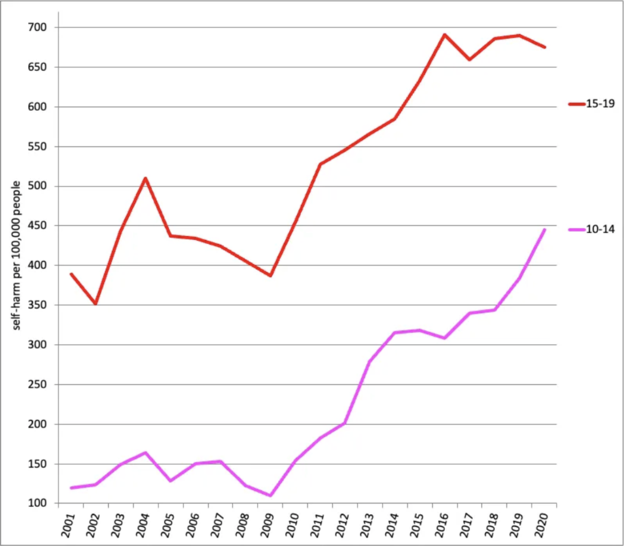
Some argued with their conclusion, positing that perhaps younger generations were more open to talking about mental health than older generations, which would skew the self-reported data. However, Twenge and Haidt noted that it is not just self-reported mental health issues that are showing up. The same parabolic rise is seen in suicide attempts and hospitalizations from self-harm for the same age bracket as seen in Figure 2.33Jean M. Twenge, “Here Are 13 Other Explanations for the Adolescent Mental Health Crisis. None of Them Work,” After Babel, 24 October 2023, https://www.afterbabel.com/p/13-explanations-mental-health-crisis. The author refers to the Center for Disease Control as the source for these statistics on the rate of emergency room admissions for self-harm behaviors among US girls and young women, by age group.
Figure 1
Still others insisted that this might be a uniquely Western problem, which would mean causation could be found in other cultural issues (the pressures of college admissions, or financial crises, for example). Twenge and Haidt’s argument, however, was supported with evidence from Sapien Labs, an organization that published a study measuring the Mental Health Quotient (MHQ)34The Mental Health Quotient is made up of a variety of factors that are combined into six main categories: Mood & Outlook, Social Self, Adaptability & Resilience, Drive & Motivation, Cognition, and Mind-Body Connection. Sapien Labs, “Age of First Smartphone/Tablet and Mental Wellbeing Outcomes,” 15 May 2023, https://tinyurl.com/bdfr42ma. of 30,000 teens and adolescents from all over the world. One aspect of the study involved examining mental health as a consequence of the age they received their first smartphone. As suspected, the later a teenager received their first smartphone, the better their MHQ score.
It seems clear that the earlier an adolescent has a smartphone the worse their mental health outcomes are, but what about social media?
A study of UK adolescents showed a direct correlation between time spent on social media and mental health for girls, such that more time on social media meant worse mental health outcomes. Boys began to see a “dose-response” at around two hours, but that hardly means that boys are not shaped by social media, just that they are shaped in different ways.
Though the conclusions of Twenge and Haidt are still debated, more voices of concern are emerging. In October 2023, forty-one states filed lawsuits against Meta for creating addictive features targeted at kids.35Cristiano Lima and Naomi Nix, “41 States Sue Meta, Claiming Instagram, Facebook Are Addictive, Harm Kids,” The Washington Post, 24 October 2023, https://www.washingtonpost.com/technology/2023/10/24/meta-lawsuit-facebook-instagram-children-mental-health/. In June 2024, the Surgeon General asked Congress to consider requiring social media platforms to carry a warning label outlining the potential effects their services may have on children.36Michell Chapman, “Tobacco-like Warning Label for Social Media Sought by US Surgeon General Who Asks Congress to Act,” Associate Press, 17 June 2024, https://apnews.com/article/surgeon-general-social-media-mental-health-df321c791493863001754401676f165c. Many schools are adopting phone-free environments,37Susan Linn, “The Movement to Free Schools of Smartphones Is Winning,” The American Prospect, 13 December 2024, https://prospect.org/education/2024-12-13-movement-free-schools-of-smartphones-winning/. and though not directly related to children, ecclesial communities are experimenting with “digital fasts.”38Darren Whitehead, “The Joy of Missing Out: Lessons from a Church-Wide Digital Detox,” After Babel, 23 October 2024, https://www.afterbabel.com/p/the-joy-of-missing-out-lessons-from.
A connection can be seen between Haidt and Twenge’s conclusion of negative mental health outcomes and Beale’s “sensory-organ-malfunction” that comes as a result of idolatry. Just as those in Psalm 115, who are no longer able to see or hear, even though they have eyes and ears, children with addictions to internet-connected digital technologies find that “‘nothing feels good anymore’ when they [are] not doing their preferred activity.… Ordinary life becomes boring and even painful without the drug.”39Haidt, The Anxious Generation, 135.
We are what we attend to, and if the idols we attend to have a way of deadening our senses, both physically and spiritually, then Christian parents ought to have great concern for the “soul-deadening” realities that are coming to light as a result of the internet-connected digital technologies beckoning for their children’s attention.
Because we are what we attend to, in the next section we will examine the need for Christian parents to (1) protect their children’s attention from being captured and (2) cultivate their children’s ability to attend.
4. (At)tending the Garden in Digital Babylon
Christian parents today may feel like they and their children are living in a Digital Babylon—a dystopian wasteland where God cannot possibly be found. And even if a Christian household decides not to use internet-connected digital technologies, there is no escaping the world created by them.40Strate, Media Ecology, 36–37. Strate writes, “I can choose not to own or use a gun, but I cannot live in a world without firearms, or nuclear weapons for that matter. I can choose not to own a car or fly on an airplane, but I cannot choose to live in a world without automobiles or jets flying overhead.” However, amidst the Digital Babylon, resignation is not an option; Christian parents have a moral duty to tend to that which their children attend to, ensuring that their children’s attention is not captured but rather cultivated and curated in such a way that they might bear the fruit of the Spirit.
4.1. Protecting Our Children’s Attention from Being Captured
In their paper, “On the Duty to Be an Attention Ecologist,” authors Timothy Aylsworth and Clinton Castro, make a case for an individual’s ethical duty (to themselves) to be a digital minimalist.41Aylsworth and Castro, “On the Duty to Be an Attention Ecologist.” They write, “The attention economy … poses a variety of threats to individuals’ autonomy, which, at minimum, involves the ability to set and pursue ends for oneself.”42Aylsworth and Castro, “On the Duty to Be an Attention Ecologist.” Rooted in an argument from Kantian ethics, Aylsworth and Castro argue that the greatest problem at hand with internet-connected digital technology use by our children is that they may get to a place of problematic use in which they cannot choose their own “higher ends.” Rather, they are driven to use technologies based on a compulsion created by the addictive design of the device. As Haidt argues, “Capturing the child’s attention with ‘immediately exciting sensorial stimuli’ is the goal of app designers, and they are very good at what they do.”43Haidt, The Anxious Generation, 128.
The end goal for Kant (and thus Aylsworth and Castro) is autonomy, something that technological heteronomy simply does not allow for. “The problematic use of smartphones is not merely inconsistent with higher-order desires, it can undermine our capacity to pursue some of our autonomous desires,” they argue. Because children have underdeveloped frontal cortexes, the capacity to resist these addictive technologies is much lower, which means the duty to protect children’s attention does not fall to them but to parents.
Aylsworth and Castro conclude, “Parents and teachers are in a uniquely privileged position when it comes to shaping how their children and students engage with technology. If we believe that parents and teachers have a duty to promote autonomy, and if we believe that problematic use of technology poses a threat to autonomy, then we should conclude that parents and teachers have a duty to protect their children and students from this threat.”44Aylsworth and Castro, “On the Duty to Be an Attention Ecologist.”
For the Christian parent, autonomy is not the end goal, theonomy—a God-governed life—is. Nevertheless, a CHPoT can find alignment with Aylsworth and Castro’s conclusion because of a shared desire to not see children’s attention captured by the idols of the day. A CHPoT recognizes the importance of protecting children’s attention from being captured, while also seeking to cultivate children’s capacities for attention, and more specifically, to be able to attend to God.
4.2. Cultivating Our Children’s Ability to Attend
In her essay, “Reflections on the Right Use of School Studies with a View to the Love of God,” philosopher Simone Weil helps to elucidate the importance of attention in the life of children, as well as the responsibility of parents to cultivate a child’s capacity to attend. Because Weil primarily deals with the arena of education in her essay, it will require parsing out some of her language to make the connection to the subject at hand—the cultivation of children’s attention by parents.
Weil’s first key point is that “prayer consists of attention.”45Weil, Simone. “Reflections on the Right Use of School Studies with a View to the Love of God.” Waiting For God (New York: Harper & Row, 1973), 105. In Weil’s thinking, to rightly orient a child’s school studies, one must view the cultivation of attention through diligent learning as the primary desired outcome of education. This is because the life of prayer requires one to be able to attend to God whole-heartedly. She writes, “[Prayer] is the orientation of all the attention of which the soul is capable toward God.”46Weil, “Reflections on the Right Use of School Studies,” 105. All of one’s attention is required to commune deeply with God.
For Weil, the point of school studies in one sense is not even to get problems correct but to continue exercising the capacity for attention. If during a child’s study, they are concentrating their attention on a specific problem, even if they make no progress on the actual problem, something mysterious is still taking place. She says, “Without our knowing or feeling it, this apparently barren effort has brought more light into the soul.”47Weil, “Reflections on the Right Use of School Studies,” 106. For Weil, attention is of such importance because effort of attention indicates a real desire of the soul.
But the depth of true attention required for the spiritual life is not something that comes easy and is usually avoided. This explains the quickness, in our digitally-mediated world, to reach for the glowing rectangle in our pocket at the first hint of boredom. Weil points out, “Something in our soul has a far more violent repugnance for true attention than the flesh has for bodily fatigue.… That is why every time that we really concentrate our attention, we destroy the evil in ourselves. If we concentrate with this intention, a quarter of an hour of attention is better than a great many good works.”48Weil, “Reflections on the Right Use of School Studies,” 111. Because of the importance of attention for the spiritual life, Weil argues that it is the duty of “those who teach [children] but also their spiritual guides” (to which we would also include parents) to cultivate children’s abilities to attend. Weil concludes, “Happy then are those who pass their adolescence and youth in developing this power of attention.”49Weil, “Reflections on the Right Use of School Studies,” 114.
If Aylsworth and Castro clarify the moral duty of parents to prevent children’s attention from being captured, Weil helps us understand that it is the moral duty of parents to help cultivate our children’s capacity to attend. A CHPoT does not simply keep attention capture at bay but cultivates the capacity to attend, because, as Weil points out, it is only in being able to fully channel our attention towards God that we can fully commune with Him.
4.3. The Duty of Christian Parents to Have a Household Philosophy of Technology
Because of the power of attention for our weal or our woe (depending on the object), Christian parents have a moral duty to protect their children’s attention from being captured and to cultivate their children’s ability to attend. These two duties can most easily be carried out by parents through the development of a philosophy of technology for their own household.
In the digital age, many Christian parents have simply accepted unfettered use of internet-connected digital technologies as the default position for all people regardless of age or gender. It is counter-productive for Christian parents to beat themselves up if they have not thought critically about what and how they allow their children to use technologies. However, Christians, more than anybody, should be able to step out of the cultural stream, to carefully examine the status quo, and proceed to ask challenging questions of the technological milieu of our day.50Christian parents can ask simple, yet powerful questions like: Are these technologies forming my kids in ways that might help them flourish in Christ? How are they being shaped by that which they are attending to? For more questions, see L. M. Sacasas, “The Questions Concerning Technology,” Convivial Society, 4 June 2021, https://theconvivialsociety.substack.com/p/the-questions-concerning-technology.
McLuhan once wrote, “There is no inevitability as long as there is a willingness to contemplate what is happening.” 51Marshall McLuhan, Quentin Fiore, and Jerome Agel, The Medium Is the Massage: An Inventory of Effects (Corte Madera, CA: Gingko, 2001). In speaking about technological change, Postman argued, “We need to proceed with our eyes wide open, so that we may use technology rather than be used by it.”52Postman, “Five Things We Need to Know About Technological Change.” As important as it is for adults to think critically about what, why, and how they use internet-connected digital technologies in order that they might not be used by them, how much more ought parents to think critically about the what, why, and how for their children?
5. Practices for a Christian-Household Philosophy of Technology
Writer Flannery O’Connor once quipped, “Push back against the age as hard as it pushes against you.”53Flannery O’Connor, The Habit of Being: Letters, ed. Sally Fitzgerald (New York: Noonday, 1988), 229. The technological age—or Digital Babylon—is pushing on Christians harder than ever, yet Christian parents have an opportunity to take a stand. One way to do so is to develop a philosophy of technology for their own household. A CHPoT is primarily a set of guiding principles and practices that steer a household’s use of technologies. It could include guidelines for what technologies are used; however, this proposal is primarily about establishing guidelines about how technologies are used. Because of the rapidity of technological change, the latter allows any CHPoT to last beyond Google’s next I/O event.
In addition to the undergirding principles offered above, what follows are suggestive practices that could serve as foundational for a CHPoT. This list is certainly not exhaustive nor required for any household to adhere to.54L. M. Sacasas warns parents of falling victim to technocratic-parenting by succumbing to the one-right-way approach of parenting. This approach to parenting assumes that if parents follow techniques or hacks, they can optimize their child’s life. Sacasas writes, “Parents have enough to worry about without also accepting the anxieties that stem from the assumption that we can perfectly control who our children will become by the proper application of various techniques.” Parents must not be tempted to either pressure others or feel external pressure to adopt a specific set of practices in their CHPoT; to succumb to such pressure would be to subject their households to a technocratic impulse. Sacasas, “Children and Technology,” Convivial Society, 7 July 2020, https://theconvivialsociety.substack.com/p/children-and-technology. Furthermore, the following are not hacks or techniques—quick fixes to optimize children’s lives; these are habits that take time and handwork to instill, develop, and live by.
5.1. Cultivate Counter-Communities
A recent study55Leonardo Bursztyn et al., “When Product Markets Become Collective Traps: The Case of Social Media,” Becker Friedman Institute for Economics at University of Chicago, 3 October 2023, https://bfi.uchicago.edu/wp-content/uploads/2023/10/BFI_WP_2023-131.pdf. from the University of Chicago elucidates the current problem with social media: it is a “Collective Trap.” In short, the more people that are on social media, the more “costly” it is for an individual to not be on social media. Though the focus of the aforementioned study is on social media, collective traps abound in technological spaces, especially for children and adolescents. When multiple children in a class at school have smartphones, or play Roblox, or have TikTok accounts, the pressure to engage or remain in a technological environment increases exponentially. One way for parents to free their children from collective traps is through cultivating counter communities. Convincing one lone child, for instance, to get off social media is difficult; convincing a child to get off social media when a handful of their closest friends have done the same is much easier. Collective traps require collective action for individuals to experience freedom.
The local church is already a counter-community, one committed to a categorically different way of life as it sojourns from its earthly home to the coming kingdom. The local church should be a place for parents to cultivate technological counter-communities for their children, creating spaces to diffuse the technological pressures that might compound in other groups. Christian parents might consider banding together to, say, delay social media access or smartphone ownership together until their kids reach a certain age.56Jonathan Haidt makes similar recommendations in The Anxious Generation, ch. 9 (“Preparing for Collective Action”). Though children—and even parents themselves—may experience this as restrictive, collective technological traps are still traps; they are the opposite of freedom. Cultivating counter-communities could provide children the freedom they desire, just in a different form.
5.2. Protect Children’s Right to Sanctuary
In her work, The Age of Surveillance Capitalism, Shoshana Zuboff discusses the importance of the home as a place of sanctuary. She writes,
Home is our school of intimacy, where we first learn to be human. Its corners and nooks conceal the sweetness of solitude; its rooms frame our experience of relationship. Its shelter, stability, and security work to concentrate our unique inner sense of self, an identity that imbues our daydreams and night dreams forever. Its hiding places—closets, chests, drawers, locks, and keys—satisfy our need for mystery and independence. Doors—locked, closed, half shut, wide open—trigger our sense of wonder, safety, possibility, and adventure.57Zuboff, The Age of Surveillance Capitalism, 476.
The walls of homes and the rooms of children once stood as a barrier from the pressures of the market, the performativity of social relationships, and the bombardment of noise. But those barriers are now non-existent in the modern household because internet-connected digital technologies have knocked them down. If children have smartphone access in their rooms, there remains no safe spaces anywhere in their world for them to be “off-stage.” There is no respite from the barrage of bad news, no relief from the painful social dynamics of adolescence and no safety from the algorithmically-driven ad-machine.
Children need a sanctuary. They need a safe space, a place where the pings and buzzes driven by others’ needs and agendas don’t even register in their minds. They need a place to make sense of the world so they can truly form their own identity. Philosopher Matthew Crawford warns, “What happens when our attention is subject to mechanized appropriation, through the pervasive use of hyperpalatable stimuli? … What is at stake in our cultural moment would seem to be the conditions for the possibility of achieving a coherent self.”58Matthew B. Crawford, The World beyond Your Head: On Becoming an Individual in an Age of Distraction (New York: Farrar, Straus and Giroux, 2015), 22.
At minimum, children’s rooms should be free of internet-connected digital technologies because it is only in the silence and solitude that they can truly develop a coherent self. They have a right to sanctuary, so parents should protect it.
5.3. Establish Guidelines for What, When, and How Technologies Are Used
Internet-connected digital technologies are not going away, nor is the end goal of a CHPoT necessarily the elimination of a child’s use of them. However, it is imperative that each household establish guidelines that will provide a rough sketch for what, when, and how internet-connected digital technologies will be used. Guidelines are not rules; even within a family unit they should not be treated as inviolable law, and certainly not a new Law. Guidelines are intentional, pre-determined parameters that help guide a family in their everyday use of internet-connected digital technologies.
Guidelines should first begin by addressing the “what?” What devices are allowed in our household (smartphones, laptops, tablets, game consoles)? Do we use social media? If so, which ones? What types of entertainment services do we use (Spotify, Netflix, YouTube)? Do we own smart-devices or wearables? The answers to these questions can then lend themselves to addressing the question of “when?” If we’re okay with our children having their own devices, at what age can they have their own laptop, tablet, smartphone, game console? When are we comfortable with our children using YouTube? Snapchat? TikTok? These questions finally set up households to answer the question of “how?” If our children have their own devices, are they allowed to use them whenever they want, or within certain boundaries of time? Do they need to be used in public spaces, or can they be used in private? Are devices allowed at the dinner table? During homework time? In the backyard? Can (or should) family members use multiple devices simultaneously? Should screens be shared with others, or are they always for personal consumption?
These questions are simply a jumping off point to further discern what guidelines might be established in each individual household. They may result in different guidelines for each household and may even change within a household depending on the season of life. Though the prospect of prayerfully considering the establishment of guidelines may seem daunting, “almost anything is better than letting technology overwhelm us with its default settings.”59Andy Crouch, The Tech-Wise Family: Everyday Steps for Putting Technology in Its Proper Place (Grand Rapids: Baker, 2017), 20. Because the teloi of internet-connected digital technologies do not always align with those of the Christian Household, “if we want a better life … we will have to choose it.”60Crouch, The Tech-Wise Family, 37.
6. Conclusion
It turned out, Joe Bowers was correct: Brawndo was killing the plants. Simply giving plants water, rather than ultra-processed liquid, allowed them to grow and all the Idiocracy’s problems were solved. Establishing a Christian Household Philosophy of Technology will not solve all the world’s problems, but it may protect children’s attention from being captured, while also cultivating their ability to attend to things that will lead to their flourishing—most notably, their flourishing in Christ. Because we become what we behold—either for our glory or our ruin—it is of the utmost importance for parents to have a framework which reorients the attentional life of a household away from the shallows of internet-connected digital technologies towards the depths of communion with the Triune God.
Parents may be overwhelmed by the prospect of creating their own CHPoT, but the simplest step for parents to take—especially those with older children—is to have conversations. A recent Pew Research survey reported that almost 40% of teens feel “they spend too much time” on social media,61Emily A. Vogels and Risa Gelles-Watnick, “Teens and Social Media: Key Findings from Pew Research Center Surveys,” 24 April 2023, https://tinyurl.com/k6u6vwca. which means there’s a 40% chance that a child may welcome a CHPoT with open arms.
Because of the scope of this paper, there is opportunity for further study in multiple areas. Largely, the proposed CHPoT is like turning off the Brawndo spigots, but nothing has been said about turning on the “water”—the practices, habits, and rhythms that have helped Christian children flourish for millennia. Additionally, further exploration into the effects of internet-connected digital technologies at various childhood development phases would be helpful so parents can develop a CHPoT that is contextually appropriate for their children at different ages and stages.
Nicholas J. Weyrens
Nicholas J. Weyrens is a graduate of The Southern Baptist Theological Seminary and lives in Louisville, Kentucky.
Other Articles in this Issue
This essay develops a distinctly Christian theology of free speech in response to mounting threats of censorship across Western societies...
In every generation and in every place, there is a need to identify, equip, and encourage new leaders for Christ’s church...
Missio Trinitatis: Theological Reflections on the Origin, Plan, and Purpose of God’s Mission
by Brian A. DeVriesTrinitarian theology provides the basis for understanding missio Dei...
This essay argues that monogamous sexually-differentiated marriage (MSDM) is uniquely revealed through Christ’s relationship with the church in Ephesians 5:30–32...
Other Reviews in this Issue


Genesis
Reviewed by Dustin Burlet