
Volume 50 - Issue 3
The Right-Side-Up Kingdom: A Lexical, Contextual, and Theological Study of Acts 17:6 and Its Implications
By Joanne J. Jung & Eric B. OldenburgAbstract
The kingdom of God is sometimes referred to as an upside-down kingdom. This descriptor originates from translating ἀναστατόωin Acts 17:6 as, “to turn the world upside down.” A lexical study will show that such a translation is misguided. A contextual study will show that using the phrase “upside down” to describe the kingdom is similarly problematic. Finally, a theological case will be made for prioritizing “right-side-up” over “upside-down” language for the kingdom of God. When God empowers success in our efforts to reconcile, redeem, and transform that which is upside-down, the kingdom of God is actualized in the world, and “right-side-up” is more appropriate in describing such realities.
In the first pericope of Acts 17, Luke describes the evangelistic teaching efforts of Paul and Silas in the Thessalonian synagogue.1A preliminary version of our case can be found here, “The Right-Side-Up Kingdom,” The Good Book Blog, 9 September, 2022, https://www.biola.edu/blogs/good-book-blog/2022/the-right-side-kingdom1. A mixed group of Jews and Gentiles came to faith, which infuriated the unbelieving Jews in the town. They gathered a mob, stormed Jason’s house—wherein Paul and Silas were presumably staying—and dragged him and others before the city officials. Among the accusations levied against them, these irate Jews shouted, “These men who have turned the world upside down, have come here also…” (Acts 17:6 ESV). Fast forward twenty centuries, and we find that this derogatory, inflammatory accusation has not only been embraced by many sectors of the church but has been developed into a paradigm for Christian worldview analysis and cultural engagement. A few published examples will substantiate the claim, but such upside-down-kingdom language is found in many sermons, lectures, podcasts, and other venues.
Donald Kraybill published the first edition of his influential study of Jesus’s life and parables, The Upside-Down Kingdom, in 1978.2Donald B. Kraybill, The Upside-Down Kingdom, 25th anniversary rev. ed. (Scottdale, PA: Herald, 2003). In his preface to the 25th anniversary revised edition, he restates the main argument of his study, “The kingdom of God announced by Jesus was a new order of things that looked upside-down in the midst of Palestinian culture in the first century. Moreover, the kingdom of God continues to have upside-down features as it breaks into diverse cultures around the world today.”3Kraybill, Upside-Down Kingdom, 9. While emphasizing that Jesus’s radical teachings promote love, grace, and compassion, he affirms that “the kingdom of God points to an inverted, upside-down way of life that challenges the prevailing social order.”4Kraybill, Upside-Down Kingdom, 16. As he closes out the charge to his readers at the end of his first chapter, Kraybill clarifies the dichotomy between the way of Jesus and the way of the world: “We want to understand the Kingdom of God, examine it, and analyze it. But God enjoins us to enter it. God calls us to turn our backs on the kingdoms of this world and embrace an upside-down world.”5Kraybill, Upside-Down Kingdom, 32, italics added. We will return to the rationale for Kraybill’s language at the close of the article, but these quotations are adequate to illustrate how wholeheartedly he has embraced upside-down language to describe the kingdom of God.
In his recent work of biblical-political theology Preston Sprinkle consistently frames the posture of the people of God toward the world as upside-down.6Preston Sprinkle, Exiles: The Church in the Shadow of Empire (Colorado Springs, CO: Cook, 2024), 12 (x2), 13, 25, 27, 28 (x2), 30, 31 (x2), 36, 39, 41–44, 55 (x2), 57, 65, 69–71, 77–78, 86, 93, 106–8, 115, 122, 133, 136, 139, 156, 158–59, 165, 176, 188 (x2), 208 n. 26. Actual citations of Acts 17:6, as well as section and chapter headings featuring the phrase are not included in this count. He opens his book, Exiles, noting how important it is for our theologizing today that we grasp the very political nature of the Christian message in the first century Greco-Roman context. “Before we address today’s political environment, we need to understand why a peace-preaching Jew living on the fringes of the Roman Empire was crucified for treason and how a Jew from Tarsus could be accused of turning the world upside down by telling people about Jesus.”7Sprinkle, Exiles, 13. As one would expect, he addresses both Jesus’s countercultural message,8Chapter 4 is titled, “Jesus, the New Israel, and the Kingdom Not of This World” (Sprinkle, Exiles, 67–78), and Chapter 5 is titled, “Jesus and the Subversion of Empire” (pp. 79–96). as well as Paul’s political confrontations, including the upside-down charge by the anti-Jesus Jewish mob in Thessalonica.9Sprinkle, Exiles, 107–9. Interestingly, he also projects the upside-down nature of God’s program backward onto Old Testament Israel and the countercultural nature of the Mosaic Law in its ancient Near Eastern context. He goes so far as to designate ancient Near Eastern culture as right-side-up. In terms of armies and warfare, Sprinkle states, “Militarism makes sense from a right-side-up kingdom perspective.… It’s logical to fight power with more of the same power. But in God’s upside-down kingdom, things aren’t always what they seem. Lions rule the land. But sometimes lambs are more powerful than lions.”10Sprinkle, Exiles, 36–37. David W. Bercot refers to Old Testament Israel as the right-side-up kingdom in his The Kingdom That Turned the World Upside Down (Amberson, PA: Scroll, 2003), 7–9. In contrast to Sprinkle, Bercot claims that Israel’s sole uniqueness from her neighboring countries is the God whom they worshiped. The preoccupation of both Israel and the rest of the nations in the ancient Near East with land, political power and influence, and material/physical prosperity are all right side up for Bercot. The upside-down aspect of the new covenant is that God is no longer working through these means or for these ends. Sprinkle’s emphasis on the many contrasts between Israel’s intended way of life and the way of life of ancient Near Eastern cultures is more biblically faithful and historically nuanced, as we see it, although we would prefer neither Old Testament Israel nor ancient Near Eastern culture to be described as “right side up.” The sharp contrast between the way of Jesus and the way of the world is clear and compelling in Sprinkle’s book. The question is which side should bear the moniker “upside-down,” and which should bear the moniker “right-side-up.”
Moving into the realm of practical theology, church ministry consultant, Reggie McNeal,11McNeal is also recognized as an author, speaker, leadership coach, denominational executive, and founding pastor at http://reggiemcneal.org/. offers many helpful principles for Christian leaders in all contexts and professions, whom he calls kingdom collaborators, which is the name of his book.12Reggie McNeal, Kingdom Collaborators: Eight Signature Practices of Leaders Who Turn the World Upside Down (Downers Grove, IL: InterVarsity Press, 2018). In calling the church away from an “institutional” mindset and toward a “movement” mindset, McNeal challenges us to see the kingdom-impact potential in leaders across all sectors of society, including business, healthcare, government, and more.13McNeal, Kingdom Collaborators, 4–5. A “church as movement” mindset will focus on equipping and empowering such kingdom collaborators to advance God’s work in the world in the specific spheres where God has placed them. The subtitle of the book is what intersects McNeal’s important work with our study: Eight Signature Practices of Leaders Who Turn the World Upside Down. “Wreak havoc”14McNeal, Kingdom Collaborators, 6. “foment dissatisfaction,”15McNeal, Kingdom Collaborators, 29. “agitate,”16McNeal, Kingdom Collaborators, 30. and “disrupt,”17McNeal, Kingdom Collaborators, 30. are all terms used to describe the actions of kingdom collaborators that foster change. The ends are all rightly framed as bringing people to the feet of Jesus where they can find the good news of “real life—life as God intends.”18McNeal, Kingdom Collaborators, 4, italics original. But as both the subtitle and the action verbs attest, McNeal has embraced Acts 17:6 as paradigmatic for the church. His conclusion makes the case plainly.
In the early days of church-as-movement, Paul and Silas journeyed to Thessalonica to preach the good news of Jesus. They enjoyed early success that threatened resident religious leaders, who promptly incited a street riot. The mob dragged some of the new believers to court, charging them with disturbing the peace. In their opening remarks, the plaintiffs characterized the situation as follows: “These men who have turned the world upside down have come here too” (Acts 17:6 NKJV). Kingdom collaborators welcome the accusation. They see it as a badge of honor, and wear it proudly.19McNeal, Kingdom Collaborators, 169.
Many other examples could be presented to evidence the widespread use of upside-down language both in the church and the academy.20Chris Castaldo, The Upside Down Kingdom: Wisdom for Life from the Beatitudes (Wheaton, IL: Crossway, 2023); Greg Laurie, Upside Down Living: A Template for Changing the World and Ourselves from the Book of Acts (Dana Point, CA: Kerygma, 2009); Upside Down Living Bible Study: A Study from the Book of Acts (Colorado Springs, CO: NavPress, 2014);; Preston Sprinkle, ed., NIV Upside-Down Kingdom Bible (Grand Rapids: Zondervan, 2025). But now that the relevant Acts episode has been briefly rehearsed—twice—we turn to lexical, contextual, and theological analysis in order to assess the propriety of such a thorough and programmatic attribution of “upside down” to the kingdom of God and the posture that exemplifies that kingdom.
1. Lexical
Starting with the earliest Bible translation to contain the phrase—the King James Bible, authorized in 1604 and published in 1611—Acts 17:6 reads, “And when they found them not, they drew Jason and certain brethren unto the rulers of the city, crying, ‘These that have turned the world upside down are come hither also.’”21Italics added. Predating the KJV, however, the earliest confirmed usage of the phrase, “turned the world upside down,” appears as “The wourld is tournyd almost up so doun,” used by John Lydgate (ca. 1370–ca. 1450), a Benedictine monk, in his poem, “The Cok hath Lowe Shoone,” found in Minor Poems, a ca. 1430 collection of poems.22John Lydgate, The Minor Poems of John Lydgate: Part II Secular Poems, eds. H. N. MacCracken and Merriam Sherwood (Oxford: Oxford University Press, 1934), 814.
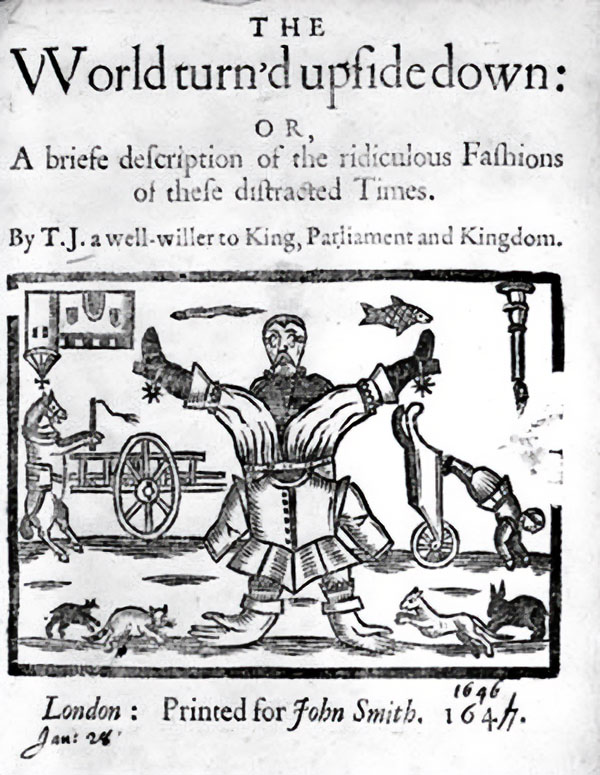
In sixteenth- and seventeenth-century England, ballads were written on a topic subject, printed on broadsides (a printed advertising circular), and sung in public (as on a street corner) by a professional balladeer. In 1646, and in closer proximity to the printing of the KJV, “The world turn’d upside down” appears as the title of an English ballad first published on a broadside for a “John Smith.” It was created to protest Parliament’s position that the Christmas holiday should be a solemn occasion and its outlawing of traditional English Christmas celebrations. This usage reveals the disruptive nature of the phrase.
A number of modern Bible translations follow the King James Version in their renderings of Acts 17:6. These translations are listed alphabetically and with the phrase italicized for emphasis:
- Christian Standard Bible (CSB): “When they did not find them, they dragged Jason and some of the brothers before the city officials, shouting, ‘These men who have turned the world upside down have come here too.”
- English Standard Version (ESV): “And when they could not find them, they dragged Jason and some of the brothers before the city authorities, shouting, ‘These men who have turned the world upside down have come here also.’”
- Jerusalem Bible (JB): “However, they found only Jason and some of the brothers, and these they dragged before the city council, shouting, ‘The people who have been turning the whole world upside down have come here now.’”
- Revised Standard Version (RSV): “And when they could not find them, they dragged Jason and some of the brethren before the city authorities, crying, ‘These men who have turned the world upside down have come here also.’”
In the Nestle-Aland Greek-English New Testament (8th ed.), we read ἀναστατόωin Acts 17:6, which can be translated, “cause trouble or disturb.” The English translation in this work is the RSV, which, as mentioned above, maintains the KJV wording, “turned the world upside down.”23The 8th edition of the Greek-English New Testament uses the NA27. Interestingly, the Zondervan Greek-English New Testament, which uses the UBS5 edition of the Greek New Testament, includes the NIV for its English version, and thus reads, “caused trouble all over the world.” Given its high scholarly regard, the Nestle-Aland Greek and English translation’s use of the phrase has had and may still have influence on other Bible translations. This shows how the KJV’s veering from “formal equivalency” or “literal” translation to include this English idiomatic neologism is perpetuated.
Approximately 50 years prior, Acts 17:6 in the Geneva Bible (AD 1560) reads, “But when they found them not, they drewe Jason & certeine brethren unto the heads of the citie, crying, These are they which have subverted the state of the worlde, and here they are.” So, while a number of translations follow the KJV wording, many others do not. The following Bible translations do not follow the KJV wording, rendering the phrase differently:
- Common English Bible (CEB): “When they didn’t find them, they dragged Jason and some believers before the city officials. They were shouting, ‘These people who have been disturbing the peace throughout the empire have also come here.’”
- Today’s English Version (TEV): “But when they did not find them, they dragged Jason and some other believers before the city authorities and shouted, ‘These men have caused trouble everywhere! Now they have come to our city.’”
- New American Standard Bible (NASB): “When they did not find them, they began dragging Jason and some brethren before the city authorities, shouting, ‘These men who have upset the world have come here also.’”
- New International Version (NIV): But when they did not find them, they dragged Jason and some other believers before the city officials, shouting: ‘These men who have caused trouble all over the world have now come here.’”
- New Living Translation (NLT): “Not finding them there, they dragged out Jason and some of the other believers instead and took them before the city council. ‘Paul and Silas have caused trouble all over the world,’ they shouted, ‘and now they are here disturbing our city, too.’”
BDAG defines ἀναστατόωas “to upset the stability of a person or group, disturb, trouble, upset τὴν οἰκουμένην(the inhabited world) Acts 17:6.”24BDAG 72. Danker and Krug expand to add “agitate, disturb, excite, unsettle” as used in Acts 17:6.25Frederick W. Danker, with Kathryn Krug, The Concise Greek-English Lexicon of the New Testament (Chicago, IL: University of Chicago Press, 2009), 28. The NIDNTTE agrees, noting a negative nuance, “to disturb” (Acts 17:6; Gal 5:12), or even “to cause a revolt” (Acts 21:38).26“ἀνίστημι, ἀνάστασις, ἀναστατόω,” NIDNTTE 1:323.
In a case of mistaken identity, Paul is suspected of being the escaped Egyptian rebel, a messianic pretender, who tried to coordinate an attack on Jerusalem in AD 54 (Acts 21:38 ESV), “Are you not the Egyptian, then, who recently stirred up a revolt [ἀναστατώσας] and led the four thousand men of the Assassins out into the wilderness?” The riot that had ensued was incited by the mob believing Paul had violated the temple by bringing Greeks into it.
In Galatians 5:12, ἀναστατοῦντεςis used of the Jewish leaders who opposed Paul’s message and sought to cause confusion among the Galatian Christians. The apostle entreats, “I wish those who “are disturbing you might also get themselves castrated!” (CSB)
Balz and Schneider’s definitions for ἀναστατόωare consistent with other lexicons (incite, disturb, and mislead) yet word its use in Acts 17:6 as “turned the whole world upside down,” as found in the KJV.27Horst Balz, “ἀναστατόω,” EDNT 1:92.
Thus, we conclude that “turn the world upside down” is a less than accurate translation of ἀναστατόωfrom the original Koine Greek and an unfortunate stretch from its lexical bearings. While it may represent the hyperbolic tone of the charge against Paul and others, its exaggeration does not help in establishing a more accurate tone of the event. And yet, it has found a following that has been and continues to be perpetuated via a certain lexicon, the KJV, and subsequent other translations of the Bible. The simpler translation, “upset the world” (NASB), addresses both the political urgency and the exaggeration of the accusation against Paul and his team.28We thank our former colleague, Dr. Doug Huffman, for offering insight on the Greek nuances of this passage. “Upside down” may be a catchy phrase to which many have latched, but its use is a distortion of what is recorded and unfortunately implies a behavior contrary to Luke’s description and message.
Careful consideration is a must before claiming that because Paul and his followers “turned the world upside down” Christians today should do likewise. Revisiting the context of this incident in Thessalonica lends further support in clarifying who said what and why in Acts 17:6.
2. Contextual
Luke’s purpose in his Gospel and the Book of Acts was to demonstrate that the universal kingdom of God was offered to Jews and Gentiles by Jesus’s completed work on the cross. The salvation Jesus offers crosses all geographical, ethnic, and social boundaries, and its kingdom citizens are to give evidence of the Holy Spirit’s indwelling presence and power as identifying marks of that kingdom. These were contrary to the deeply held, identifying marks—circumcision and law observance—of Judaism.
Paul powerfully preached the gospel message in synagogues of major cities in Asia Minor and Europe. Philippi of Macedonia, on his itinerary before arriving in Thessalonica, was one such city. Many Jewish and Gentile hearers were convinced of its truth and became followers of Christ, and of these, some ministered alongside Paul. Paul’s time in Philippi was met with a flogging and jail time for casting out a demonic spirit from a slave girl that resulted in a loss of income for those who profited from her powers. After suffering an illegal beating, being denied a trial as a Roman citizen, and undergoing wrongful imprisonment, Paul insisted his release from prison be public as a clear vindication of the gospel message, the church, and himself, so as to avoid any characterization as a troublemaker or lawbreaker.
Known for its ports, trade centers, and large population, the strategic city of Thessalonica was Paul’s next destination. As was Paul’s customary practice when entering a city, he went first to the Jewish synagogues. For three Sabbaths, he reasoned with them from their own Scriptures and proclaimed the gospel truth, as evidenced by the life, death, and resurrection of Jesus. Jesus’s completed work proved that he is the promised, anticipated, and expected Messiah. Among those who believed his message were Jewish listeners, Greeks, and a significant number of influential women. The non-believing Jews became furious at Paul’s approach since his converts were from among the Jews themselves or potential proselytes. The two-part execution of their plan publicly revealed their snap judgment, and disapproving envy and anger. They experienced a disruption to their religious status quo and took to the streets.
First, these Jewish opponents knew exactly where to go and to whom their quest for a mob-for-hire to stir up unrest would be actualized. Riots were not uncommon as a form of protest against any number of social ills—poverty, overcrowding, high unemployment, and more. These marketplace rabble-rousers may not have even known the reason behind the riot; they were on-call to riot for any reason. This disturbance was instigated and engineered by the Thessalonian Jews themselves, who were responsible for the riot and the negative bad press against Paul and his associates. A repeat performance occurred when these Jewish instigators traveled to Berea, Paul’s next destination (Acts 17:13).
Second, their plan of action involved invading the home of Jason, a Jewish convert to Christ, who extended hospitality to Paul and Silas. Perhaps hidden by the small band of believers, Paul and Silas were nowhere to be found at the time of the raid. So as to not leave empty-handed, the Jews dragged Jason and friends from his home to the city officials with two charges that sought to appeal to the Gentile leaders and the culture’s status quo.
The first of two deliberate yet fabricated charges sought to connect the Jesus followers with the crime that by preaching a religio illicita they instigated a disturbance, “upsetting the world” wherever this message was delivered.29Richard N. Longenecker, “Acts,” in Luke-Acts, EBC 10, ed. Tremper Longman III and David E. Garland, rev. ed. (Grand Rapids: Zondervan, 2007), 975. In the shadows of recent history, Claudius’s edict (AD 49–50) had expelled the Jews from Rome for the “constant riots at the instigation of Chrēstus.”30Suetonius, Claudius 25.4, cited in William J. Larkin, Jr., Acts, IVPNTC 5 (Downers Grove, IL: InterVarsity Press, 1995), 248. In Thessalonica, the investigation determined the actual architects who disturbed the highly prized Pax Romana were the non-believing Jewish accusers. Subsumed in this charge was the accusation against Jason for harboring the alleged disturbers of peace.
The second charge was the more serious of the two: claiming allegiance to another king meant treason against Caesar. Disloyalty on any level was unacceptable. Perhaps this was grounded in Paul’s preaching of the kingdom of God that inferred allegiance to a new and different king, though one who had clearly suffered death by crucifixion at the hands of the Romans.
It did not take much to determine the guiltlessness of the wrongly-charged friends of Paul and the bitter jealousy of the non-believing Jews. The resulting issue of a security bond, designed to protect the people and discourage further chaos, was paid by the innocent accused, placating the crowd and officials. Though Jason and others were released, this unprovoked incident was enough for Paul to shorten his ministry time in this key city. Yet his concern for the new believers’ perseverance persisted as evidenced by his continuing correspondence with them amid persecution in his absence (1 Thess 3:2–5).
Luke records the stark contrast between the non-believing Jews—who feared and thus overreacted to the disruption of their current state of affairs—and those who modeled the kingship of Christ’s rule in a Spirit-led life. Kavin Rowe asserts that neither sedition nor a coup was the missionaries’ agenda but rather bearing witness to the reality of Jesus’s resurrection.31C. Kavin Rowe, World Upside Down: Reading Acts in the Graeco-Roman Age (Oxford: Oxford University Press, 2009), 88. Their newly transformed kingdom culture was living evidence directed toward a world that is upside down. He maintains that the normative behavior of Christ followers is as those whose “culture and its set of practices are instantiations of a world turned right side up.”32Rowe, World Upside Down, 6.
3. Theological
If our case is anywhere close to correct that the descriptor, “turned the world upside down,” is a less than desirable translation of ἀναστατόωin Acts 17:6 and that, contextually—even if we continue to use that translation—the early Christians should appropriately, from God’s perspective, be referred to as engaging in right-side-up activity, what are the theological consequences? Are we merely meddling in semantics when we could be making a concrete impact in the world for Jesus? Our claim is that the theological import of using right-side-up language, and having a right-side-up mind and heart posture that undergirds such language, is significant indeed. We hope to show this by addressing an argument against right-side-up language, considering an oft-used framework adjacent to upside-down, and reflecting on the implications of a number of relevant New Testament passages.
3.1. An Argument against Right-Side-Up Kingdom Language
Returning to Donald Kraybill’s work, The Upside-Down Kingdom, we note that he does not merely grab the term from Acts 17:6 and use it throughout. At one point, he actually acknowledges that “the kingdom portrays God’s blueprint for our lives,”33Kraybill, The Upside-Down Kingdom, 20. and because it does, we could possibly choose right-side-up language to refer to the kingdom of God. Here is a summary of the reasons he decidedly and intentionally chooses not to do so:
- Social stratification is vertical, not horizontal. Some are lower and some are higher in the social hierarchy. Using upside-down language reminds us of such inequalities.
- We naturally accept “the way things are.” We thus fail to ask questions about the world. Upside-down language reminds us to challenge what we otherwise take for granted.
- Jesus regularly used paradox, irony, and reversal to surprise his hearers and shatter their assumptions. Upside-down language is thus quite in line with Jesus’s form of pedagogy.34Kraybill, The Upside-Down Kingdom, 20–21.
Kraybill’s points are compelling to a degree but in our estimation fall short in some key ways when compared to a right-side-up paradigm. We offer these counterpoints to Kraybill’s case against right-side-up language:
- True, our social strata are varied, and hierarchical relationships exist. But according to Scripture, not every stratum is an inequity that needs to be equalized. If upside-down language is intended to convey that all hierarchies are to be overturned, then it is misguided. Right-side-up language allows us to recognize those strata that are naturally in alignment with God’s desires, while encouraging us to right the wrongs that do exist.
- Perhaps it is human to accept “the way things are.” But as citizens of God’s kingdom, we know that since Genesis 3, the world is by and large in an upside-down state. Thus, rather than looking at those things that seem overtly and obviously out of sync with God’s kingdom and turning them upside-down from the world’s perspective, we propose viewing the world as primarily upside-side down, i.e., out of sync with God’s kingdom, and turning any and all upside-down elements right-side up from God’s perspective.
- Yes, Jesus’s language shocked his hearers, causing them to reflect on his words and reevaluate their approach to life and understanding of reality. But for those who reflect, reevaluate, and ultimately realign their lives with true kingdom life, they are now living as God has always wanted his people to live. They were upside down, but by following Jesus’s seemingly odd and paradoxical call, they are now right side up. The surprising language is the same, but the teleological aim is more theologically apt.
The semantic decision to refer to God’s kingdom as right side up carries with it the deep desire to convey the work of that kingdom as obedient and restorative, rather than unruly and destructive. This does not dilute or detract from the radical nature of Jesus’s words or work; rather, it more appropriately frames what it is that he came to do. In his last words on the opening section of the Sermon on the Mount, Dallas Willard captures the intent as we desire to capture it.
Surely it is this radically revolutionary outlook that explains why Jesus, in completing his statement … in Matthew 5, finds it necessary to caution, “Don’t think I have come to abolish the Law and the Prophets”—that is, to abolish the entire established order as far as his hearers were concerned. Obviously he had to say this because this is precisely what his hearers were thinking. They could think nothing else! They had not heard just another powerless list of legalisms, however pretty, and they knew it. They had heard an upside down world being set right side up.35Dallas Willard, The Divine Conspiracy: Rediscovering Our Hidden Life in God (San Francisco: HarperCollins, 1998), 126.
3.2. An Adjacent Upside-Down Kingdom Framework?
Obviously, there are other ways to refer to the kingdom of God that accentuate the contrast between God’s kingdom and the world but that avoid the right-side-up and upside-down linguistic dilemma. “Subversive” has found purchase among a number of recent Christian authors. Ed Stetzer wrote Subversive Kingdom36Ed Stetzer, Subversive Kingdom: Living as Agents of Gospel Transformation (Nashville: Broadman & Holman, 2012). We are in hearty agreement with the main thrust of Stetzer’s book, as well as his many bold exhortations to true kingdom living. We merely question whether subversion is the appropriate descriptor for the radical life we are called to as God’s kingdom citizens. just over a decade ago. Here’s one of his many provocative descriptions.
It’s here. It’s happening. It’s right there in the room with you. It has broken into time and space and is subversively working to overcome the darkness of our age. The kingdom of God is a radical rejection of every value or point of view that keeps people in bondage to untruth, blinded to Christ’s mercy. It is a refusal to classify any person as being expendable or beyond reach, an unwillingness to view any situation as something that cannot be transformed and infused with hope. It means knowing that while not everything will be made perfectly right on this earth or in this era, we have opportunities to witness the kingdom’s reality this week on every street, in every neighborhood, in every nation of the world.37Stetzer, Subversive Kingdom, 8, italics original.
Stetzer emphasizes that the enemy of the kingdom of God, and hence the one whose efforts we are aiming to subvert, is Satan and his kingdom of darkness.38“This is the condition we were each born into—an oppressive, deceptive kingdom that kept us buried in lies, spiritual laziness, and pointless activities disguised to look meaningful. But Jesus subversively came into the world to destroy Satan and his schemes, to set free those who suffered under his enslaving rule.” Stetzer, Subversive Kingdom, 18. “Our new kingdom citizenship with its transferred loyalties compels us into becoming agents of ‘rebellion against the rebellion,’ working intentionally to subvert the devil’s claim to authority over our and others’ individual lives.” Subversive Kingdom, 21. Despite these important insights, it is unknown whether Jesus coming into the world was subversive from Satan’s perspective, given the “secretive” and “indirect” connotations of the term. The words and actions of Satan’s demons during Jesus’s ministry appear to imply that they were fully aware of the intent of the incarnation.
Other accounts of subversion cast the contrast in kingdoms differently. In his thoroughly compelling articulation of the political nature of Christian commitment, Political Gospel, Patrick Schreiner balances what he calls the way of subversion and the way of submission.39Patrick Schreiner, Political Gospel: Public Witness in a Politically Crazy World (Nashville: Broadman & Holman, 2022). The emphasis on the subversion/submission relationship is primarily found in chapters 4–6. Commenting on Acts 17:6, wherein he affirms that he “loves” the “turned the world upside down” translation of ἀναστατόω, Schreiner states, “It fits seamlessly with the idea that the Christian message is not only political but politically subversive.… The word … literally means ‘to subvert, agitate, overthrow, or disturb.’”40Schreiner, Political Gospel, 83. Preston Sprinkle, toward the end of Exiles, actually construes Acts 17:6 as a command for followers of Jesus. “Christians are to be good citizens by being subversive citizens, political prophets, strangers and foreigners who ‘[turn] the world upside down’ by ‘acting contrary to Caesar’s decrees, saying that there is another king—Jesus.’” Exiles, 177. The rhetorical flourish is moving, but we hope we have shown that the verse does not carry imperative intent. And yet, pages later, he states, “The church is a political assembly, but that does not mean we are to overthrow the government. We submit to it. It does not mean lashing out at those who persecute us but doing good to our enemies.”41Schreiner, Political Gospel, 116. Acknowledging the obvious tension, he closes by stating, “The church’s political posture is no different from that of Jesus. The way of subversion and the way of submission collide.… This is the paradox of our political lives.”42Schreiner, Political Gospel, 122. In Exiles, Sprinkle presses Schreiner’s contrast, seeking to remove the tension and bring cohesion. “Instead of subversion and submission existing in tension like two sides of the same coin, what if it’s more accurate to speak of subversion through submission? Here the two concepts are not opposites, nor do they exist in tension. Rather, in God’s upside-down kingdom, submitting to the state is a way we subvert the authoritative power of the state, similar to the way Christ defeated the dragon by submitting to the cross.” Exiles, 208 n. 26, italics original.
So, are we subverting Satan and his plans, à la Stetzer, or figuring out whether to subvert or submit to political powers, à la Schreiner? And how does either articulation of kingdom subversion affect how we deal with the women and men whose lives are tangled up in the webs of demonic or political powers? If our driving motivation is to undermine, disturb, and overthrow, how do we do so without harming the individuals who are so entangled in these systems? Given the contextual fact that the agitate-subvert-turn-upside-down paradigm was an accusation against the early church by hostile agitators and not a descriptor of what she was truly all about, and given the fact that there is confusion about what we ought to subvert and how we could do so without victimizing the very people who need to experience the gospel of the kingdom, we do not agree that “subversion” is the best way to frame the kingdom task. To fix what is broken, to reconcile that which has been separated, to heal that which is wounded, to build up that which has been torn down, to redeem that which has been lost—these phrases better describe the renewing, restorative posture of a kingdom that is turning the world right side up. And, undoubtedly, each and every right-side-up kingdom act that draws people to Jesus and realizes God’s will on earth is a frustrating and infuriating strike against Satan and his minions.
3.3. Three New Testament Texts on Turning the World Right Side Up
We have explored the nuances of Acts 17:6 and its language. And we have argued that right-side-up thinking is preferable to upside-down-thinking. But does our claim measure up with New Testament teaching more broadly? Below we explore teaching from Jesus, Paul, and Peter that not only corroborates the case we’ve been building, but expounds and expands it.
Matthew 5:16: “Let your light shine before men in such a way that they may see your good works, and glorify your Father who is in heaven” (NASB). It is the very nature of light to dispel darkness. And this darkness-dispelling quality of God, who is light, and by extension God’s kingdom citizens, who are also light, is a clear biblical theme.43Michael J. Wilkins, Matthew, NIVAC (Grand Rapids: Zondervan, 2004), 214–16. In this passage, Jesus further clarifies that the way we shine as God’s light in the dark world around us is not merely by doing good works but by doing them in a way that points those who experience our good works to God as their source. Contextually, this kingdom way of doing good works is characterized by the Beatitudes: poverty of spirit, gentleness, righteousness, mercy, purity of heart, peace, etc. Those in the dark, those truly in the upside-down kingdom, may not experience our good works as we, or God, intend. But according to Jesus, some should see the light of our works as coming from our light, and our light, as coming from the very light of God, dispelling the darkness by which they are enveloped.44Colin J. Smothers argues that Jesus’s intent, as well as Matthew’s intent in recording Jesus’s words, in Matthew 5, is to allude to the “light of the nations” emphasis in the Book of Isaiah, specifically 42:6. Such an allusion is meant to call out Jesus’s disciples as the new Israel carrying out a new covenant function. Whether one agrees with Smothers’s “canonical” connection or holds that Jesus is using light as a broader-yet-still-biblical metaphor, the shared conclusion still stands: “Jesus’s disciples are those whose light will shine forth to attract the nations.” “Salt and Light: A Canonical Reading of Matthew 5:13–16 and Isaiah 42:6,” JETS 67 (2024): 249. Turning the world right side up seems much more in step with this metaphor of light driving away the darkness.45Wilkins continues, “It is a real temptation for humans …, for fallen creatures [to] want to impose their way on others. But Jesus brought the kingdom of God in a very different way. It is the way of regeneration and renewal by the Spirit.” Wilkins, Matthew, 224.
First Thessalonians 4:11–12: “Make it your ambition to lead a quiet life and attend to your own business and work with your hands, just as we commanded you, so that you will behave properly toward outsiders and not be in any need” (NASB). Recall that it was the Thessalonian Jews who charged that Paul and company were “turning the world upside down,” implying societal upheaval and violations of law. But as is the case throughout Acts, Paul is declared innocent of these kinds of charges.46Schreiner, Political Gospel, 110–12. This legal reality aligns with his instructions to the Thessalonian church, wherein Paul delivers this message of respectful, social behavior. Summarizing this passage, D. Michael Martin states,
It was not Paul’s intent that the church disrupt society or overthrow governments. Rather, he encourages Christians to be good citizens and exemplary members of their families and of their society … in a manner consistent with the teachings of Christ. People who live in such a way that they are counted as respectable members of society, who engage in respectable pursuits, are living euschēmonōs [properly/worthily].47D. Michael Martin, 1, 2 Thessalonians, NAC 33 (Nashville: Broadman & Holman, 1995), 138–39.
“‘Subvert, agitate, overthrow, or disturb,’”48Schreiner, Political Gospel, 83. all claimed characteristic actions of the upside-down kingdom, seem far from what Paul has in mind here for Christians living their day-to-day lives. Living Christianly, but in a winsome, contagious manner, is the right-side-up kingdom way.49Gary Shogren’s comments provide appropriate nuance regarding this passage, “Some suggest that [Paul] promote[s] mere respectability, that rather than turn the world upside down with the gospel, Christians are to stay home, be quiet and dignified, and obey the government (e.g., 1 Tim 2:2). Nevertheless, ‘quiet’ does not necessarily mean passivity; 1 Thessalonians combines a radical commitment to the gospel … with a conventional manner of living.… It was always Paul’s desire that Christians make a sincere and positive impression on non-Christians.” 1 and 2 Thessalonians, ZECNT (Grand Rapids: Zondervan, 2012), 171–72.
First Peter 2:13–15:50We note that the previous two verses of 1 Peter 2 call Christians to the same kinds of behavior as do Matthew 5:16 and 1 Thessalonians 4:11–12, and for the same reasons. “Submit yourselves for the Lord’s sake to every human institution, whether to a king as the one in authority, or to governors as sent by him for the punishment of evildoers and the praise of those who do right. For such is the will of God that by doing right you may silence the ignorance of foolish men” (NASB). It goes without saying that Peter wrote these instructions when the church was in the minority. And while there is debate over when the letter was written and which emperor was in charge when he wrote,51See Scot McKnight, 1 Peter, NIVAC (Grand Rapids: Zondervan, 1996), 29, 145, for Nero; and Karen Jobes, 1 Peter, BECNT, 2nd ed. (Grand Rapids: Baker Academic, 2022), 32–48, 247, who leans more toward Claudius. there is no doubt that the church faced hostility in the form of slanderous accusations and, at least, sporadic persecution. Under these circumstances, Peter does not call his readers to agitate, disturb, cause trouble, or overthrow, but to submit and do right. This instruction coheres with Jesus’s words in Matthew 5:16, and Paul’s in 1 Thessalonians 4:11–12, but the purpose directly addresses the negative and untrue charges levied against them. The behavior of the early Christians was to be politically and morally above reproach so that, when an angry critic publicly raises a charge that they were “turning the world upside down,” the Christians’ words and actions would prove the accusations false and thus, in the words of Karen Jobes, “silence the slander.”52Jobes, 1 Peter, 246. Our political structures may be different today, but the attitude of the culture toward the church is in some ways the same. So, Christians ought to heed Peter’s words and wisely and contextually apply them. However that might work out in our various communities, these admonitions appear to us to be better described as right side up (with connotations to build up) than upside down (with connotations to tear down).53McKnight’s commentary has an extended section discussing how the differences between the context of the first century and the twenty-first century require a more idealizing application of Peter’s instructions. 1 Peter, 155–62.
4. Conclusion
The lexical, contextual, and theological analysis of Acts 17:6 reveals (to us, at least) that a correction is in order concerning the use of the phrase, “turn the world upside down.” The fallen, broken, sinful world we live in is already, truly upside down. God’s kingdom purposes are to penetrate our lives and thus impact as much of the world as possible with God’s kingdom values, i.e., to turn it right side up.
When our heart, mind, and will align with the kingdom of God, we are right side up. How we live out this truth should reflect God’s kingdom. It starts with a change in perspective, a prayerful dependence on the Holy Spirit to lead us in observing the opportunities to manifest right-side-up kingdom realities. He will guide us to act and speak in redemptive ways as in, e.g., caring for creation, being present with the elderly in and beyond our families, extending friendship to a stranger, or forgiving the unforgivable. It is not just doing the right thing; it is doing the right thing in the right way. In other words, it is doing the right-side-up kingdom thing. It will not always be easy or convenient. It is not supposed to be. Otherwise, we would not need the Holy Spirit’s empowerment. To align with kingdom values bears witness with and through observable differences, and it pleases the King of the kingdom. We firmly believe that our call as citizens of God’s right-side-up kingdom is to do as Jesus, the announcer and fulfillment of that kingdom, did, and work to turn our upside-down world right side up, as well.
Joanne J. Jung & Eric B. Oldenburg
Joanne Jung is associate dean of Online Education and Student and Faculty Engagement and professor of Biblical and Theological Studies at Talbot School of Theology, Biola University in La Mirada, California.
Eric Oldenburg is a PhD student in systematic theology at Melbourne School of Theology and adjunct professor of Biblical and Theological Studies at Talbot School of Theology, Biola University in La Mirada, California.
Other Articles in this Issue
This essay develops a distinctly Christian theology of free speech in response to mounting threats of censorship across Western societies...
In every generation and in every place, there is a need to identify, equip, and encourage new leaders for Christ’s church...
Missio Trinitatis: Theological Reflections on the Origin, Plan, and Purpose of God’s Mission
by Brian A. DeVriesTrinitarian theology provides the basis for understanding missio Dei...
This essay argues that monogamous sexually-differentiated marriage (MSDM) is uniquely revealed through Christ’s relationship with the church in Ephesians 5:30–32...
Other Reviews in this Issue

Genesis
Reviewed by Dustin Burlet