
Volume 50 - Issue 3
The Pastors and Teachers in Ephesians 4:11
By Jonathan D. WorthingtonAbstract
Paul’s reference to “the pastors and teachers” in Ephesians 4:11 is regularly discussed and often misunderstood. In conversation with some key voices in the debate, I argue this double-sided thesis: (1) Paul’s grammar portrays pastors and teachers as two recognizably distinct groups—i.e., in general, pastors are not teachers and teachers are not pastors—and (2) they nevertheless must serve the saints in closer connection together than the other groups of leaders mentioned. On this sound foundation, I offer constructive possibilities with reference to the connected Greco-Roman systems of home and education for who within Pauline circles the pastors likely were, who the teachers likely were, and how they were likely meant to work together.
Nearly 30 years ago, I was sipping cheap coffee with school friends home from their first year of Bible college. “Paul’s phrase ‘the pastors and teachers’ in Ephesians 4:11,” they explained, “should not be considered two offices, but one: something like pastor-teachers.”
Like a good Berean, I opened my heavily highlighted NIV 1985 Study Bible and read:
It was [Christ] who gave some to be apostles, some to be prophets, some to be evangelists, and some to be pastors and teachers, to prepare God’s people for works of service, so that the body of Christ may be built up. (Eph. 4:11–12)
“Yeah,” they said knowingly, “our professor showed us the Greek.” Impressed, I then read the NIV note at 4:11:
Because of the Greek grammatical construction … it is clear that these groups of gifted people are closely related. Those who have pastoral care for God’s people (the image is that of shepherding) will naturally provide “food” from the Scriptures (teaching). They will be especially gifted as teachers (cf. 1 Tim. 3:2).1Walter Liefeld, “Ephesians,” in The NIV Study Bible (Grand Rapids: Zondervan, 1985), ad loc.
Since then, I’ve seen many established pastors and theologians claim “the pastors and teachers” in Ephesians 4:11 are one role (many say “office”),2Kevin DeYoung, “Why the Ascension?” Christ Covenant, 22 May 2022, https://christcovenant.org/sermons/why-the-ascension/); John MacArthur, Bible Doctrine: A Systematic Summary of Bible Truth (Wheaton, IL: Crossway, 2017), 757; Doug Wilson, “The Difference Between Pastors and Teachers,” Blog & Mablog, 26 May 2014, https://dougwils.com/the-church/the-difference-between-pastors-and-teachers.html; Jeramie Rinne, Church Elders, 9Marks (Wheaton, IL: Crossway, 2014), 46; Ligon Duncan, “What Elders Are and Do,” LigonDuncan.com, 7 September 2008, https://ligonduncan.com/what-elder-are-and-do-728/. Paul’s grammar supposedly expressing “dual responsibilities of the same people.”3Craig Keener, “Ephesians,” in NIV Cultural Backgrounds Study Bible, ed. John Walton and Craig Keener (Grand Rapids: Zondervan, 2016), 2062. Hence popular glosses like “pastor-teachers” or “teaching pastors.” Some argue Paul’s Greek construction actually shows that the main way pastors are to pastor is by teaching.4Henry Alford, The Greek Testament (Chicago: Moody, 1959), 3:117, followed by John Piper, “Elders, Pastors, Bishops, and Bethlehem,” Desiring God, 2 March 1987, https://www.desiringgod.org/messages/elders-pastors-bishops-and-bethlehem); cf. Benjamin Merkle, 40 Questions about Elders and Deacons (Grand Rapids: Kregel, 2008), 86.
This exegetical-theological claim has implications for whom we call, appoint, or ordain as “pastors” and exactly what pastoral training programs should include. But what if “pastors” are not usually meant to teach? What if “teachers” are not usually meant to pastor? What if Christ has provided two differently gifted groups of people and intends them to serve the saints in partnership?5By focusing on “the pastors and teachers,” I am not making any claim about the continued activity of apostles, prophets, and evangelists. That issue is beside the point here and would be distracting.
Here is this article’s double-sided thesis:
- Paul’s grammar in Ephesians 4:11 portrays “pastors” and “teachers” as two recognizably distinct groups—i.e., in general, pastors are not teachers and teachers are not pastors—
- who nevertheless must serve the saints in closer connection together than the other leaders mentioned.
Elements of this are not new.
Yet two significant points tend to be uncritically mixed in. First, Daniel Wallace masterfully argues that the Greek of Ephesians 4:11 does not suggest pastors and teachers are identical (so not “pastor-teachers”). Yet Wallace includes theological and exegetical reasoning that perpetuates confusion. Second, some theologians admit in their exegesis that pastors and teachers are not identical,6E.g., Constantine Campbell, The Letter to the Ephesians, PNTC (Grand Rapids: Eerdmans, 2023), 177–79; Darrell Bock, Ephesians, TNTC (Downers Grove, IL: InterVarsity, 2019), 126; Clinton Arnold, Ephesians, ZECNT (Grand Rapids: Zondervan, 2010), 260–62; Harold Hoehner, Ephesians (Grand Rapids: Baker Academic, 2002), 543–44; Ernest Best, Ephesians, CEC (Edinburgh: T&T Clark, 1998), 393; Andrew Lincoln, Ephesians, WBC 42 (Grand Rapids: Zondervan, 1990), 250. but this does not then affect their general theological constructions (e.g., Benjamin Merkle, Constantine Campbell, Harold Hoehner). I believe this confuses laymen, students, pastors, and professors. Section 7 directly addresses both after analyzing the data in §§1–6. Sections 8–9 then presents a better way forward.
1. Paul’s Basic Grammar: “The Pastors and Teachers”
Paul does connect “teachers” to “pastors” in two ways, not so for the other three types of leaders.7Arnold, Ephesians, 260; cf. Markus Barth, Ephesians, AB 34 (New York: Doubleday, 1974), 2:438.
1.1. “And”: Paul’s καί Somewhat Connects Pastors and Teachers in Ephesians 4:11
Paul uses a μὲν… δέ… construction for this list of leaders: “on the one hand [μὲν] … on the other [δέ]…” It’s like Paul is placing each set of leaders into its own place: “On the one hand, Christ gave the apostles—over there. On the other hand, Christ gave the prophets—over here. On another hand, Christ gave the evangelists—over there. On still another hand, Christ gave the pastors and teachers—over here.”
Paul breaks the μὲν… δὲ… δὲ… δέ… construction with a καίbetween pastors and teachers. This subtly implies that he is not considering five equidistant groups—five groups, yes (see below), but not equidistant in the context. The fifth plural noun (teachers) is somewhat connected to the fourth (pastors) in a way that is different from the first three.8“Somewhat” is nebulous, I know, but is meant to create pause and prompt consideration of what “somewhat connected” might mean—which will be explored later.
1.2. “The”: Paul’s τούςSomewhat Connects Pastors and Teachers in Ephesians 4:11
Paul uses the definite article for the apostles, the prophets, the evangelists, and the pastors, but not for teachers. The pastors and teachers share one article. This feature also somewhat connects pastors and teachers to each other slightly differently from the other groups. So, is Paul presenting pastors and teachers as the same? No.
2. A Little More Detail on the Grammar
Many people (like myself formerly) treat Paul’s grammatical technique with plural nouns in Ephesians 4:11 differently from its uses virtually everywhere else. The hyphenated claim of “pastor-teachers” (or “teaching pastors”) has gained popularity in Reformed circles over the past number of decades.9See footnote 2 above for a sample of popular-level sources. Calvin, the Westminster Directory, and the New England Puritans promoted a distinction between pastors and teachers in Ephesians 4:11; Charles Hodge called their view “a false interpretation of Scripture.”10Charles Hodge, A Commentary on Ephesians (Edinburgh: The Banner of Truth Trust, 1856), 161–62.
But the hyphen is eisegeted (see §§3–6 below for textual substantiation). The hyphenated mis-reading of Paul’s grammar largely stems from a mis-understanding and mis-application of rule one of six by Granville Sharp (1735–1813), a British abolitionist and amateur grammarian.
Ancient Greek writers often connected two or more substantives in the same case (e.g., accusative or dative) and same number (i.e., singular or plural) by (1) joining both/all with “and” and (2) placing them under one “the.” The basic grammatical construction can involve substantival adjectives, substantival participles, singular nouns, and plural nouns, so I will use the label A-S-K-S (article-substantive-kai-substantive).11See Daniel Wallace, Granville Sharp’s Canon and Its Kin: Semantics and Significance (New York: Lang, 2009), 7n. 21 for the nomenclature.
Sharp’s first rule described a New Testament (NT) pattern wherein multiple singular substantives (not plurals as in Eph 4:11) were united under one “the” and with “and.”12Granville Sharp, Remarks on the Definitive Article in the Greek Text of the New Testament, 1st American edition (Philadelphia: Hopkins, 1807), 3. Sharp argued that the singular substantives tended to be attributed to the same referent, functioning adjectivally. His classic example is Titus 2:13: “the great God and savior [τοῦ μεγάλου θεοῦ καὶ σωτῆρος] of us Jesus Christ.” Sharp argued that Paul is not talking about “the great God” the Father and “our savior Jesus Christ”; the two singular substantives (God, savior) function as co-descriptors of the one referent (Jesus).
Sharp did not intend his “rule” to be applied to plural groups.13See Daniel Wallace, “The Semantic Range of the Article-Noun-Kai-Noun Plural Construction in the New Testament,” Grace Theological Journal 4.1 (1983): 59–84; Greek Grammar Beyond the Basics (Grand Rapids: Zondervan, 1996), 270–90; Granville Sharp’s Canon and Its Kin (New York: Lang, 2009). If he had, he would have mis-interpreted myriad passages in the NT, early Judaism, and the Greek OT. See §§3–6. First, some general orientation will help: A-S-K-S constructions do not all function alike.
Focus first on adjectives and participles, whether singular or plural. When authors use adjectives or participles or a mix in an A-S-K-S construction, they tend to carry an adjectival (descriptive) force even though they are substantival (thus like nouns).14See Wallace, “Semantic Range,” 73–79. For example, Paul describes “the saints” (the referent) of Ephesus with a plural participle and a plural adjective in the A-S-K-S construction: “to the saints—the ones being in Ephesus and believing” (τοῖς ἁγίοις τοῖς οὖσιν[ἐν Ἐφέσῳ] καὶ πιστοῖς; Eph 1:1; cf. Col 1:2 and 1 Pet 2:18). Likewise, Paul writes to Titus: “to the ones who are stained and unbelieving, nothing is clean” (τοῖς δὲ μεμιαμμένοις καὶ ἀπίστοις; Titus 1:15), in which Paul links a plural substantival participle (stained) and a plural substantival adjective (unbelieving) under one “the” and with “and”—an A-S-K-S construction—carrying a descriptive or adjectival force.
Focus next on singular nouns, or on a combination of singular nouns with singular participles or adjectives. They can carry something of an adjectival sense in A-S-K-S constructions when attributed to a referent: e.g., Sharp’s reading of Titus 2:13 above. Singular nouns, however, are also used in their strictly nominal sense as distinct beings that are somehow connected in a given context. “The vulture and kite” in Leviticus 11:13–14 are not a vulture-kite bird. “The camel and hare and coney” in Deuteronomy 14:7 are not a camel-hare-coney animal.
Regarding plural nouns in A-S-K-S constructions (as in Eph 4:11), we do not seem to have any examples of NT authors (§5), other early Jewish authors (§4), or Greek OT translators (§3) using A-S-K-S to conflate plural nouns into one group with multiple descriptors.15See Wallace, “Semantic Range,” 78–79. Plural nouns in the A-S-K-S construction are simply not blended or hyphenated. Let us look at the data.
3. Greek OT A-S-K-S Plural Nouns
Greek translators of the OT used the same plural noun A-S-K-S construction (around 40 times) that Paul later used. Many instances are in lists of groups such as “the Canaanites and Hittites and Amorites and Perizzites and Gergasites and Jebusites” (e.g., Exod 3:8, 17; 13:5; cf. 1 Chron 5:19; 2 Chron 1:17; 16:8; 36:5; Neh 9:8; 1 Esth 5:20; 5:53b), or “the priests and Levites” (2 Chron 35:8; Ezek 10:5 [cf. 1 Esth 1:7; 8:5, 92]; etc.). The plural nouns clearly refer to distinguishable groups, not a single group with hyphenated descriptors. Indeed, if you hyphenate into one group the priests with non-priest Levites (which is what “Levites” means in such contexts) and push the latter into the sacrificial work in the temple, you would condemn them to death—literally.
Likewise, the translator of Daniel uses A-S-K-S[-K-S-K-S] to describe “the enchanters and magicians and Chaldeans and astrologers” coming together to interpret the writing on the wall (Dan 5:7 LXX). The grammar is not used to express four “responsibilities of the same people” (as some posit about the pastors and teachers). Rather, “each title technically represents a different expertise”16According to Wendy Widder, Daniel (Grand Rapids: Zondervan Academic, 2023), Chaldeans (as a technical term, not a general reference to people from that area) were “a special class of priest-scholars” and “experts in astrology”; magicians were experts in “the occultic arts, including astrology, sorcery, and exorcism”; enchanters may have been “priests who communicated with the spirit world (including the dead) via magic spells and incantations”; and sorcerers specialized in “witchcraft: using charms, incantations, and spells to manipulate supernatural powers for good or evil” (89, and see nn.13–14). Cf. Cornelius Van Dam, “Divination, Magic,” Dictionary of Old Testament Prophets (Downers Grove: IVP Academic, 2012), 159–62. Cf. Carol Newsom, Daniel: A Commentary (Louisville: Westminster John Knox, 2014), 67–68 and John Goldingay, Daniel, WBC (Dallas: Word, 1989), 46, who is not as careful with the nuances. or “class”17John Collins, Daniel (Minneapolis: Fortress, 1993), 137–39. or “category”18Collins, Daniel, 155–56. or “guild.”19Goldingay, Daniel, 45–46; cf. James Montgomery, A Critical and Exegetical Commentary on the Book of Daniel, ICC (Edinburgh: T&T Clark, 1927), 142–44, 252–53; Collins, Daniel, 138. These were distinguishable groups that could be summoned in different combinations at different times (and expressed with different Greek constructions)20Cf. Daniel 1:20 and 2:2 (each group with own article); 2:10 and 27 (no group with article); 4:7 and 5:15 (one article governs all, none joined with καί); 5:11 (no articles, no καί).—connected by the Greek translator with A-S-K-S for a particular contextual reason.
Pause. A question from messy reality may come up here. (I will mention it again to critique Wallace’s otherwise stellar studies of A-S-K-S.) Could it be that a “magician” was also an “astrologer”? Perhaps not in that ancient Near East setting, but let’s suppose so for argument’s sake. Would such happenstance imply that the author is trying to tell us by the A-S-K-S construction that there is overlap between the groups? No. Imagine going to a conference to meet with “the professors and administrators” of various seminaries. A few professors happen to be administrators too, and vice versa. But the plural noun A-S-K-S construction I just used—the professors and administrators—is portraying recognizably distinct groups (regardless of whether here or there they might or might not happen to contain some over-lappers) who are working together or at least viewed in conjunction in this situation. Any happenstantial overlap is not the author’s point with plural noun A-S-K-S, which conveys distinction in partnership.
4. Early Jewish A-S-K-S Plural Nouns
Other Jewish authors writing in Greek used plural nouns A-S-K-S. They also subtly connect multiple recognizably distinct groups for some contextual reason.
Tobit instructs his son: “do not be arrogant in your heart against your brothers and the sons and daughters of your people” (4:13). Is Tobit suggesting there are son-daughters out there?! So also Tobit conveys “the paths and plans” in A-S-K-S as distinct things contextually connected in needing God’s blessings to prosper.21The A-S-K-S in Tobit is straightforward, not meriting mention in Robert Littman, Tobit: The Book of Tobit in Codex Sinaiticus (Leiden: Brill, 2008), 92–95, or Michele Murray, Tobit (Collegeville, MN: Liturgical Press, 2023), 100 and 104–5.
In 1 Maccabees, “All the feasts and the sabbaths and new moons and recognized days” are four distinct groups, not two (10:34). The distinct appointed days (sabbaths, new moons, recognized days) are similar together apart from the feasts (e.g., Passover, Pentecost, Tabernacles),22Jonathan Goldstein, 1 Maccabees (Garden City, NY: Doubleday, 1976), 409. John Bartlett draws no attention to the ordinary A-S-K-S in The First and Second Books of the Maccabees (Cambridge: Cambridge University Press, 1973). which is not the same as intending to blend them in a way that loses their distinctions. (Cf. 1 Macc 13:6, 42; 3 Macc 1:4). In 4 Maccabees—a more philosophical-ethical text than the other Maccabee books23See David DeSilva, 4 Maccabees: Introduction and Commentary on the Greek Text in Codex Sinaiticus (Leiden: Brill, 2006).—we read of “the jungle of the habits and passions” (1:29), mastering “all the enjoyments and passions” (5:23), and even “the digits of the feet and hands” (15:15). All are distinct yet set in connection for a particular contextual purpose. God doesn’t usually create “foot-hands” (see §10 below).
In Psalms of Solomon, “king-ruler-persons” is not a fitting descriptor of “the kings and rulers and peoples” (5:11).24R. B. Wright simply cuts out the definite article because these are so clearly distinct: “Psalms of Solomon (First Century B.C.),” in The Old Testament Pseudepigrapha, vol. 2, ed. James Charlesworth (New York: Doubleday, 1985), 657. In 1 Esdras, “the treasurers and toparchs and governors and satraps” (4:47; cf. 3:2) are recognizably distinct groups of “associated administrators.”25See Michael Bird, 1 Esdras: Intro and Commentary on the Greek Text in Codex Vaticanus (Leiden: Brill, 2012), 182–83 (emphasis added). Hence the grammar. Compare 1 Esdras 8:22 wherein “all the priests and the Levites and temple-singers and gate-keepers and temple-servants and businessmen of this temple” are in A-S-K-S[-K-S-K-S-K-S] likely because the first group (the priests) is the only group with duties in the sacrificial system while all other groups, though recognizably distinct from each other, are nevertheless connected in this context as those diverse non-priests who variously minister with their distinct duties around the temple precincts.
Finally, in Judith 14:12 the Assyrians “sent word to their superiors, and they came to the generals and commanders of thousands and all the officers of them” (14:12; cf. 2:14).26For navigation through Judith 2:14, see Carey Moore, Judith: A New Translation with Introduction and Commentary, AB 40B (New York: Doubleday, 1979), 135, 137; Jennifer Koosed and Robert Paul Seesengood, Judith, Wisdom Commentary 16 (Collegeville, MN: Liturgical Press, 2022), 12 and cf. “rulers” in Wis 5:23; Sir 4:27; 2 Macc 9:25; 3 Macc 6:4. The two middle groups of the four are connected by A-S-K-S, but not the first or last. It seems the superiors (the first group) were alerted directly by the Assyrians; the superiors then approached the two distinct higher-ranking sets of commanders together—i.e., the generals and commanders of thousands—who finally alerted all the officers.27See Koosted and Seesengood, Judith, who insert the word “all their other officers” (143); cf. Moore, Judith, 238–39.
A definite pattern has emerged. In all these Jewish texts (and beyond),28S. M. Baugh, Ephesians, points out some statements from Plutarch (c. 46–119 CE) using plural nouns A-S-K-S to describe two clearly different groups that are functioning together in some way (335 n. 72). plural nouns in A-S-K-S have a consistent intent:
- The grammar portrays two or more recognizably distinct groups
- who nevertheless are seen in some sort of connection together in the given context.
Does this pattern continue into the NT (§5), and Ephesians in particular (§6)? Yes.
5. Gospels and Acts A-S-K-S Plural Nouns
The NT follows the plural noun A-S-K-S pattern from the Greek OT and early Jewish sources.
5.1. General Meaning: Recognizably Distinct Groups Connected in Context
Matthew writes about “the Pharisees and Sadducees” (Matt 3:7). These two recognizably distinct groups tend to hate each other. In this particular context, though, they are connected in their approach toward John the baptizer (cf. Matt 16:1, 6, 11, 12.) Imagine saying to the Pharisees and Sadducees, “Because you are connected under one the and with and, you each are a ‘Pharisee-Sadducee’.” They might just stone you!
Similarly, there were no “chief priest-Pharisees” (John 7:45), even though John’s grammar is like Paul’s in Ephesians 4:11.29S. M. Baugh, Ephesians, 335 n. 72. Nor were there “Grecian woman-men,” even though Luke sets plural nouns in A-S-K-S in Acts 17:12. The rhetorical point of the plural noun A-S-K-S grammar in the NT continues to function like the Greek OT and early Judaism. That said, messy reality has confused some otherwise great studies of this grammar.
5.2. Groups Overlapping Misses the Point of A-S-K-S
Daniel Wallace robustly demonstrates that plural nouns in the A-S-K-S construction in the NT do not communicate identity between the nouns. But Wallace then confuses occasional messy happenstance drawn from elsewhere with what the author intends to convey by A-S-K-S plural nouns.
A great example is his treatment of four plural substantival adjectives in A-S-K-S in Jesus’s parable. These are not plural nouns, and my point is even more applicable with them. The master told the slave to bring “the poor people and crippled people and blind people and lame people” (Luke 14:21). In historical reality, surely some people fit different combinations of these maladies: e.g., some poor people might also be blind, a few were likely all four. Because of occasional blurry boundaries between generally recognizably distinct groups, Wallace concludes “an overlap of categories is obviously the nuance intended by the author.”30Wallace, “Semantic Range,” 73 (emphasis added); cf. 73–75; Wallace, Greek Grammar Beyond the Basics, 279–81. This is a mistake.
Imagine the master saying, “Bring in the poor people.” The servant obediently returns with a crowd of poor people. The master says, “Now, bring in blind people.” The servant, understanding whom the master means, returns with blind people, never considering that he could point out that some of the poor people he brought in earlier were also blind. He knew his master’s point. The rhetoric was clear. (Remember “the professors and administrators” above.) The point of the Greek construction intended by the author is that the Lord is welcoming people from those four generally recognizably distinct groups who are connected in this context as marginalized groups of sufferers who are all invited together, whether there may or may not be someone here or there who happens to fit multiple categories.
5.3. Groups as Subsets Misses the Point of A-S-K-S
Another NT professor told me in a personal email that Wallace “concludes that the Greek construction in Eph. 4 means that all pastors are teachers but that not all teachers are pastors”—as if pastors are a subset of teachers. This subset idea is what Wallace concludes theologically about the relationship between pastors and teachers. I will challenge this below. But regardless, the Greek construction itself doesn’t mean this.
Compare “the scribes and Pharisees” (Matt 5:20; cf. 12:38). Wallace includes this as a clear example of one of the plural nouns in A-S-K-S (scribes) being a subset of the other (Pharisees). That may or may not be historically true in this particular instance; the grammar doesn’t say so. But what does that mean?
Scribes in general were not a subset of the Pharisees. Wallace agrees with this.31Wallace, “Semantic Range,” 73 n. 32. Cf. Michelle Lee-Barnewall, “Pharisees, Sadducees, and Essenes,” pages 217–27 in The World of the New Testament: Cultural, Social, and Historical Contexts, ed. Joel Green and Lee Martin McDonald (Grand Rapids: Baker, 2013), 218. Contra Albert Bell, Exploring the New Testament World (Nashville: Nelson, 1998), 34–35. “Scribes,” which was their job, could associate with various political, theological, or cultic parties (e.g., Sadducees, Pharisees, priests) according to their bent beyond their scribal work.32Cf. Graham Twelftree, “Scribes,” pages 1086–89 in Dictionary of New Testament Background, ed. Craig Evans and Stanley Porter (Downers Grove, IL: InterVarsity, 2000), 1087; Julius Scott, Jewish Backgrounds of the New Testament (Grand Rapids: Baker, 1995), 168 n. 5; Gregory Thellman, “Scribes,” pages 840–45 in Dictionary of Jesus and the Gospels, ed. Joel Green (Downers Grove: IVP Academic, 2013), 841. For some blurring between priestly and scribal identities from the Maccabean era to the NT, see 4 Macc 5:4; Josephus’s Jewish Antiquities 11.128; 12.142; and Jewish War 5.532; Testament of Levi 8:17; Thellman, “Scribes,” 841; cf. C. T. R. Hayward, “Some Notes on Scribes and Priests in the Targum of the Prophets,” JJS 36 (1985): 210–21. Historically speaking, some scribes did associate themselves with the Pharisee party: cf. the scribes “of the Pharisees” (Mark 2:16); the Pharisees “and their scribes” (Luke 5:30); the scribes “of the Pharisees’ party” (Acts 23:9). But scribes were associated with other groups too: e.g., “the chief priests and scribes of the people” (Matt 2:4; cf. 20:18) and “the elders and chief priests and scribes (16:21; cf. 27:41; Mark 15:1). In the context of Matthew 5, the scribes—of whatever religio-political persuasion; sure, maybe the Pharisees, but maybe not—and the recognizably distinct group of non-scribe Pharisees are being linked together by Jesus as the low-bar of righteousness. Hence the grammar. Some sort of possible subset-ness would need to be discerned and imported from elsewhere; it is not the rhetorical point of A-S-K-S.
5.4. Portrayal and Reality
Wallace describes “portrayal vs. reality” in linguistics. He observes (about the aorist tense, but it is conceptually applicable) that “the aorist takes something of a snapshot of the action. The action itself may be iterative, durative, progressive, etc., but the aorist refrains from describing such intricacies.”33Wallace, Greek Grammar Beyond the Basics, 11. The grammatical feature is capturing something importantly true that is not necessarily nailing down the messiness of reality. So too is the rhetorical function of plural nouns in the A-S-K-S construction:
- Within the messiness of real life, there may well be occasional overlap here or there between generally recognizably distinct groups.
- The A-S-K-S grammatical construction is not attempting to communicate the nuances of that messiness.
- The point in using an A-S-K-S construction remains this: the author views ultimately or generally recognizably distinct groups as somewhat connected for a contextual reason.
Paul uses A-S-K-S plural nouns in just such a common, ordinary, all-over-the-place way in Ephesians.
6. Ephesians A-S-K-S Plural Nouns
Paul uses the general A-S-K-S construction (i.e., with plural substantives other than nouns) in Ephesians in various ways before 4:11 (1:1, 3; 2:20; 3:5, 12, 18). A few were mentioned above in §2. In Ephesians 2:20, 3:5, and 4:11, though, Paul uses plural nouns in A-S-K-S. In the grammar’s ordinary sense in Ephesians 2:20 and 3:5, “the apostles and prophets” are not a group of “apostle-prophets.”34Contra Wayne Grudem, The Gift of Prophecy in the New Testament and Today (Wheaton, IL: Crossway, 2000), 330. Commentaries that recognize the distinction are legion. True, in messy reality (governed by God’s providence) most or all apostles did prophesy. But for Paul, “the apostles, on the one hand” and “the prophets on the other” in 4:11 clearly refer to recognizably distinct groups. Compare 1 Corinthians 12:28 wherein apostles are “first” in the church with prophets “second”—i.e., different groups—and teachers “third.” Indeed, the common grammatical argument that in Ephesians 4:11 Paul is blending pastors and teachers into “one order” of ministry necessarily assumes “the apostles” and “the prophets” are obviously distinct groups; for only through Paul’s shift in grammar should we (supposedly) see the pastors and teachers as one group!
Paul’s use of A-S-K-S plural nouns in Ephesians 2:20 and 3:5 makes perfect sense in its ordinary use: recognizably distinct groups are viewed together for a contextual reason—i.e., co-foundation of God’s church (2:20), co-revealers of God’s mystery (3:5). But in the context of 4:11, Paul apparently feels no reason to connect the apostles and prophets in such a way, so he relates them to each other with different grammar (cf. LXX Daniel noted in §3 and footnotes above).
Notice an implication. Paul expressed apostles and prophets as grammatically distinct in 4:11 but as contextually connected via A-S-K-S in 2:20 and 3:5. Could he do that with pastors and teachers too? We have no grammatical reason to assume Paul could not or would not likewise grammatically separate the recognizably distinct groups of pastors and teachers in a different context. That said, people have imported ill-fitted ecclesiological reasons into the text to keep them united more closely than Paul’s grammar allows.
7. Exegesis and Ecclesiology
Daniel Wallace is “emphatic” that identifying pastors and teachers “has no grammatical basis” in Ephesians 4:11.35Wallace, “Semantic Range,” 83. Good, and this is helpfully affecting some otherwise avid “pastor-teachers” proponents. But his attempt to figure out how Paul contextually connects them confuses some issues.
7.1. Daniel Wallace’s Attempt to Relate Pastors to Teachers
Wallace ecclesially claims: “all pastors are teachers” but “not all teachers are pastors.”36Wallace, “Semantic,” 83; followed by Hoehner, Ephesians, 544. Thus:

Per §§3 and 5.2–4 above, Paul’s plural noun A-S-K-S portrays recognizably distinct groups and thus does not mean this.
To get this ecclesiology, Wallace imports two elements, the second being ill-fitting:
- Wallace imports from elsewhere in Paul (and Peter) the idea that pastors are the same people as overseers and elders.37I think this is probable though not air-tight regarding the data. Regardless, it does not necessarily affect how pastors and teachers are meant to be connected in Eph. 4:11.
He reasons that “elders and pastors had similar functions in the NT,”38Wallace, “Semantic Range,” 83. so whatever Paul says of elders or overseers must be applicable to pastors. Then:
- Wallace imports (a) a theological over-extension of (b) a certain common (but I think mistaken) reading of διδακτικόςabout overseers from 1 Timothy 3:2 into Ephesians 4:11.
Regarding (2a), Wallace over-extends διδακτικός, even when traditionally interpreted as “able to teach,” morphing “able” into identity: i.e., “all pastors are teachers,” and “since elders were to be teachers, the pastors were also to be teachers.”39Wallace, “Semantic Range,” 83 (italics added). Regarding (2b), ability is the wrong category for διδακτικόςanyway (whether to teach or be taught);40Paul Himes, “Rethinking the Translation of διδακτικόςin 1 Tim. 3:2 and 2 Tim. 2:24,” BT 68.2 (2017): 189–208. rather, it concerns having a character that is oriented toward the teaching that was happening in the community (even if doing none of it themselves).41See Jonathan Worthington, “Overseers Must be Didactic, not ‘Able to Teach,’” Journal of Global Christianity 9 (2025): 23–40.
Positively, Wallace steers theologians and commentators away from identifying teachers as pastors. Negatively, he leads them toward thinking of pastors as teachers, which is foreign to Ephesians 4:11 (and elsewhere in Paul). Here are two examples of Wallace’s affect on others..
7.2. Benjamin Merkle’s and Constantine Campbell’s Attempts to Relate
Pastors to Teachers Based on Wallace
In 2003 and 2008, Merkle explained from Ephesians 4:11 that “the pastors and teachers” are “only one group,” “one order of ministry” to label “pastor-teachers” or “shepherd teachers.”42Benjamin Merkle, “Hierarchy in the Church? Instruction from the Pastoral Epistles concerning Elders and Overseers,” SBJT 7.3 (2003): 39 n. 3 (emphasis added); 40 Questions, 55–56 and fn.2, 86; Shepherding God’s Flock, ed. Benjamin Merkle and Thomas Schreiner (Grand Rapids: Kregel, 2014), 84; Exegetical Gems from Biblical Greek (Grand Rapids: Baker Academic, 2019), 118. According to Merkle then, Paul’s language means “a two-fold designation referring to one group (the pastor-teacher).”43Merkle, 40 Questions, 55–56 n. 2. He repeated this in 2014 (in the book’s body), and (oddly) in 2019.
In a footnote in 2014 and in 2016, 2018, and 2022 (hence 2019 being odd), Merkle removed those claims, citing Wallace, and explicitly criticized “Barth (2:438–9) and Bruce (348) who view [pastors and teachers] as only one group.”44Merkle, Ephesians: Exegetical Guide to the Greek New Testament (Nashville: B&H Academic, 2016), 128 (emphasis added). Merkle now more carefully states that pastors and teachers are not identical.45Merkle, Ephesians, 128; “Ephesians,” in Ephesians–Philemon, ESV Expository Commentary 11 (Wheaton, IL: Crossway, 2018), 74; United to Christ, Walking in the Spirit: A Theology of Ephesians, NTT (Wheaton, IL: Crossway, 2022), 106.
Yet Merkle also adopts Wallace’s idea that pastors are a subset of teachers.46Sherrelle Wright agrees with the subset idea and actually takes this as her sole reason for taking pastors and teachers as separate from each other! See Wright, “The Authority of Scripture: A Biblical Exegesis of Ephesians 4:11–16, Diligence 6 (2020), article 6, page 4. Like Wallace, Merkle thinks 1 Timothy 3:2 says overseers (and therefore pastors) must be “able” to teach, though he also oversteps the data with “all pastors teach.” Being able to teach and actually teaching are not the same. Merkle also agrees that “not all teachers are also pastors,”47Merkle, Ephesians, 128; “Ephesians,” 74; United to Christ, 106. which is a step in a more exegetically sound, Pauline direction.
Constantine Campbell also agrees with Wallace’s explanation that pastors and teachers are not identical. Even so, like Merkle, Campbell sometimes still uses the hyphenated “pastor-teachers” as theological shorthand—even though it doesn’t match the admitted exegesis.
But Campbell does not agree with Wallace’s and Merkle’s sub-set idea. Also from sources external to Ephesians 4:11, Campbell chooses a Venn relationship for pastors and teachers:

For Campbell:
- some teachers are not also pastors;
- some pastors are not also teachers;
- some people are simultaneously a pastor and a teacher.48Campbell, Ephesians, 177–79, and 179 n. 80.
For Merkle and Wallace:
- some teachers are not also pastors;
- all pastors “teach” (Merkle) or “are teachers” (Wallace).
Yet none of this comes from the A-S-K-S grammar of Ephesians 4:11 itself. Also, both perspectives actually render the language of “pastor-teachers” or “teaching pastors” (and the like) inappropriate as short-hand for what Paul is getting at in Ephesians 4:11—as these images show:
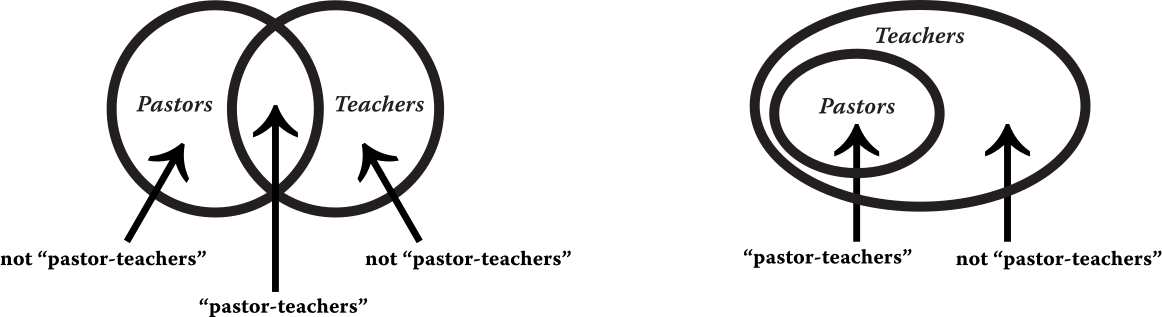
The hyphenated amalgam does not apply to three-fifths of Wallace’s, Merkle’s, and Campbell’s theological schemes.49Cf. Hoehner, Ephesians, who uses the theological short-hand “pastor-teachers” (112) while his exegesis of 4:11 undercuts this when he observes: “one article used for two plural nouns does not necessarily denote identity, as seen in 2:20 where there is one article for apostles and prophets”; rather “it does indicate that ‘groups more or less distinct are treated as one for the purpose in hand’” (543–44). And their theological schemes do not match what Paul means in Ephesians 4:11 on grammatical and historical grounds wherein the pastors and teachers are recognizably distinct groups.
But who is each group for Paul (§8)? And how does he envision them related (§9)?
8. Paul’s “Pastors” and Paul’s “Teachers”
This image better reflects Paul’s intended meaning in linking pastors with teachers by A-S-K-S:

This image captures the fuller picture of Eph. 4:11 of five recognizably distinct groups with the final two somewhat connected for a contextual reason:

But who are they and how are they connected?
This article’s main point is to interpret A-S-K-S data. Dogmatism beyond that would be foolish here. But to stimulate further research, here are some historical and cultural remarks.
8.1. “Pastors”/“Shepherds”
In ancient Sumerian, Akkadian, Egyptian, and Greek sources, pastor/shepherd metaphors are repeatedly associated with ruling, leading, and caring (or at least taking care of).50See the data compiled in Piotr Swiercz, “The Idea of Shepherd Rule in the Ancient Mediterranean Region: Searching for the Context of the Idea of Orpheus the Shepherd,” Colloquia Orphica IX Conference (2014). The OT is similar: e.g., King David (2 Sam 5:1–2), the judges before him (2 Sam 7:7), and other community leaders (cf. Jer 2:8; 3:15; 24:4; Zech 11:16–17). Have you noticed that teaching terms were rarely (if ever) connected.
Jesus arrived as the pastor (Matt 26:31; Mark 14:27), even “the good pastor” (John 10:11–18). While he certainly taught a lot (!), he cast his pastoral goodness in terms of (1) laying his life down for the sheep; (2) caring for them; (3) staying with them in danger; (4) protecting them by taking on the attackers, even at cost to himself; and (5) knowing them and they him (John 10:11–18).
Jesus commissioned Peter in pastoral language: “feed [βόσκε] my lambs” (John 21:15), “pastor [ποίμαινε] my sheep” (v.16), “feed [βόσκε] my sheep” (v.17). Some people too narrowly simply assume “feeding” is teaching (e.g., the NIV note from the introduction), though Peter later focuses on leadership (not teaching) aspects of pastoring under the Pastor:
So I exhort the elders (πρεσβυτέρους) among you … pastor (ποιμάνατε) the flock of God that is among you by over-seeing/super-vising (ἐπισκοποῦντες) … not as dominating/lording over (κατακυριεύοντες) those in your charge, but being examples to the flock. And when the chief Pastor appears, you will receive the unfading crown of glory. (1 Pet 5:1–4)
Paul (through Luke) expresses a similar leadership understanding of “the elders” (τοὺς πρεσβυτέρους) of Ephesus: “pay attention [προσέχετε] to yourselves and the whole flock [παντὶ τῷ ποιμνίῳ] among whom the Holy Spirit established you over-seers/super-visors [ἐπισκόπους] to pastor [ποιμαίνειν] God’s church” (Acts 20:28). These leaders may very well have been “the pastors” Paul mentions in Ephesians 4:11. In that passage, Paul gave them no commission to do any teaching. That said, given a type of protection Paul does clarify for the Ephesian elders—i.e., from people (wolves) speaking distorted things (20:29–31)—the teaching that was happening within the community of faith must certainly be under their careful “overseeing” or “supervising” attention (see below).
Interestingly, “over-seers” or “super-visors” (ἐπί-σκοποι) were well known in the Greco-Roman world among Gentiles and Jews. Within broader Greco-Roman society (and compare the Septuagint), ἐπίσκοποιsupervised/oversaw various groups and activities: e.g., military bodies (cf. LXX Num 31:14; 2 Kgs 11:15); building initiatives (cf. LXX Num 4:16; 2 Chr 34:11–12); voluntary associations, including cultic ones; legal and financial matters (cf. LXX 2 Chr 34:14–17); even cities, including Ephesus (cf. the ἐπίσκοποιover Judah in 1 Macc 1:51).51Korinna Zamfir “Once More About the Origins and Background of the New Testament Episkopos,” Sacra Scripta 10.2 (2012): 202–22. Cf. Ben Witherington III, Paul’s Letter to the Philippians: A Socio-Rhetorical Commentary (Grand Rapids: Eerdmans, 2011), 47–48; Merkle, Elder and Overseer, 59–61; Raymond Collins, I and II Timothy and Titus, NTL (Louisville: Westminster John Knox, 2002), 329.
Paul connects “overseers” with προΐστημι: stand out in front, lead, be in charge of, preside over, manage, govern, rule, direct, even care for.52Cf. William Mounce, Pastoral Epistles (Nashville: Nelson, 2000), 178; Andreas Köstenberger, 1–2 Timothy and Titus, EBTC (Bellingham, WA: Lexham, 2020), 130; Stanley Porter, The Pastoral Epistles: A Commentary on the Greek Text (Grand Rapids: Baker Academic, 2023), 280–81; Collins, I and II Timothy and Titus, 329–30. Within this realm of supervisory leadership, Paul inserts “fathers” (and “household-managers”).53The Septuagint used προΐστημιregarding households: cf. 2 Sam 13:17; Amos 6:10. The overseer/supervisor “must lead/manage/direct [προϊστάμενον] his own house, having children in submission … take care of [ἐπιμελήσεται] God’s church” (1 Tim 3:4–5; cf. Titus 1:5–7). Paul’s ecclesial pattern regarding overseers may even have been “directly dependent on the structure of the ancient family, in which the head of the household had oversight responsibilities.”54Porter, The Pastoral Epistles, 281.
This last detail—fathers—will help us explore how the recognizably distinct group of “pastors” were likely meant to be somehow connected with the other recognizably distinct group of “teachers” (§9). Before that, though, who might the “teachers” be?
8.2. “Teachers”
Most basically, it’s important to Paul’s mission that all saints “teach” each other so the word of Christ dwells richly among them (Col 3:16).55Cf. Jonathan Worthington, “‘You’ and ‘Y’all’ in the Culture of the New Testament,” 9Marks, 7 Oct 2024: https://www.9marks.org/article/you-and-yall-in-the-culture-of-the-new-testament/; “Mature Together: The Task of Teaching in Missions,” Desiring God, 22 March, 2022: https://www.desiringgod.org/articles/mature-together. Numerous unnamed people were “teaching” in Ephesus (Eph 4:14; 1 Tim 6:3): Paul condemns those who taught falsely, while teaching per se seems acceptable.56A Thyatiran woman (“Jezabel”) was condemned for false teaching and leading Christians astray (Rev 2:20), and her condemnation explicitly rests on her sexual immorality and falseness (2:20–21) without hinting that her teaching per se was inappropriate. Perhaps her teaching was not in public worship but more like Prisca’s more private tutoring, which made the act itself not worth commenting on even while condemning its falseness and associated sexual immorality. Many (including Paul) were “teaching and evangelizing” in Antioch (Acts 15:35).
Getting more personal, Paul delights that Timothy “learned” scripture from his grandmother and mother (2 Tim 3:14–15; cf. 1:5). Older Christian women in Crete were commendable for giving “good teaching” to younger women (Titus 2:3). . Paul’s dear co-worker Priscilla, with her husband Aquila, theologically educated Apollos in Ephesus (Acts 18:26); whether she was gifted by the Spirit like some in the church (1 Cor 14:6; Rom 12:6–8) or she simply took seriously her (and her husband’s) general Christian responsibility we do not know.
(NB: I assume Priscilla and Aquila agreed with Paul’s words in 1 Tim 2:11–12. Thus, I assume they would have carefully arranged how their biblical and theological training of Apollos—and other young leaders?—took place while maintaining gendered propriety.)
Timothy is meant to entrust what he learned from Paul “to faithful people, whoever will be suitable even to teach others” (2 Tim 2:2). This could refer to more formal “teachers,” though it’s likely more general, perhaps including many of those mentioned above.57In the Pastoral Epistles, Paul tends to use ἀνήρwhen referring specifically to men. Every use of ἄνθρωποςin 1 Timothy and Titus (except maybe 1 Tim 6:11) is most likely about humans in general (1 Tim 2:1, 4, 5; 4:10; 5:26; 6:5, 9, 16; Titus 1:14; 2:11; 3:2, 8, 10). In 2 Timothy, two of five clearly refer to generic humans (3:2, 13); one refers to two men as corrupt humans and not just corrupt males (3:8); and “God’s human” equipped by Scripture in 3:17 could refer to the effect of Scripture on any human belonging to God, though it could refer to Timothy in particular (like 1 Tim 6:11 might be). My conclusion: it is likely (though not airtight) that Paul’s language of “faithful people” instead of “faithful men” in 2 Tim 2:2 is more general, perhaps including people like Apollos, Priscilla, nameless people teaching, and the old women in Crete. See Porter, The Pastoral Epistles, 560; Osvaldo Padilla, The Pastoral Epistles (Downers Grove: IVP Academic, 2022), 174 n. 20; Walter Liefeld, The NIV Application Commentary: 1 and 2 Timothy (Grand Rapids: Zondervan, 1999), 246–47, 246 n. 2; contra George Knight III, The Pastoral Epistles (Grand Rapids: Eerdmans, 1992), 391; I. Howard Marshall, The Pastoral Epistles (London: T&T Clark, 1999), 176, 726; Mounce, Pastoral Epistles, 506–7. Paul also describes (not necessarily prescribes) how some of “the elders” in Ephesus (at least) also labored “in word and teaching” (1 Tim 5:17).58Some commentators mention it is “possible” (though not necessarily favorable) to translate μάλιστα(“especially”) as “that is,” which would imply the way to “lead well” is by laboring in word and teaching: e.g., Philip Towner, The Letters to Timothy and Titus (Grand Rapids: Eerdmans, 2006), 125; Mounce, Pastoral Epistles, 306; Marshall, Pastoral Epistles, 612. They base this on T. C. Skeat, “‘Especially the Parchments’: A Note on 2 Timothy IV.13,” JTS 30.1 (1979): 173–77. But Skeat launches his article with confessed inability to understand how Paul could want additional “books” to the parchments he “especially” wants. I find this natural to imagine. Skeat then explores data in the NT and second and third century Greco-Roman letters he believes make more sense with μάλισταas “that is” rather than its normal “especially.” In my reading, every instance Skeat posits makes better sense with “especially.” Paul mentions “teachers” as third in the church behind apostles and prophets (1 Cor 12:28–29). And Paul himself was one among the cluster of “prophets and teachers” in Antioch (Acts 13:1).
“Teachers” and many people “teaching” were ubiquitous in Paul’s circles. What is more, Paul’s many teachers and people teaching, on the one hand, alongside his cluster of supervisory leadership ideas associated with pastoring on the other, both make great sense within the household and educational culture of the Greco-Roman world.
9. The Relationship Between the Pastors and Teachers within the Greco-Roman System of Household and Education
Christopher Hutson observes that “a primary responsibility of a father” in the Greco-Roman era “was to attend to the education of his children.”59Christopher Hutson, First and Second Timothy and Titus (Grand Rapids: Baker Academic, 2019), 93; cf. Porter, The Pastoral Epistles, 281. “Attend to” is helpful language, though Hutson means teach, which actually gets away from Paul’s Greco-Roman context.
In his early first century CE exposition of the Pentateuch, Philo of Alexandria (c. 20 BCE–50 CE)60For orientation to Philo and his various types of commentaries, see Jonathan Worthington, “Philo (1): Use of the OT,” in Dictionary of the New Testament’s Use of the Old Testament, ed. G. K. Beale, D. A. Carson, B. Gladd, A. Naselli (Grand Rapids: Baker Academic, 2023), 603–11. explains:
Parents have received not only the power of a ruler [ἀρχὴν] and governor [ἡγεμονίαν] over their children, but also that of a master [δεσποτείαν] … for [the parents] expend a price many times greater than their real value on their children [εἴς τε παῖδας] and for the sake of their children [ὑπὲρ παίδων], in wages to nurses [τιτθαῖς], and pedagogues [παιδαγωγοῖς], and teachers [διδασκάλοις], besides all the expenses which they incur for their dress and their food, and their other care of them when well and when sick, from their earliest infancy till the time that they are full grown. (Special Laws 2.233)61See also Christian Laes, “Educators in the Late Ancient City of Rome (300–700 CE), Revue belge de Philologie et d’Histoire 94.1 (2016): 183–207. Although this study is about Late Ancient Rome, Laes’s and others’ work shows its relative stability and therefore applicability to pre-NT and NT times. Cf. Mark Joyal, “Education in Greek and Roman Antiquity,” in The Oxford Handbook of the History of Education , ed. John Rury and Eileen Tamura (Oxford: Oxford University Press, 2019), 82–97. (See subsequent notes.)
Philo distinguishes “fathers” from “guardians and teachers and pedagogues” (ἐπιτρόπων καὶ διδασκάλων καὶ παιδαγωγῶν) whom the parents give to children to train and educate them (Embassy to Gaius 26–27, 53, 115). Philo never insinuates that the fathers (or mothers) are thereby alleviated of their duties to raise their children well. Indeed, he posits that parents, nurses, pedagogues, and teachers all work together to raise and train the children,62Cf. Philo’s Mig. 116; Her. 295; Mut. 217; Virt. 178. though he does not thereby conflate the various parties into each other. He submits all educators (e.g., pedagogues and teachers) to the parents’ authority, rule, governance.
Paul himself discusses this system, with children being put under the παιδαγωγός, “child-leader,” custodian, guardian (Gal 3:24–25). The pedagogue was supplied by a father (or by a house-manager charged by the pater familias) who cared about and was thereby “attending to” the son’s education.63Regarding pedagogues, see Plutarch, Moralia 4A–B; Epictetus, Discourses 3.19.5–6; Xenophon, Constitution of the Lacedaemonians 3.1—the latter helpfully put in conversation with Gal 3:24 by Eugene Boring, Klaus Berger, and Carsten Colpe (eds), Hellenistic Commentary to the New Testament (Nashville: Abingdon, 1995), 466. So David de Silva, The Letter to the Galatians, NICNT (Grand Rapids, 2018), 327–30. Cf. Norman Young, “Paidagogos: The Social Setting of a Pauline Metaphor,” Novum Testamentum 29.2 (1987): 150–76; A.V. Yannicopoulos, “The Pedagogue in Antiquity,” British Journal of Educational Studies 32.2 (1985): 173–79; Stanley Bonner, Education in Ancient Rome: From the Elder Cato to the Younger Pliny (London: Routledge, 1977), 38–46. Pedagogues would generally care for the children’s moral development—as Philo points out, “foolish children hate their teachers and pedagogues [τοὺς διδασκάλους καὶ παιδαγωγοὺς], even everyone who reproves them or corrects them or would lead them to virtue” (On the Sacrifices of Cain and Abel 51)—as well as for their physical and sometimes linguistic development, even escorting the sons to school and over-seeing or super-vising them receiving instruction from their “teachers.”64Christian Laes, “Pedagogues in Greek Inscriptions in Hellenistic and Roman Antiquity,” Zeitschrift für Papyrologie und Epigraphik 171 (2009): 113–22; Michael Smith, “The Role of the Pedagogue in Galatians,” Bibliotheca Sacra 163 (2006): 197–214; Norman Young, “Paidagogos: The Social Setting of a Pauline Metaphor,” NovT 29 (1987): 150. Cf. Matthew Harmon, Galatians, EBTC (Bellingham: Lexham, 2021), 196–97; Ralph Martin and Julie Wu, “Galatians,” in Zondervan Illustrated Bible Backgrounds Commentary, ed. Clinton Arnold (Grand Rapids: Zondervan, 2002) 284; Richard Longenecker, “The Pedagogical Nature of the Law in Galatians 3:19–4:7,” JETS 25 (1982): 53, though Longenecker downplays the tutoring role too much: see Laes, “Educators,” 183–84.
Consider Paul’s charge for the overseer (as father) to be “didactic” in his Greco-Roman context: an overseer/father with the community continuously engages in selecting, vetting, and supplying (and removing and finding new) pedagogues and schools and teachers—though not himself doing the teaching. I have more fully argued elsewhere how Paul’s adjective διδακτικόςin 1 Timothy 3:2 has nothing to do with “ability” but is understood best in its ancient context like this: the overseer has a character oriented toward the teaching that is happening in the community even if doing none of it himself.65Worthington, “Overseers Must be Didactic, not ‘Able to Teach,’” 23–40. The “teachers,” and more generally those “teaching,” would thus do what they are called and gifted to do under the supervision, oversight, care, and watch of the “fathers” of God’s household—the elders who were overseers meant to pastor/shepherd God’s people.
One final point will help, for some readers will likely trip here. In messy reality—even governed as it is by God’s mysterious providence—there may occasionally happen to be some pastor here or there to whom God has also given a gift in teaching—like some of those in Ephesus. This is not the norm to strive toward, for in general Paul’s language shows that the pastors and teachers are recognizably distinct groups who are nevertheless meant to work closely together—like the pater familias would work closely with the pedagogues and teachers—to equip the saints to help each other mature in Christ as each of the saints also uses their distinctive gifts in concert (Eph 4:11–16).
10. Conclusions
In this article I have provided data, navigation, and a few practical ideas from Pauline circles within their Greco-Roman (including Jewish) context regarding how “the pastors and teachers” are mentioned in Ephesians 4:11. In conclusion, here are a few points about culture and character to stimulate your community’s practical thinking regarding ecclesiology in general, your church or denomination in particular, your ordination practices, seminary training, etc.
10.1. Culture
Guard against pushing an individual person to be both a pastor and a teacher. That will most likely place on his shoulders a moral (supposed scriptural) weight to be and do two roles that God has made recognizably distinct. We (especially Americans) may convert (or continue converting) God’s “body” economy into something too individualistic, pushing one of God’s “hands” to be a “hand-foot” that he was not designed to be. This will simultaneously deprive the church of those whom God has actually designed to be “feet” and to work closely with the “hands” for the upbuilding of the body.
But take care. Blending “pastor” and “teacher” in your context might not be as simple as ecclesiology out of step with Ephesians 4:11 (and other passages). Zulu, Ndebele, and Shona peoples tend to call the pastor “teacher” as well, but this is because missionary pastors tended to bring education and be the schoolteachers—not because of a misreading of Ephesians 4:11.66Rabson Hove, “The Pastor as the Primary Teacher in the Church: The Meaning and Expectations of Pastoral Ministry Within the Mainline Denominations,” Pharos Journal of Theology 104.5 (2023): 1–15.
10.2. Character
Know yourself with humility and others with openness. Suppose you are a gifted pastor (shepherd), and suppose that is identified with “overseer” and “elder” in your ecclesial tradition. This means that like a father you are gifted at caring for and leading, overseeing, and directing God’s household family (1 Tim 3:4–5; cf. Titus 1:5–7). Know with humility that God did not design you to do everything, and most likely not even to be a teacher. Therefore, look diligently with openness for gifted teachers in your community or communities of faith to join you and supplement your caring and leading with their teaching strengths.
Alternatively, suppose you are aware (and confirmed by others) that God has made you a teacher beyond what is necessary for all Christians, perhaps even a gifted one. Diligently look for gifted pastors to partner with you, even to oversee and lead and direct and care for you, and to compensate for your weaknesses with their strengths. Neither of you are meant to do it all or to do it alone.
King Jesus intentionally gave to the church the pastors and teachers as recognizably distinct groups meant to work closely together. God does not tend to create hand-feet. He tends to connect (in an A-S-K-S fashion) the hands and feet to serve closely together for the sake of equipping the saints to help each other mature in Christ as each of them uses their own distinct gifts in concert together.
Jonathan D. Worthington
Jonathan Worthington (PhD, Durham University) is vice president of theological education at Training Leaders International. He is the author of Creation in Paul and Philo and numerous articles on creation in Paul and early Judaism, cross-cultural theological education, and motivation theory.
Other Articles in this Issue
This essay develops a distinctly Christian theology of free speech in response to mounting threats of censorship across Western societies...
In every generation and in every place, there is a need to identify, equip, and encourage new leaders for Christ’s church...
Missio Trinitatis: Theological Reflections on the Origin, Plan, and Purpose of God’s Mission
by Brian A. DeVriesTrinitarian theology provides the basis for understanding missio Dei...
This essay argues that monogamous sexually-differentiated marriage (MSDM) is uniquely revealed through Christ’s relationship with the church in Ephesians 5:30–32...
Other Reviews in this Issue

Genesis
Reviewed by Dustin Burlet