
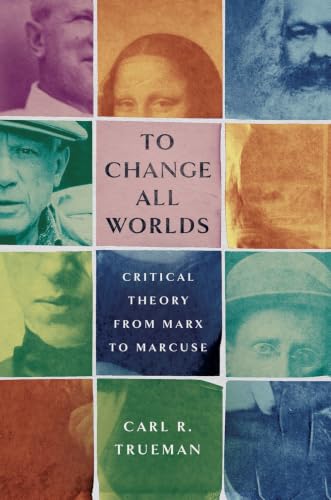
To Change All Worlds: Critical Theory from Marx to Marcuse
Written by Carl Trueman Reviewed By Stephen ChavuraMany Christian intellectuals today are more than happy to speak of the continuing influence of the Christian religion in our so-called “secular age.” And yet some of the same leaders can become very skittish about the suggestion that Marxism could be a powerfully operating ideology as well. Cultural Christianity in our “secular” age? Of course! But Cultural Marxism in a capitalist liberal democracy? Don’t be a reactionary culture warrior! Fortunately, a number of scholars are now pointing out Marxism’s abiding influence, especially in the form of “Great Awokening.” (See, for example, Neil Shenvi and Pat Sawyer, Critical Dilemma: The Rise of Critical Theories and Social Justice Ideology—Implications for the Church and Society [Eugene, OR: Harvest House, 2023].) Indeed, Marxism’s genius, like Christianity’s, is its ability to adapt to changing times.
In light of all this, Carl Trueman’s latest book offers an important contribution to our understanding of where this Great Awokening has come from, historically and intellectually. To Change All Worlds is Trueman’s account of an intellectual movement—the Frankfurt School—that evolved into critical theory, postmodernism, and so much that is today labeled “woke.” Most of the early Frankfurt School theorists were middle-class Jews trying to come to grips with the failure of the working class to overthrow capitalism, as well as the rise of anti-Semitism and fascism, both of which proved more appealing than Marxism to the working classes, particularly in Germany.
The focus of Trueman’s study is critical theory, a form of social analysis that seeks to prove that society is merely a theatre of oppression in order to inspire a movement to overthrow society in its current form. As Trueman writes, “Critical theory does not seek to critique the contemporary system with a view to improving it. It seeks to critique the contemporary system with a view to overthrowing it entirely” (p. 100). (Recall that the motto of Black Lives Matter is not “Reform the police” but “Defund the police.”) In all, Trueman does a masterful job of showing how classical Marxism, married with Freudianism and some early-twentieth-century sociology, morphed into the critical theory that would help spawn the Sexual Revolution and the modern critical race theory that inspires Black Lives Matter.
I will now highlight three of the theorists Trueman discusses. First, while never himself a member of the Frankfurt School, the Hungarian Marxist philosopher, Georg Lukacs, profoundly influenced its development and made several contributions to what would become critical theory. Trueman offers a clear and illuminating discussion of his thought, showing how it leads to conclusions at work in the radical left today. For example, Trueman calls Lukacs’s concept of “reification” (literally “thing-ification”) “arguably one of the most important [concepts] for critical theory, perhaps even its central concern” (p. 74). According to Lukacs’s idea of reification, people have a propensity to describe complex social relations and behaviors—our economic relations and transactions, for example—as though they are things or realities that exist apart from and independently of humans, and which we enter and participate in, and whose laws we are subject to. The economy, for example, is nothing but an umbrella term for how humans behave towards one another as far as buying, selling, trading, and lending goes. And yet we talk about the laws of the economy as though they are a reality apart from and beyond human behavior. For Lukacs, however, the economy is not some thing or entity existing independently of our actions; rather, it is our actions, it is our social relations.
Understanding that the economy is nothing other than a reification of our behavior is the first step to changing our behavior and liberating ourselves from a particular mode of it—capitalistic behavior. It is not hard to see how this idea of Lukacs might evolve and, during the Sexual Revolution, be applied not so much to economic relations but to sexual relations between men and women. Enter Simone de Beauvoir and second-wave feminism and, later, Judith Butler and queer theory, and being a woman or a man is merely a performance that can just as easily be put off as it is put on.
Second, Max Horkheimer was “the most distinguished and influential director” of the Institute for Social Research, the home of the Frankfurt School (pp. 80–81). As well as continuing the analysis of reification, Horkheimer developed Marx’s teachings on alienation and false consciousness. Alienation is the malady that plagues people in capitalist societies. They feel alienated from their work because it is exploitative and meaningless, they feel alienated from fellow workers with whom they are often in competition, they certainly feel alienated from their employers, and one might add that they feel alienated from their families because of the nature of modern work.
So why do the workers not rise up and overthrow the system? Simply because they either do not know they are being exploited or, if they do, they do not know exactly how and why. Perhaps they have bought into reifications like “work” or “national economy,” reifications that make them think these are natural orders within which they must live and whose laws are binding and necessary. Perhaps they are enthralled by nationalism or religion or popular entertainment, and these things convince them that their exploitation is either justified or bearable. Whatever the reason, these are forms of “false consciousness,” and the job of the critical theorist is to shake the workers out of it and rouse them to revolution. Horkheimer also gave serious consideration to the problems created by technology, which has always been seen as something of a savior for humans, liberating us from drudgery. But, at least in the modern world, it has become a new overlord, enslaving us to itself. Trueman offers modern examples of the problem Horkheimer identifies. For example, do we spend less time on daily correspondence since the introduction of email, or more time?
Third, Herbert Marcuse, the most famous of the first generation of critical theorists, spent a good deal of his life teaching in California. Marcuse accepted the notions of reification, alienation, and false consciousness but, drawing on the work of Wilhelm Reich, added a Freudian twist and argued that capitalism does not merely oppress us economically but also represses us sexually. For Marcuse and Reich, then, an economic revolution would also lead to a sexual revolution. But at the same time, both theorists were happy to see a sexual revolution unfolding without the economic revolution. In other words, our received notions of what it is to be a man or a woman, what proper sexual expression is, and how men and women should relate to the social sphere in general, were all forms of false consciousness—exploitative reifications whose function was to maintain an exploitative economic order. Thus, to be liberated meant to cast off traditional sexual morality and embrace a kind of sexual anarchy. Or to be pithy, all consensual sex is fine. Michel Foucault would develop this idea to a greater degree and become the most influential intellectual behind the formation of queer theory, the offshoot of critical theory that seeks to “disrupt” and “destabilize” all sexual “givens.” In other words, the modern LGBTQ movement is largely a continuation of the critical theory of the likes of Reich and Marcuse.
Marcuse was also a passionate critic of freedom of speech, which he thought had as much potential to be oppressive as it did to be liberating. In his famous 1965 essay “Repressive Tolerance,” Marcuse argued that freedom of speech and association, indeed, freedom in general, should not be extended to conservative social movements, for this would be like feeding the snake that would eventually devour its owner. As Trueman points out, Marcuse had the rise of Nazism in mind and Hitler’s open promise that he would use democracy to smash democracy—which he did. But as Trueman points out, this aspect of Marcuse’s thought is still very influential on university campuses:
Hence, the pressure that freedom of speech is under on college campuses and in wider Western society makes sense: once one assumes that culture is [oppressive] ideology, false consciousness or, to use contemporary language, a discourse of power designed to empower some at the cost of excluding others, then the terms by which it asserts its virtues become the tools by which it actually exercises its vices. (p. 106)
In other words, free speech, like private property rights according to Marxism, is truly just a covert way to oppress racial and sexual minorities and, like property rights, needs to be either abolished or greatly revised for the sake of liberation, hence the cancel culture and deplatforming that now takes place in many universities.
As per Trueman’s style, he tries to be charitable where he can and is at pains to make the reader understand why critical theory arose in the first place and what genuine social maladies it was often responding to—e.g., Nazism, fascism, war, and an ethic of consumption. He also points out that umbrella terms or reifications are absolutely necessary for coming to grips with and talking about the world. The key is not to avoid them but first to see people as God’s image bearers and then to analyze society through a biblical lens.
There are many more riches to be gleaned from Trueman’s book, but the best way to find them is to buy it and read it. What Trueman offers is a clear outline and valuable Christian appraisal of critical theory. But ultimately, he is not optimistic about searching out the critical theorists for insights. His concern, which I share, is that not all meats are worth chewing on, even if one intends only “to eat the meat and leave the bones” (p. 109). Not that Trueman says no one should ever read the critical theorists, but he suggests that probably more harm than good will come from a general encouragement to do so. Given the pernicious impact that much critical theory is having on evangelical churches, I have no doubt he is being wise here. (On this point, see also Voddie T. Baucham, Fault Lines: The Social Justice Movement and Evangelicalism’s Looming Catastrophe [Washington, DC: Salem Books, 2021].) In short, some meats are so full of bones they are better avoided. For most of us, Trueman’s summary and evaluation will be more than sufficient.
Stephen Chavura
Campion College
Toongabbie, New South Wales, Australia
Other Articles in this Issue
Against a wider cultural narrative that now pathologizes even biologically determined differences between men and women, evangelicals respond with a theological anthropology grounded in the biblical texts...
Christ Existing as Church-Community: Bonhoeffer’s Ecclesiology and Religionless Christianity
by Ryan CurrieBonhoeffer’s theology is well known for generating many contradictory interpretations...
Slavery, Submission, and Separate Spheres: Robert Dabney and Charles Hodge on the Submission of Wives and Enslaved People
by Isaac TuttleRobert Dabney and Charles Hodge were two of the most influential Presbyterian theologians of nineteenth-century America...
Interpreters need a systematic taxonomy for interpreting Colossians 1:24, a pivotal yet challenging passage in Colossians...
In Galatians 2:15–21 the apostle Paul addresses the core issue of the epistle and sets forth his central thesis concerning the “truth of the gospel...
Other Reviews in this Issue