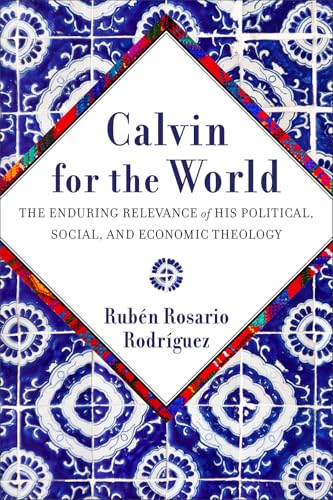

Calvin for the World: The Enduring Relevance of His Political, Social, and Economic Theology
Written by Rubén Rosario Rodríguez Reviewed By Kenneth J. StewartRubén Rosario Rodríguez is the Clarence Louis and Helen Steber Professor of Theological Studies in Missouri’s Jesuit-founded St. Louis University. He is concerned with showing that the social teaching of John Calvin, embedded in his theological writings, remains an important resource for Christians wrestling with societal questions of wealth and poverty, racial justice, toleration, and the right use of political authority. He is not the first writer to take up such questions; one thinks, for instance, of historian Fred Graham’s The Constructive Revolutionary: John Calvin and His Socio-Economic Impact (Richmond, VA: John Knox, 1979). But Rosario Rodríguez is the first writer known to this reviewer to take up such questions as a Latin American, now a naturalized American citizen, openly identifying with both the Reformed theological tradition and Liberation Theology (p. 114).
The author’s stance is that of a mainline Protestant and an admirer of the Barthian theological tradition. He is a theologian who, while affirming that God has revealed himself in history and left us a written “Word of God,” at the same time concludes that this record of revelation in writing has been subject to distortion because it has been mediated by human means (p. 110). This somewhat equivocal stance means that Rosario Rodríguez will concern himself with the dissemination of ideas passed down to us from the era of Reformation rather than the judging of whether such views are faithful to the scriptural revelation. His position may be described as that of general loyalty to the Reformed tradition, broadly conceived, yet his position is averse to confessionalism.
In prefacing the book, Rosario Rodríguez acknowledges (pp. xi, xii) that a fair share of its contents has appeared in other formats extending as far back as the year 2001. As one would expect, he has made attempts to revise and update where possible. But the reader needs to note that the chapters which bring John Calvin into dialogue with such questions as the role of civil government (ch. 1), of Latin American Liberation Theology (ch. 2), the modern Refugee Crisis (ch. 3), Post-Vatican II Roman Catholicism (ch. 4), Religious Toleration (ch. 5) and the slow painful overthrow of South African Apartheid (ch. 7) do not necessarily represent fresh scholarship. In at least one case (a description of the failed Genevan mission to Brazil, part of the wider discussion of refugees [ch. 3]), his account is based on outdated research. Superior accounts of this important missionary effort are available. Still, overall, these chapters represent competent and stimulating introductions to their subject fields.
Scattered across these chapters are fascinating tidbits that will take the reader off-guard. Who was aware that Massachusetts Puritan Cotton Mather had a missionary concern for then-Spanish America? Mather taught himself Spanish and penned a catechism for illicit distribution in 1699 (p. 134). One of the earliest advocates of the theology of Karl Barth in Latin America was the president of Princeton Seminary, John A. Mackay, in lectures given in 1953 (p. 129). Mackay, fluent in Spanish, had earlier been a missionary to Peru. Calvin’s Institutes were a primary resource in the campaign to overthrow apartheid in late twentieth-century South Africa (ch. 7).
The chapters also contain some interpretations that are questionable. In discussing Calvin’s conception of the church of the Reformation era as transnational (transcending the efforts of any local or regional government to control it), Rosario Rodríguez describes Calvin’s debt to Martin Bucer, the Reformer of Strasburg. Bucer’s important description of a Christian society, De Regno Christi, is dated to 1533 (p. 83). This treatise was presented by Bucer to England’s King Edward VI in 1550. American missionary effort towards Latin America (which he portrays as broadly Calvinist) is portrayed as driven largely by commercial expansionist tendencies most recognizable in the late nineteenth century (p. 126). Under-recognized is the role played earlier by European Protestant immigrants to the newly-independent Latin American republics; the religious liberty granted as an enticement for them to immigrate also permitted the Bible Societies of London and New York to freely disseminate the Scriptures from the 1820s onwards. He seems largely unaware that Protestants generally focused greater missionary efforts in the late nineteenth century on India and China than on Latin America, which was at least under the influence of Roman Christianity.
For all that, this reviewer considers that Calvin for the World serves as a necessary reminder that the fresh appropriation of Calvin in the modern world is by no means the exclusive preoccupation of conservative evangelical Calvinists; it is also far from being the exclusive domain of those who live in Europe-derived societies. Why do conservative evangelicals persist in erroneously thinking that they hold something like proprietary rights to Calvin? And why does this same constituency primarily turn to Calvin on questions of soteriology and ecclesiology but not on matters such as the power of the state or human rights?
Calvin for the World invites comparison with segments of the recent Oxford Handbook to Calvin and Calvinism (Oxford: Oxford University Press, 2021). The latter volume, in addition to highlighting the modern reach of Calvin’s teaching into Latin America and South Africa (regions explored by Rosario Rodríguez), probes Calvin’s influence in modern China, West Africa, and Korea. Thus, it is fair to say that Calvin for the World, rather than being a trailblazing volume, is part of a much larger recent effort to explore the global dissemination of Calvin’s influence across more than four centuries.
Kenneth J. Stewart
Ken Stewart is emeritus professor of theological studies at Covenant College in Lookout Mountain, Georgia.
Other Articles in this Issue
Against a wider cultural narrative that now pathologizes even biologically determined differences between men and women, evangelicals respond with a theological anthropology grounded in the biblical texts...
Christ Existing as Church-Community: Bonhoeffer’s Ecclesiology and Religionless Christianity
by Ryan CurrieBonhoeffer’s theology is well known for generating many contradictory interpretations...
Slavery, Submission, and Separate Spheres: Robert Dabney and Charles Hodge on the Submission of Wives and Enslaved People
by Isaac TuttleRobert Dabney and Charles Hodge were two of the most influential Presbyterian theologians of nineteenth-century America...
Interpreters need a systematic taxonomy for interpreting Colossians 1:24, a pivotal yet challenging passage in Colossians...
In Galatians 2:15–21 the apostle Paul addresses the core issue of the epistle and sets forth his central thesis concerning the “truth of the gospel...
Other Reviews in this Issue