
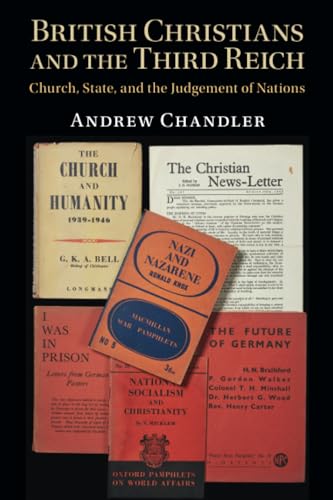
British Christians and the Third Reich: Church, State, and the Judgement of Nations
Written by Andrew Chandler Reviewed By Matthew HoustonHow might today’s church leaders engage with the heightening international tensions and outbreaks of armed conflict precipitated by competing ideological systems? Those who wish to think well about such challenges might consider how their ancestors in the faith responded to clashes between nations under conflicting ideological regimes.
In British Christians and the Third Reich, Andrew Chandler argues that historians should study British Christian thinking about the Third Reich because, by having been subject to a wealth of scholarly endeavour, it allows us to evaluate trends in the practice of historiography, building upon them to reach clearer, more precise, and more complex interpretations of the past (p. 2). It therefore forces us to reconsider earlier understandings of twentieth-century Britain as a secularising state where religious belief and practice were increasingly relegated to the margins (p. 6). It also challenges previous assumptions that twentieth-century Britain was largely detached from Europe, showing how British churches pursued international ecumenical ties and advocated internationalism as a means of peacekeeping (pp. 6–7).
Chandler develops the argument chronologically, dividing the years between 1933 and 1945 into five periods to chart how British Christian attitudes toward the Third Reich changed and intersected (pp. 8–9). The opening two chapters lay the groundwork for this approach, outlining the religious cultures from which British Christians engaged with the rise of the Third Reich. By evaluating a 1922 reflection on British Christianity by German professor Wilhelm Dibelius, Chandler establishes ‘the reality of religious pluralism’ throughout British society (p. 19) before showing that ecumenism and internationalism were interlinked in British public life with religious values at its centre (pp. 22–23).
Chapters 3–5 cover 1933–1934, demonstrating that, following the rise of Nazism, British church leaders developed definitive opinions on the regime and its ideology before considering how to respond. Informed of Nazi ideologies and practices through ecumenical networks, British Christians saw Nazism as evidence of a global crisis. They therefore started to protest the early displays of Nazi antisemitism (pp. 53–57). Chapter 4 shows that British Christians saw the tightening bonds between German churches and the Nazi state as an international problem requiring an international solution (p. 104). Becoming aware of concentration camps and secret police in Germany, British Christians engaged in international ecumenical dialogue to explore ecclesiastical responses (pp. 130–31).
Chandler then argues that, between 1935 and 1937, British Christians who opposed Nazism had to contend with those who, assuming the new regime would endure, increasingly sympathised with it. As chapters 6–8 indicate, many British Christians continued to protest the dangers of totalitarianism, particularly in light of Nazi antisemitism. They deemed Christianity and totalitarianism entirely incompatible (pp. 154–55). By 1936, ‘there were many voices expressing a view on Hitler’s Germany’ (p. 169). Evidence of Nazi crackdowns on German Christians, epitomised in the arrest of Martin Niemöller in July 1937, provoked further ecumenical dialogue on the nature of totalitarianism in Nazi Germany (pp. 195–96).
Such dialogue gained urgency from 1938 to 1939 when successive instances of Nazi expansionism raised the spectre of war. British Christians, although critical of Nazism, supported Appeasement and encouraged prayers for its success (p. 233). Despite jubilantly interpreting the Munich Agreement as an answer to those prayers, the Kristallnacht attacks on Jews in November 1938 crystallised clerical fears that war was inevitable (pp. 246–48). This set the tone for a ‘bleak fatalism which overtook the last days of peace’ (p. 269).
In chapters 11–12, Chandler charts the changing attitudes of British Christians toward Nazi Germany during the first three years of the war. Whereas at the outbreak of war most Christians criticised the Nazi regime, not the German people, with the fall of France in mid-1940, they employed more stringent anti-German rhetoric (pp. 277–88). By late 1942, thanks to military victories and the potentially problematic alliance with the Soviet Union, British Christians adopted a cautious optimism about the prospects of victory (p. 325). Chandler also outlines how British Christians engaged more intensely in ecumenical work, including with Catholics, to protest Nazi persecution of Jews (p. 300).
The final section, comprising chapters 13–15, highlights that Christian leaders, often in ecumenical dialogue, debated possible responses to challenges likely to be presented after the increasingly probable Allied victory. Christians, still committed to ecumenism, mirrored political leaders in developing the basis of any future peace and international order (pp. 349–50). Victory in 1945 vindicated Christian interpretations of the Third Reich, but for churchmen aware of events in Europe, it marked the next stage of an ongoing ‘humanitarian crisis’ necessitating European reconstruction and care for refugees (p. 371). Wartime Christian dialogue about the treatment of those deemed guilty of war crimes emphasised the need for a fair process and warned against vengefulness (p. 379).
Although purporting to encompass British Christian responses to the Third Reich, Chandler self-consciously focuses on the private and public records of significant figures within the Church of England since such clerics exerted significant influence on the leaders of other, smaller denominations in Britain (p. 5). This Anglo-centric approach, while justifiable, can be problematic insofar as it downplays regional distinctives, especially those of Scotland and Northern Ireland, where church leaders at a distance from the Church of England went to great lengths to formulate their own denominational attitudes towards the Third Reich.
Though this study focuses on British Christian responses to Nazi Germany, it could also inform how contemporary church leaders might engage with ostensible competitor states and ideologies. The efforts of such Christians to respond wisely to totalitarianism through public protest, ecumenical engagement, and commitment to internationalism are instructive for us today. However, if the church is to continue to be the church amid international tensions, the appropriation of such measures must not transcend or compromise the witness to the gospel.
Matthew Houston
Union Theological College
Belfast, Northern Ireland, UK
Other Articles in this Issue
Against a wider cultural narrative that now pathologizes even biologically determined differences between men and women, evangelicals respond with a theological anthropology grounded in the biblical texts...
Christ Existing as Church-Community: Bonhoeffer’s Ecclesiology and Religionless Christianity
by Ryan CurrieBonhoeffer’s theology is well known for generating many contradictory interpretations...
Slavery, Submission, and Separate Spheres: Robert Dabney and Charles Hodge on the Submission of Wives and Enslaved People
by Isaac TuttleRobert Dabney and Charles Hodge were two of the most influential Presbyterian theologians of nineteenth-century America...
Interpreters need a systematic taxonomy for interpreting Colossians 1:24, a pivotal yet challenging passage in Colossians...
In Galatians 2:15–21 the apostle Paul addresses the core issue of the epistle and sets forth his central thesis concerning the “truth of the gospel...
Other Reviews in this Issue