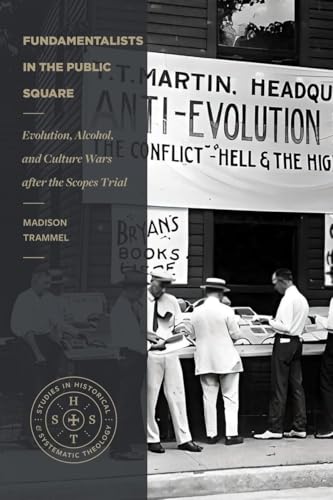

Fundamentalists in the Public Square: Evolution, Alcohol, and Culture Wars after the Scopes Trial
Written by Madison Trammel Reviewed By Nathan A. FinnThere is a common narrative among evangelicals that goes like this: fundamentalists withdrew from culture following the Scopes Trial in 1925 so they could lick their wounds and focus on investing in their churches and institutions. It was not until the postwar era, when Carl F. H. Henry published The Uneasy Conscience of Modern Fundamentalism (1947; reprint ed., Wheaton, IL: Crossway, 2022), that born-again Protestants rediscovered cultural engagement. Henry and his colleagues were “neo-evangelicals” who were distancing themselves from self-identified fundamentalists because the latter were content to separate from the culture and focus their activism on evangelism.
This narrative has been an important part of evangelical self-conception since Henry wrote his manifesto. Many historians—especially those with evangelical sympathies—have advanced this interpretation, though perhaps with a bit more nuance. I will confess that I have been shaped by this interpretation, and it has informed both my teaching and my scholarship. Madison Trammel is among the growing number of historians who call this narrative into question. He believes the dominant historiography relies too much upon Henry’s original diagnosis and the influential works of George Marsden and Joel Carpenter. He argues that fundamentalists did not go into hiding after Scopes, and nobody at the time thought they had.
In Fundamentalists in the Public Square: Evolution, Alcohol, and Culture Wars after the Scopes Trial, a revision of Trammel’s dissertation, the author demonstrates that in at least two cases fundamentalists remained committed to faith-motivated cultural engagement in the years following Scopes. Notably, fundamentalists continued to agitate against the normalization of Darwinism in public schools and the wider culture. Fundamentalists also organized to oppose the repeal of the Eighteenth Amendment, which prohibited the manufacture, sale, and transportation of hard liquor.
To make his case, Trammel examines newspapers from the four most populous states at the time: New York, Pennsylvania, Illinois, and Ohio. He also focuses on the years 1920 to 1933, identifying trends on either side of Scopes. The takeaway is that there was far more continuity than discontinuity. Major papers did not treat Scopes as a humiliating defeat for fundamentalists, though H. L. Mencken did his best to lampoon them during this period. There was no significant difference between how fundamentalists engaged with evolution or alcohol during the period under consideration. There was no fundamentalist retreat.
In addition to his research into newspapers, Trammel also dedicates a lengthy chapter to dispensationalist theology and its implications for social action. Following historians such as Ernest Sandeen and Matthew Avery Sutton, Trammel acknowledges that premillennialism was central to interwar fundamentalism, and dispensationalism had an outsized influence among premillennialists. Dispensational views of human nature, sin, personal redemption, ecclesiology, and eschatology contributed to a limited vision for social action. Rather than developing a robust theology of cultural engagement, fundamentalists “argued that the teaching of evolution and the legal sale of alcohol frayed the country’s moral fiber, leading to negative consequences for the nation and its citizens” (p. 123).
Trammel never suggests that fundamentalists did not eventually begin withdrawing from cultural engagement. He suspects many did, though that is beyond the scope of the present study. Trammel attributes any shift in posture, however, primarily to the deaths of highly engaged fundamentalist public figures such as William Jennings Bryan and John Roach Stratton, not the Scopes Trial. Another factor is the legacy of Inherit the Wind, which has shaped our cultural memory of Scopes.
Trammel also does not argue that Henry’s famous critique was entirely wrong. Rather, it was too simplistic, though likely for strategic reasons. Henry wanted born-again Protestants to be engaged on a wider range of issues than most fundamentalists would countenance. This led him to frame The Uneasy Conscience of Modern Fundamentalism as a call to abandon the retreat and return to the field of battle. Henry was critiquing the sort of limited theology of culture that could arise from dispensationalist assumptions.
Fundamentalists in the Public Square is not a comprehensive study of fundamentalist cultural engagement, but it never claims to be. Trammel’s goals are modest yet focused: to demonstrate that on two of the most controversial issues in America, during the years directly before and after the Scopes Trial, fundamentalists remained steadfastly committed to faith-motivated social activism. He accomplishes his goals admirably.
This is the sort of study that ought to inspire a raft of further research. What did fundamentalist cultural engagement look like between 1933 and 1947? Were there other issues besides alcohol and evolution that attracted fundamentalist attention? How did one’s region affect his engagement? Were there denominational variations that impacted fundamentalist social ethics? These are questions for other historians to take up, encouraged by the stones that Trammel so skillfully overturns in the present study.
Nathan A. Finn
Nathan A. Finn is Professor of Faith and Culture at North Greenville University in Greenville, South Carolina.
Other Articles in this Issue
Against a wider cultural narrative that now pathologizes even biologically determined differences between men and women, evangelicals respond with a theological anthropology grounded in the biblical texts...
Christ Existing as Church-Community: Bonhoeffer’s Ecclesiology and Religionless Christianity
by Ryan CurrieBonhoeffer’s theology is well known for generating many contradictory interpretations...
Slavery, Submission, and Separate Spheres: Robert Dabney and Charles Hodge on the Submission of Wives and Enslaved People
by Isaac TuttleRobert Dabney and Charles Hodge were two of the most influential Presbyterian theologians of nineteenth-century America...
Interpreters need a systematic taxonomy for interpreting Colossians 1:24, a pivotal yet challenging passage in Colossians...
In Galatians 2:15–21 the apostle Paul addresses the core issue of the epistle and sets forth his central thesis concerning the “truth of the gospel...
Other Reviews in this Issue