
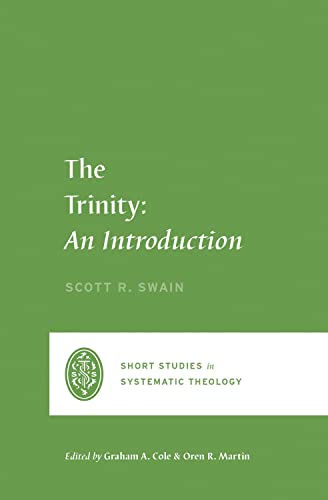
One notable contribution arising from the recent interest in Trinitarian theology is Scott R. Swain’s The Trinity: An Introduction. Swain, who serves as president and professor of theology at Reformed Theological Seminary in Orlando, Florida, acknowledges that the controversy surrounding the proposal of the eternal functional subordination of the Son partly inspired this work. He is careful, however, to emphasize that the book is not merely a reactionary response to those debates.
Swain’s introduction commences with an emphasis on the praise and adoration of the triune God, framing the discussion in a doxological context. By beginning with Christian prayer and worship directed toward the Trinity, Swain seeks to orient the reader toward a posture of humility, preparing them to engage with the doctrine while grounding their thoughts and actions in the triune name of God. The core of the book centers on articulating a proper understanding of the foundational “grammar” of Trinitarian discourse. This “grammar” is rooted in sacred Scripture, which Swain identifies as the supreme normative source for theological reflection.
Rather than embarking on an abstract or historical exploration of Trinitarian dogma, Swain opts to focus this concise volume on the scriptural patterns of divine naming. This approach reflects the book’s limited scope but remains consistent with its aim of presenting an accessible and scripturally grounded introduction to the doctrine of the Trinity.
The opening chapter of The Trinity examines the foundational grammar of God’s triune name, beginning with the sacrament of baptism. Swain highlights the baptismal formula in Matthew 28:19, where believers are baptized “in the name of the Father, the Son, and the Holy Spirit.” Through a close analysis of this Trinitarian formula, Swain offers a theologically rich discourse that affirms the existence of one God while simultaneously identifying the Father, the Son, and the Holy Spirit as fully and equally divine. While the three persons share the same divine essence, their personal names serve to distinguish them from one another: “The three are truly identical with the one God, and they are truly distinct from each other” (p. 32). These distinctions are rooted in their relations of origin: the Father eternally begets the Son, and the Father and the Son eternally breathe forth the Spirit.
Chapter 2 extends this biblical examination of the grammar of God’s triune name and provides a succinct summary of Trinitarian teaching. Swain identifies three categories of biblical texts that contribute to the doctrine of the Trinity: (1) inner-Trinitarian conversation, which captures the dialogue among the persons of the Trinity; (2) cosmic framework texts, which address the Trinity’s relation to the cosmos, particularly in creation; and (3) redemptive mission texts, which explore the sending of the Son and Spirit in acts of redemption. The chapter concludes with a summary sketch of the biblical teaching on the Trinity, synthesizing these scriptural patterns to present a coherent account of the triune God.
Chapter 3 addresses the doctrine of divine simplicity, a concept historically affirmed by the majority of theologians prior to the 19th century yet often unfamiliar to the average believer. While some argue that the doctrine lacks explicit biblical support, Swain identifies divine simplicity with the oneness of God, asserting its necessity for an orthodox confession of the Trinity. He employs 1 John 1:5 as a proof text, presenting it as a foundational summary of the Christian understanding of divine simplicity. Much of the chapter relies on apophatic theology (negative theology), which describes God by negation, emphasizing what God is not. Although the complexity of divine simplicity makes the chapter challenging to follow—a difficulty that is perhaps inevitable—the doctrine serves as a crucial affirmation of the oneness of God. Swain uses simplicity to uphold both the identity of the three persons of the Trinity with the one God and the real distinctions among the persons of the Trinity.
The subsequent three chapters focus on the three persons of the Trinity, dedicating one chapter to each. These chapters explore the language, fundamental grammar, and naming conventions of the Father, the Son, and the Holy Spirit, alongside an examination of the nature of divine persons and the doctrinal controversies that have arisen in Trinitarian theology. Chapter 5 specifically addresses three historical controversies regarding the identity of the Son: modalism, subordinationism, and eternal functional subordination. The final two chapters of Swain’s work explore the activity of the triune God and its implications for ministry and the Christian life, offering a practical application of Trinitarian theology. Similar to the structure of a Pauline epistle, which begins with doctrinal exposition and concludes with practical instruction, these chapters transition from orthodoxy to orthopraxy. Chapter 7 examines the triune nature of God’s work, emphasizing the distinct yet unified roles of the divine persons in conducting the work of the Trinity. Chapter 8 reflects on the ultimate purpose of God’s triune work, identifying God himself as its supreme end, while highlighting that his children are its primary beneficiaries. The sacraments and the preaching of the Word are the means by which believers participate in the covenant community’s blessings. Specifically, the sacraments of the Lord’s Supper and baptism “signify and seal” the promises revealed in Scripture, serving as tangible expressions of the triune God’s grace.
Swain’s book serves as a concise introduction to the doctrine of the Trinity, reflecting its inclusion in the Short Studies in Systematic Theology series. Comprising only 119 pages, the work can be read in a single afternoon. Its greatest strength lies in its clarity and focus, offering a biblically grounded exploration of the Trinity through the scriptural patterns of divine naming. By providing a succinct yet faithful survey of one of the church’s most foundational doctrines, Swain offers a valuable resource for those seeking a deeper understanding of Trinitarian theology.
The book’s primary weakness is also its inherent limitation. In crafting a concise introduction, the author must make deliberate decisions about what to include and, perhaps even more critically, what to exclude. By focusing on the scriptural patterns and grammatical framework of the triune God, the brevity of the text precludes a comprehensive historical survey of the doctrine of the Trinity. Additionally, the book does not present a fully developed model of the Trinity or offer a detailed philosophical analysis of Trinitarian dogmatics. For instance, while Swain effectively elucidates the internal grammar for naming the Father, the Son, and the Holy Spirit—emphasizing the eternal processions of the Son and the Spirit—the metaphysical implications of these processions remain unexplored. Readers seeking a more philosophically and theologically robust model of the Trinity will need to consult other specialized works. To that end, Swain includes a “Further Reading” appendix, offering a curated list of resources for those wishing to delve deeper into Trinitarian theology. The book also features a short, albeit incomplete, glossary of selected terms, along with a comprehensive general and Scripture index.
Written from a distinctly Reformed theological perspective, the book is designed to serve as an accessible resource for studied laypersons and beginning theology students. It aims to provide a biblically grounded introduction to the doctrine of the Trinity, equipping readers with the language and grammar to articulate the union of the eternal God, who exists as three distinct persons. By prioritizing Scripture as the guiding norm, Swain presents a theologically sound foundation for those seeking to engage with the Trinity from a biblical standpoint.
REVIEWER:
J. Steve Lee
Prestonwood Christian Academy
Plano, Texas, USA
Other Articles in this Issue
Against a wider cultural narrative that now pathologizes even biologically determined differences between men and women, evangelicals respond with a theological anthropology grounded in the biblical texts...
Christ Existing as Church-Community: Bonhoeffer’s Ecclesiology and Religionless Christianity
by Ryan CurrieBonhoeffer’s theology is well known for generating many contradictory interpretations...
Slavery, Submission, and Separate Spheres: Robert Dabney and Charles Hodge on the Submission of Wives and Enslaved People
by Isaac TuttleRobert Dabney and Charles Hodge were two of the most influential Presbyterian theologians of nineteenth-century America...
Interpreters need a systematic taxonomy for interpreting Colossians 1:24, a pivotal yet challenging passage in Colossians...
In Galatians 2:15–21 the apostle Paul addresses the core issue of the epistle and sets forth his central thesis concerning the “truth of the gospel...
Other Reviews in this Issue