
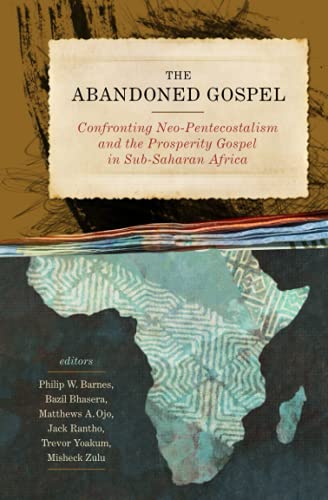
The Abandoned Gospel: Confronting Neo-Pentecostalism and the Prosperity Gospel in Sub-Saharan Africa
Written by Philip W. Barnes, Brazil Bhasera, Matthews A. Ojo, Jack Rantho, Trevor Yoakum, and Misheck Zulu, eds Reviewed By Spencer VanSickleThe Abandoned Gospel helpfully alerts evangelicals worldwide about invasive theologies spreading around sub-Saharan Africa and the globe. The authors, composed of roughly twenty pastors, professors, and missionaries who have worked extensively in African contexts, provide a clear understanding of the detrimental impact of the prosperity gospel and neo-Pentecostal movements. Furthermore, they offer biblical responses to these ideologies to strengthen the African church, contend for the faith, and protect the bride of Christ (p. 2).
The book has three primary sections. First, the authors use chapters 1–3 to trace the history and development of Africa’s prosperity and neo-Pentecostal movements. Second, chapters 4–9 outline biblical responses to specific theological concepts of the movements. Third, chapters 10–24 focus on how church planting and development strategies should respond biblically to these influences.
In part 1, the authors trace the development of Christianity within Africa, answering how these two movements gained traction. Christianity began to grow in Africa due to the Great Awakening in Europe and America, the abolition of the slave trade, and increased missionary efforts. As Christianity spread in the nineteenth century, charismatic and neo-Pentecostal leaders naturally arose and increased, aided by developments in technology, communication, and transportation.
A strength of the book is the authors’ insider perspectives that exegete their own cultures insightfully and accurately. Nearly every author in the book articulates the unique cultural situation in African culture that has allowed a syncretistic approach between Christianity and African Traditional Religion (ATR). For example, the authors describe the transition from the ATR’s use of witch doctors to cast out evil spirits that cause infirmities to the powerful “Man of God” in the Neo-Pentecostal and prosperity gospel movements (p. 76). This fundamental understanding of ATR and African culture allows the authors to see where syncretism develops and provide biblical responses.
A further strength is the authors’ rootedness in Scripture. Specifically, the authors understand that Neo-Pentecostalism and the prosperity “gospel” are indeed not the gospel (p. 47). Instead of preaching the message of Scripture to repent and have faith in Christ, these movements proclaim a message of deliverance from evil.
Part 2 of the book provides specific examples of the practices of these two movements and the biblical response to them. The authors outline key issues of these two movements, such as healings and deliverance, speaking in tongues, dreams, and prophecy, to provide biblical insight into how these practices are misused in the movement and to establish biblical boundaries.
Part 3 of the book provides examples and principles for how a local church can combat these movements through faithful teaching and ministry practices. The authors seek to keep the true gospel first in the church’s teaching ministries through a Christocentric hermeneutic emphasizing sin and Christ as Scripture presents him. Part 3 of this book will likely be a valuable tool for discipling young men aspiring to pastoral ministry in Africa and believers transitioning from the prosperity gospel to healthy theological convictions. The authors remind believers to stay faithful to the truth of Scripture while not losing themselves to the cultural syncretism in the movements spreading through Africa.
A collection with multiple authors means varying writing styles, repetitive information, and an occasional sense of disconnected chapters. On the other hand, the range of authors provides strength, as the reader is reminded, from varying voices across a healthy theological spectrum, that the neo-Pentecostal and prosperity gospel movements in Africa are not true gospels at all.
Chapter 11 concludes in such a way that it would serve well as the conclusion to the whole book. Rev. Musonda writes, “Though [leaders of these two movements] use the name of Jesus and quote passages of Scripture to justify their practices, their ministries are intended for self-glorification and therefore are devoid of the saving power of the gospel” (p. 139). The Abandoned Gospel accomplishes its task and reminds readers, “The reformation of the church in Africa is not only an urgent task, it is a feasible one because it is in the purpose of God” (p. 291). While this book addresses concerns in Africa, the worldwide church would be wise to heed the voices of these brothers as they “contend for the faith that was once for all delivered to the saints” (Jude 3).
Spencer VanSickle
Midwestern Baptist Theological Seminary
Kansas City, Missouri, USA
Other Articles in this Issue
Against a wider cultural narrative that now pathologizes even biologically determined differences between men and women, evangelicals respond with a theological anthropology grounded in the biblical texts...
Christ Existing as Church-Community: Bonhoeffer’s Ecclesiology and Religionless Christianity
by Ryan CurrieBonhoeffer’s theology is well known for generating many contradictory interpretations...
Slavery, Submission, and Separate Spheres: Robert Dabney and Charles Hodge on the Submission of Wives and Enslaved People
by Isaac TuttleRobert Dabney and Charles Hodge were two of the most influential Presbyterian theologians of nineteenth-century America...
Interpreters need a systematic taxonomy for interpreting Colossians 1:24, a pivotal yet challenging passage in Colossians...
In Galatians 2:15–21 the apostle Paul addresses the core issue of the epistle and sets forth his central thesis concerning the “truth of the gospel...
Other Reviews in this Issue