
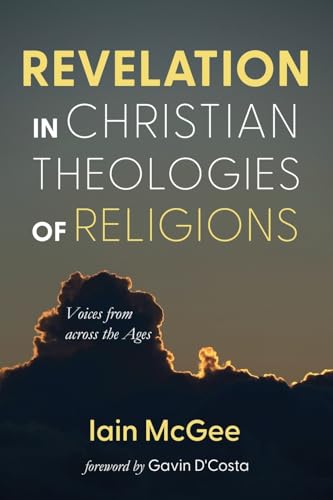
Revelation in Christian Theologies of Religions: Voices from Across the Ages
Written by Iain McGee Reviewed By Joshua KiraBooks that spring out of dissertations vary heavily in qualitay. The necessities of the doctoral writing process often require needless digressions, repetitions, and literature surveys to appease (typically well-meaning) advisors. Thus, many such books are less useful and require commitment to persevere through their reading. Fortunately, Revelation in Christian Theologies of Religions is different from many dissertations-turned-books. As a work of historical theology tracing how major theologians have thought through Scripture and its discussion of non-Christian religions, it benefits from Iain McGee’s extensive survey of primary and secondary sources. Moreover, the author is not overly repetitive and takes few tangents. For these reasons, this book is a helpful entrance if one is thinking through a theology of religions, especially from a Reformed perspective.
McGee wrote Revelation to address the lack of Evangelical theological writings on religion. He surveys five theologians: John Calvin, Jonathan Edwards, and Daniel Strange (whom he terms “Reformed Evangelicals”), along with Justin Martyr and Augustine, who are embraced by the tradition (p. 1). Rather than emphasizing soteriological debates, he examines how non-Christian religions relate to divine revelation, using three key loci: Logos revelation in the Johannine prologue, the prisca theologia tradition (i.e., external religious ideas borrowed from Jewish and Christian sources), and the role of a theology of the demonic in revelation (p. 7).
McGee begins with Justin Martyr, whose Logos Christology frames revelation beyond Scripture (p. 23). Martyr believes demons could convey truth while also distorting it (pp. 27–29). McGee criticizes attempts to subsume Martyr’s prisca theologia under his Logos concept (pp. 31–50), while clarifying his controversial claim that Socrates was a Christian (p. 41).
Augustine presents tension between demonology and divine sovereignty, viewing demons as fallen angels but minimizing their influence in light of God’s control (pp. 58, 61). While not a major proponent of prisca theologia, he acknowledges its influence (pp. 63–69). He argues that unbelievers can perceive God in creation, but this does not lead to worship. Thus, even when allowing limited metaphysical truths, it provides little ethical awareness (pp. 70, 88).
Calvin, like Augustine, downplays demons’ role in non-Christian religions, placing responsibility on their adherents (p. 97). Though familiar with prisca theologia, McGee argues he ultimately rejected it (pp. 106–9). Calvin contributes more significantly to Logos revelation, distinguishing the knowability of Christ’s role in creation and restoration (p. 110) and developing ideas like the “seed of religion” (p. 112) and the sensus divinitatis (pp. 115–20).
McGee highlights Edwards’s relatively uncritical use of prisca theologia (p. 124), likely influenced by his opposition to deism. He then describes Edwards’s understanding of the demonic, whereby demons primarily deceived through playing on “human imagination” (p. 135). In this way, he follows Augustine and Calvin in preventing humanity’s culpability from being mitigated. McGee believed that Edwards saw creation as “peculiarly an activity and revelation of the Son” (p. 154), with redemption allowing for the renewal of those God-endowed spiritual faculties which were lost at the Fall (pp. 144–50).
McGee includes Daniel Strange since he is one of the few Reformed Evangelical authors to do dedicated work in the theology of religions. Influenced by H. Kraemer and J. H. Bavinck, Strange thinks demons can “reveal,” but that this does not actually allow for truth in false religions (p. 171). This is largely justified by following Cornelius Van Til and his use of a coherence theory of truth (p. 189). He refines prisca theologia by distinguishing “Remnantal” (pre-Abrahamic tradition) from “Influential” (post-Abrahamic influence) revelation (p. 171). He asserts that the Son is involved in general revelation, though general revelation itself is not of him (p. 175). The book concludes with a comparative analysis of the five theologians.
McGee’s presentation has many strengths. It provides expansive surveys of secondary literature without avoiding primary sources. Though historical, his work is not content with simply restating past scholars’ views. He directs the reader’s attention to areas of dispute, making his own arguments where appropriate. Moreover, Revelation provides astute and humble historical exegesis. He contextualizes the theologians effectively without excessive background information and avoids speculative interpretations. His revelatory methodology also keeps the work focused, preventing it from being sidetracked by external theological debates, such as universalism, inclusivism, and exclusivism. Since the Reformed tradition exhibits greater diversity in its views on non-Christian religions’ relation to revelation than to salvation, this approach allows for a unique and varied discussion.
As a good work, the flaws in the book are few and small. First, Revelation’s chapter on Strange differs from the others, as it spends significant time discussing Bavinck. At times, the chapter would have greater cohesion if the Dutch Calvinist thinker had been the primary focus. Second, some terminological distinctions would have been helpful, as terms like “logos revelation” and “natural law” (p. 118) are used in different ways, even among the tradition he is investigating. Last, additional nuance on distinctions such as eternal law versus natural law, self-revelation versus revelation of knowledge, and inspiration of people versus inspiration of Scripture might have been beneficial. McGee can hardly be faulted, however, as these would likely add considerable length to the book.
The only real limitation to the usefulness of this book is related to its audience. McGee’s clear writing style starkly contrasts with the discussion’s complexity. He assumes broad felicity with theological concepts and basic knowledge of historical theology, which would likely require some theological education. However, McGee’s work is significant if one is a scholar or, perhaps, a seminary student with a general understanding of the Reformed tradition and the larger debates contained therein. With few difficulties and a myriad of helpful characteristics, Revelation in Christian Theologies of Religions is a notable success in converting a dissertation into a published manuscript.
Joshua Kira
Joshua Kira
Cedarville University
Cedarville, Ohio, USA
Other Articles in this Issue
Against a wider cultural narrative that now pathologizes even biologically determined differences between men and women, evangelicals respond with a theological anthropology grounded in the biblical texts...
Christ Existing as Church-Community: Bonhoeffer’s Ecclesiology and Religionless Christianity
by Ryan CurrieBonhoeffer’s theology is well known for generating many contradictory interpretations...
Slavery, Submission, and Separate Spheres: Robert Dabney and Charles Hodge on the Submission of Wives and Enslaved People
by Isaac TuttleRobert Dabney and Charles Hodge were two of the most influential Presbyterian theologians of nineteenth-century America...
Interpreters need a systematic taxonomy for interpreting Colossians 1:24, a pivotal yet challenging passage in Colossians...
In Galatians 2:15–21 the apostle Paul addresses the core issue of the epistle and sets forth his central thesis concerning the “truth of the gospel...
Other Reviews in this Issue