
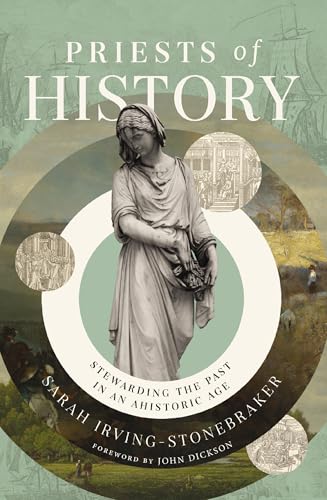
Priests of History: Stewarding the Past in an Ahistoric Age
Written by Sarah Irving-Stonebraker Reviewed By David RobertsonDr Sarah Irving-Stonebraker is a fine speaker, an excellent writer, and a brilliant historian. So, it was with more than a sense of expectation and anticipation that I approached her latest book, Priests of History. As a history graduate, and someone who never stops reading history, I looked forward to her defense of history as a vital ingredient in the Christian life. I was not disappointed. Priests of History is a well written, stimulating, provocative, and wide-ranging discussion of the role of history in the modern Church.
Irving-Stonebraker summarises the purpose of the book this way: “Drawing upon my expertise as an academic historian and my experience as an atheist who became a Christian, Priests of History examines what history is and why it matters. I argue that engaging with history ought to be a central part of Christian formation and discipleship” (p. xxvi).
Priests of History does what it says on the tin. However, it is more than just a book about history. In that sense it is hard to categorize. As well as being a history book, it is also personal and autobiographical, political and theological, devotional and literary. It also includes a number of significant biographical accounts, such as those of William Cooper, Doug Nicholls, and Mary Prince.
Irving-Stonebraker argues that we struggle to make sense of history in today’s church. Consequently, there is a growing rootlessness and spiritual malaise, and we far too often embrace elements of non-Christian culture. I have seen this work out in my own denomination where one discussion on a particular issue resulted in chaos, largely because people spoke only in the language and arguments of the contemporary rather than noting both the historical and biblical applications of the subject under discussion.
The author is also right to point out how centuries of Christian doctrine can be too easily dismissed as “outdated dogma” (p. 44, citing Bishop Spong). Steve Chalke and Alan Mann’s The Lost Message of Jesus (Grand Rapids: Zondervan, 2004) is an example of how this is played out. They argue for a contemporary, “progressive” ideology in part by cherry picking the bits of history that reinforce their “found message.”
The section on why history matters to Christians in an ahistoric age (ch. 5) is, to my mind, the most stimulating and useful of the book. Historical literacy is vital if Christians are to engage effectively with culture; it will not only help us in our evangelism but help us live more faithfully as disciples of Christ.
In another important section on recovering sacredness and beauty (ch. 10), Irving-Stonebraker makes a compelling case for an apologetic of beauty. However, the suggestion that if we are to reflect the beauty of God, then we should have beautiful buildings (p. 156), while understandable, is also questionable. Perhaps it depends on how beauty is defined, but I have been in many simple buildings where the beauty of Christ is manifestly displayed and some impressive cathedrals where he was distinctly absent!
Consistent with her appreciation of ecclesiastical history, Irving-Stonebraker argues for older practices such as catechizing, the church year, and community living. Her critique of the entertainment, consumerist, and trivialising culture of much contemporary Christianity is hard hitting—and true. “When pastors become CEOs, they no longer shepherd God’s people; instead, they merely manage their staff” (p. 54).
My one question with this, however, is: Was it not ever thus? Did not the medieval church have its own form of entertainment culture? Does not history teach us that those doctrinal aberrations, selling out to the culture and playing political power games, have, like the poor, always been with us?
Along with my increasing appreciation of the strengths of this book, the more I have read it (and I have done so three times now) the more I have begun to question some of its basic arguments. Here are three examples.
First, is it really the case that the “contemporary secular worldview in the West is ahistorical at heart” (p. xxi)?
A couple of years ago I was part of a sell-out crowd at the Enmore Theatre in Sydney where hundreds of us (many young people) gathered to listen to two men, Tom Holland and Dominic Sandbrook, pontificate on history. I do not ever recall sell out tours by historians in my youth! Their podcast, “The Rest Is History,” is one of the most popular in the world, and there are history books that sell millions. I find it hard to think of our age as an ahistorical age when I find myself discussing the History channel with my friendly neighborhood plumber!
I suspect that the general culture today is not much more ahistorical than it was fifty years ago. Perhaps the difference is that Irving-Stonebraker is dealing with the perception of history which is dominant in much of academia and the media (Dare I call it “woke history”?)—the type of history that has to be rewritten so that it meets all the current DEI requirements. But that is only one aspect of culture. The problem is just as much bad history as it is “ahistory.”
As Irving-Stonebraker points out in the chapter on “History and Intellectual Formation” (ch. 11), the difficulty is largely with universities which operate on a business model (ironically while promoting an anti-capitalist facade). It is these institutions that have become consumer-oriented and are far more likely to teach on race rather than democracy, identity rather than the enlightenment, and sex and sexuality rather than the Reformation (p. 177)!
The decline of history in academia is both significant and distressing—not least to those of us who earned our degrees in history. As we have witnessed the rewriting of the past to suit the politics of the present, it is little wonder that there has been a decline in the number of those who want to study this most important of subjects. “Go woke, go broke” is a motto that affects history departments as much as any other academic subject.
Secondly, does the dominant secular culture deny any ultimate story(p. 33)? That is true of pure post-modernism, but we are now post-post-modernist. The problem is not that we are just one story in the post-modern marketplace of ideas, it is that those who are the High Priests of our society have pronounced their secular doctrines as absolutes—which we must not blaspheme against. The sexuality story is absolute. The progressive story is absolute. Queer theory is absolute. Critical race theory is about as absolute as you can get.
Thirdly, is it really the case that the “move away from historic denominations to non-denominational churches and the move away from organised religion to the ‘nones’ both represent a rejection of history and historical communities” (p. 17)? What if the issue is rather that it is the denominations who have moved? What if they are the ones who have rejected real history? Most of the traditional denominations, especially those with a privileged status in society and the media, have tended to move with the currents of the times. They are the ones who are rejecting the history and practice of their tradition and have ended up becoming just the spiritual arm of the progressives.
Finally, a small quibble. Although in modern usage, “puritanical” has now come to mean “having or displaying an overly strict or censorious moral attitude” (which is how it is used on p. 15), I prefer the historical use of the word. In real history, I find the Puritans to be deeply joyful and much more tolerant than many of their peers.
In terms of the sense that Irving-Stonebraker intends for her book’s title—that we have a duty to tend and keep historical tradition, being faithful stewards of the past—Priests of History is an excellent title. My worry, however, is that the substance of the book attempts to do too much and, as a result, risks ending up as more of a personal testimony and encouragement to engage with history than a textbook for history, theology, ecclesiology, and devotion.
Having said that, as a defense of the importance of history, Priests of History is brilliant. As an analysis of contemporary society, it is more than useful. As a pointer to the direction in which the church should be heading, it is interesting and thought-provoking. While I am still wrestling with some of the ideas, I am grateful to Dr Irving-Stonebraker for being such a stimulating author. Which is why I have bought a second copy! Go and get yours.
David Robertson
David Robertson
Scots Kirk Presbyterian
Hamilton, New South Wales, Australia
Other Articles in this Issue
Against a wider cultural narrative that now pathologizes even biologically determined differences between men and women, evangelicals respond with a theological anthropology grounded in the biblical texts...
Christ Existing as Church-Community: Bonhoeffer’s Ecclesiology and Religionless Christianity
by Ryan CurrieBonhoeffer’s theology is well known for generating many contradictory interpretations...
Slavery, Submission, and Separate Spheres: Robert Dabney and Charles Hodge on the Submission of Wives and Enslaved People
by Isaac TuttleRobert Dabney and Charles Hodge were two of the most influential Presbyterian theologians of nineteenth-century America...
Interpreters need a systematic taxonomy for interpreting Colossians 1:24, a pivotal yet challenging passage in Colossians...
In Galatians 2:15–21 the apostle Paul addresses the core issue of the epistle and sets forth his central thesis concerning the “truth of the gospel...
Other Reviews in this Issue