
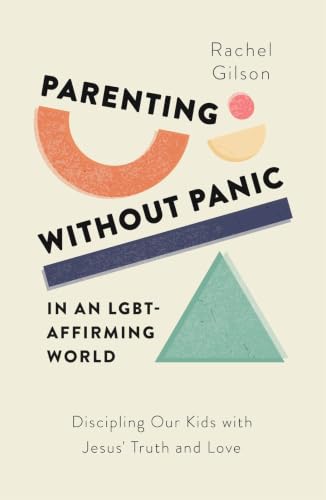
Parenting Without Panic in an LGBT Affirming World: Discipling Our Kids with Jesus’ Truth and Love
Written by Rachel Gilson Reviewed By Fleur LetcherMany years ago, when I was on “kinder duty” in my daughter’s class, the teacher asked the children what they could tell her about Christmas. My child shot up her hand and blurted out proudly, “Santa’s not real!” All eyes turned disapprovingly to me, and in coming weeks I had to answer questions from parents as to why my “anti-Santa-evangelist” had made it her mission to convert the entire grade! These days the stakes are much higher for Christian parents and their children, as our perspectives on sexuality cut sharply against the grain of societal norms.
This hit home for Rachel Gilson when she discovered that her daughter’s female kindergarten teacher was married to another woman and was concerned how her daughter would respond (p. 9). This is what prompted Gilson, author of Born Again This Way: Coming Out, Coming to Faith, and What Comes Next (Epsom: Good Book, 2021), to write Parenting Without Panic. Her aim is to help parents fearlessly communicate God’s beautiful vision of sexuality to their children and assist them to navigate the strong opposing currents of LGBT+ ideology. Gilson’s perspective is particularly insightful because she herself experiences same-sex attraction and swam in that stream as an atheist, until in college she was “confronted with the gospel” and became a believer (p. 11).
Gilson urges parents to lead with the “Yes” of “God’s Positive Vision” for human sexuality (ch. 1), in contrast to the negative view that many have grown up with (pp. 15–17). She argues that, while we do not need “overly complex conversations with our kids about theories of sex and gender,” we can teach our children, even from a young age, to celebrate and thank God for the beautiful gift of their bodies, and that it is their body that shows them whether they are a boy or a girl (pp. 18–19).
Gilson also sees relationships as “signposts” which point to the bigger vision of “the goodness of God’s forever family” (p. 20). Cautioning us to avoid unbiblical visions of both singleness and marriage (p. 20), including “salvation-by-romance” (p. 23), she reminds us that, while healthy marriages give “a glimmer of what the gospel is” (pp. 23–24), in eternity, “all of us will be single” (p. 21). Therefore, the relationships between believers on earth are a potent vision for a watching world that is “longing for intimacy, for romance, and for connection … but [is] being sold a cheap, plastic imitation of the real thing” (p. 25).
In chapter 2 (“Sex Talk”), Gilson advises that “talking to our kids about sex early will help them in the long run” (p. 30) by guarding them against sexual abuse (p. 31); by establishing ourselves as trustworthy sources of knowledge (p. 31); and by giving our kids “a sturdy, true, and even beautiful” foundation for life (p. 33). She exhorts parents to use the correct terminology for body parts, because our children “don’t need to be afraid or ashamed of the bodies God gave them” (p. 34).
In chapter 3 (“The Impact of the Fall”), Gilson gives a crash-course in transgenderism and same-sex attraction, clearly cautioning that “trying to live in opposition to how God made our bodies cannot bring lasting peace” (p. 48). She also helpfully addresses the reality of disorders of sexual development/intersex conditions and stresses the point that, while “all of our bodies face different troubles,” God made our bodies good and “we all are worthy of love and respect” (p. 51). Consequently, “no matter what our body is like now, we can praise him, serve him, and thank him” (p. 52).
In regard to the “human longing for romantic love” and its fulfilment in marriage, Gilson writes that this is an “echo” of the “passionate, intoxicating, faithful love … which Jesus has for his people,” but rightly adds that “other kinds of close relationships also echo God’s great love for his people, including parent-child relationships, friendship and siblinghood within the church” (pp. 53–54). She concludes with three messages to keep communicating to our children: “that desires and feelings are not reliable”; that “romance is not the definition of the good life” (p. 56); and that “we need to talk about the positive design of marriage frequently, so that when we encounter false visions, we have the right thing to compare them to” (p. 57).
Gilson builds on this positive vision in chapter 4 (“Tools for LGBT+ Conversations”) to demonstrate that authenticity and justice, so championed by LGBT+ advocates, essentially derive from a Christian worldview without the gospel (p. 69). She makes the compelling point that we should see ourselves “not as adversaries but as missionaries” (p. 70) and has devised a helpful “Yes-No-Yes” tool in order to teach kids how to respond to LGBT+ arguments: affirm points of connection, point out when something is destructive (p. 71), and show that “the gospel offers the only and best way to have true life” (p. 72).
In chapter 5 (“Fear Not”), Gilson addresses several underlying parental fears: that our children might have to pay the “real social cost” of a Christian sexual ethic now considered by society as “oppressive and harmful” (p. 80), that we ourselves might come to doubt whether “God’s blessing and reward is more satisfying than the love and approval of the world” (p. 84), and whether our children will walk away from Jesus (p. 85). She encourages parents to trust God with their children, reassuring them that, just as Daniel resisted the pagan Babylonian culture he was submerged in, we can help our children resist the “myths, language … literature … idols … demands … and tactics” of our own culture (p. 87).
In chapter 6 (“In the Family”), Gilson provides guidance to parents whose children are led to affirm same-sex relationships, beginning with an overall framework that love is “only great when lived according to God’s good rules” and that “the right way to love people of the same sex is in friendship” (p. 96). If teenagers disclose same-sex attraction to their parents, often after a desperate struggle or denial (p. 97), she counsels that parents must be “safe enough to talk to,” should “treat this like any other area of temptation,” and need to reassure their child of their love, compassion, and assistance (pp. 99–100). For teenagers who choose not to walk with Jesus, she wisely recommends that parents “prioritize talking about Jesus and his offer of salvation over conversations about sexuality … because their primary need is reconciliation to the Lord” (p. 104).
Gilson more than achieves her purpose of equipping Christian parents to be proactive without being alarmed by the alternative visions of sexuality presented to their children and to embrace their role as guardians of God’s positive vision for human sexuality. Although only a “little volume” (p. 102), Gilson’s book is a gold nugget of practical, Bible-based wisdom, written with candour and humour, which skilfully condenses complex issues into simple explanations and clear, creative applications. Admittedly, it is more of an overview than a comprehensive manual, something Gilson herself notes in the conclusion. As such, it provides more of a starting point, offering general principles for parents of mainly younger children rather than specific answers for every question a parent might have (p. 111). For this, she wisely points to the church, and particularly other Christian parents who can “learn from each other without pride or despair” (p. 112).
With so much to commend it, and as an accessible, introductory guide for navigating LGBT+ issues, this book is a must for every church library.
Fleur Letcher
Summer Hill Church
Summer Hill, New South Wales, Australia
Other Articles in this Issue
Against a wider cultural narrative that now pathologizes even biologically determined differences between men and women, evangelicals respond with a theological anthropology grounded in the biblical texts...
Christ Existing as Church-Community: Bonhoeffer’s Ecclesiology and Religionless Christianity
by Ryan CurrieBonhoeffer’s theology is well known for generating many contradictory interpretations...
Slavery, Submission, and Separate Spheres: Robert Dabney and Charles Hodge on the Submission of Wives and Enslaved People
by Isaac TuttleRobert Dabney and Charles Hodge were two of the most influential Presbyterian theologians of nineteenth-century America...
Interpreters need a systematic taxonomy for interpreting Colossians 1:24, a pivotal yet challenging passage in Colossians...
In Galatians 2:15–21 the apostle Paul addresses the core issue of the epistle and sets forth his central thesis concerning the “truth of the gospel...
Other Reviews in this Issue