
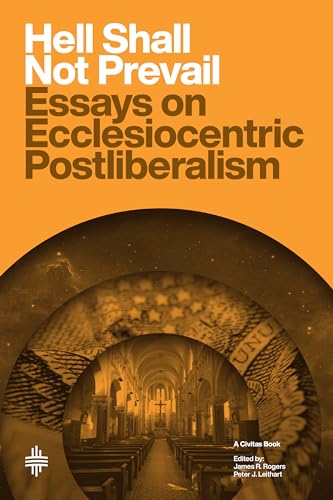
Hell Shall Not Prevail: Essays on Ecclesiocentric Postliberalism
Written by James R. Rogers and Peter J. Leithart, eds. Reviewed By Gregory SoderbergPatrick Deneen’s Why Liberalism Failed (New Haven: Yale University Press, 2018) garnered praise from a wide spectrum of voices: from Barack Obama and David Brooks to Allan Carlson and D. G. Hart. Although there seems to be a widespread sentiment that political liberalism has indeed failed, there is no clear consensus on what should take its place. Part of the problem is a lack of clear definitions.
The burden of Hell Shall Not Prevail, a volume of essays edited by James Rogers and Peter Leithart, is to bring the resources of a robust doctrine of the church into the question of what comes “after” liberalism. It is the fruit of the Civitas Group, a “research colloquium sponsored by the Theopolis Institute” (p. x). For the Civitas Group, “ecclesiocentric postliberalism” flows out of core theological commitments: “As a political message, the gospel offers salvation to peoples as well as to individuals. Social salvation, like individual salvation, is the gift of King Jesus” (p. x). The contributors come from a wide variety of backgrounds: theologians, pastors, professors of political science and philosophy, and lawyers. This adds both depth and breadth to the volume.
Leithart’s initial essay, “Liberalism Is Heretical Ecclesiology,” critiques foundational liberal thinkers from an ecclesiological view. He argues that both Hobbes and Locke had a deficient view of the church, and so the foundations of liberalism are theologically weak at their core. But why should we care what Hobbes and Locke thought about the church? Is not the point of liberalism the creation of a public square free from any churchly influence? Does not bringing the church into discussions of politics lead to “Christian nationalism”? Not necessarily.
Dave Reiter (“Can Liberalism Provide an Adequate Secular Justification for Respect of Persons?”) takes on some of the most influential liberal accounts of personal worth—notably, Immanuel Kant, John Stuart Mill, and John Rawls—and demonstrates that none of these thinkers can ultimately provide a cogent case for valuing human persons. This, then, proves to be a major Achilles’ heel in the liberal project. If we have no reason to value people or their opinions, then what is the point of liberalism? Here, the radical woke critics seem to be more consistent when they argue that we should curtail “free speech” when it opposes the current orthodoxy regarding minorities and oppression. In contrast, Reiter offers a theological account of human worth, rooted in the imago Dei and in the doctrine of the church.
Gary Young is both a lawyer and a professor, and so his chapter (“The Church Builds the World”) provides a unique perspective. Drawing on legal theorist Robert Cover’s analysis of how religious communities build unique political and social orders, he applies this framework of “world-maintaining forces” and “world-building forces” to how the church can become a world-building force in an increasingly fragmented world. Young articulates some of the central features of the “ecclesiocentric” postliberal position. Fundamentally, “Ecclesiocentrism is the claim that after the ascension of Christ and the announcement of the Great Commission, the church was placed at the center of the world, just as the temple had been the center of the world in the prior order (Ezek 5:5)” (p. 66). But what does this focus on the church look like, practically? How does this vision translate into the nitty-gritty of politics and policy? Young, along with most of the authors in this volume, does not provide these specifics. The ecclesiocentric vision is just that—a vision. This volume does not pretend to flesh out all the details. That is the work of the readers, assuming they are part of Christ’s church.
This highlights a key point of the book:
In this way, the church stands in the center of the world, presenting a divinely constituted World [the church] to the world: In both the teachings and practices of the church, it portrays the divinely designed signs of the fundamental issues of political and social life. The gospel, through both Word and sacrament conveyed in the church, transforms its members. So too, by living out its common practices, the gospel transforms our imaginations: We are able to convey possibilities in the world that otherwise cannot conceive of them. As we live out those possibilities, the world outside the World is transformed as well (cf. 1 Cor. 14:14). (p. 67)
In his essay “Liberalism and the Restlessness of the American Soul,” Andrew Bobo revisits the work of Alexis de Tocqueville and shows his continuing relevance for our current cultural challenges. De Tocqueville saw that one of the defining features of the American experience was “restlessness.” Bobo demonstrates how this basic restlessness lies at the root of many of our contemporary pathologies: distraction, short-sightedness, isolation, and degradation. Bobo’s answer to these pathologies is, unsurprisingly, the power of Christ, as mediated through his church. This is not a criticism. After all, the main thrust of the book is how a robust ecclesiology can explain, apply to, and potentially heal, the fragmentation of the modern project.
In addition to penning the introduction, James R. Rogers authored two essays for this volume. His first essay (“Church as Polis, Church as Ethnos, Church as Oikos: Ecclesiocentric Political Theory”) should perhaps have been placed earlier in the book, since it presents the main concerns of the “ecclesiocentric” model. In opposition to the majority of Americans, including Christians, who regard civil community and civil jurisdiction to be primary, Rogers argues that the church provides both the telos and the model for all earthly communities. Central to ecclesiocentrism is the claim that “the telos of the nation-state—ethnos and polis—as well as that of the household (or oikos), is found in the church. Or … the worldly polis and ethnos (and oikos) provide, at most, figures of the church and of the solidarity found fully only within the church” (p. 95). Because Christ is the telos of all creation (Col 1:15–20) and because the church is the body of Christ, it is a small step to see Christ/church as the telos of all earthly communities (Rev 21). Ecclesiocentric post-liberalism aims to flesh out the political consequences of taking seriously the centrality of the church for every arena of human action.
Overall, this volume is a welcome addition to the current discourse and debate about how Christians and Christian theology should relate to and think about politics and culture. It avoids many of the simplistic and reductionistic answers currently on offer, such as the “keep religion out of politics” view of many on the left or the “put the Bible and prayer back in public schools” attitude of many on the right. It reminds us, as baptized believers, that our true identity is found in Christ and his body, the church. The authors call all of us to live our lives more consistently with this fundamental reality. If every Christian did that, it would be interesting to see how our political and cultural life might be transformed.
Gregory Soderberg
Gregory Soderberg
BibleMesh Institute and Redemption Seminary
Moscow, Idaho, USA
Other Articles in this Issue
Against a wider cultural narrative that now pathologizes even biologically determined differences between men and women, evangelicals respond with a theological anthropology grounded in the biblical texts...
Christ Existing as Church-Community: Bonhoeffer’s Ecclesiology and Religionless Christianity
by Ryan CurrieBonhoeffer’s theology is well known for generating many contradictory interpretations...
Slavery, Submission, and Separate Spheres: Robert Dabney and Charles Hodge on the Submission of Wives and Enslaved People
by Isaac TuttleRobert Dabney and Charles Hodge were two of the most influential Presbyterian theologians of nineteenth-century America...
Interpreters need a systematic taxonomy for interpreting Colossians 1:24, a pivotal yet challenging passage in Colossians...
In Galatians 2:15–21 the apostle Paul addresses the core issue of the epistle and sets forth his central thesis concerning the “truth of the gospel...
Other Reviews in this Issue