
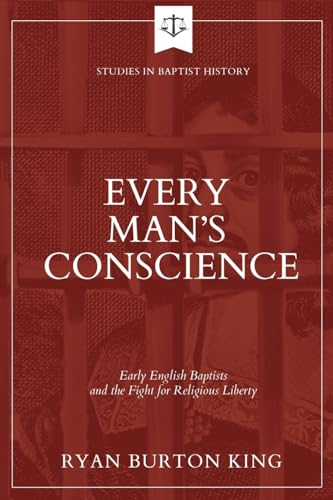
Every Man’s Conscience: Early English Baptists and the Fight for Religious Liberty
Written by Ryan Burton King Reviewed By Marc MinterRyan Burton King is the pastor of Grace Baptist Church Wood Green in London, England. The church meets in a picturesque, early twentieth-century, red brick building in a residential area north of the old city, acquired in a church merger after Grace Baptist first covenanted together (under a different name) in 2004. This places Ryan King at the geographical heart of the subject he is addressing in his first book publication—Every Man’s Conscience.
Malcolm Yarnell began his foreword by saying, “Every Man’s Conscience will be one of the most valuable texts you ever read.” (p. iii) This is quite a statement—I think an overstatement—but the book is certainly valuable. King provides the reader with a broad and concise summary of English Baptist history, especially focused on the Baptist fight for religious toleration. He marks out a fast-paced chronological history, highlighting major Baptist figures among the English Baptists. Students of Baptist history will easily recognize the big names (e.g., John Smyth, Thomas Helwys, and Roger Williams), and King also notes the progression of important confessions of faith produced by English Baptists during the seventeenth century.
In sum, King argues that “freedom of conscience” and “religious liberty” are “intrinsically linked to the Baptist ‘free church’ ecclesiology,” and this “fuelled Baptists’ intentional evangelistic methodology.” (p. 2) Perceiving that many today (including some Baptists) are departing from this historic conviction, King wants people to “know and learn from Baptist history” so that they might trust “in the word of God, not a weaponised government, to do the work of gospel advance and to shape the conscience of the nation” (p. 2 n. 100). King’s aim is to “provide an accessible framework for appropriate Christian engagement in response to apparent and emerging threats to religious liberty today” (p. 5).
After describing the hostile conditions into which Baptists sprouted at the beginning of the seventeenth century (in part 1), King weighed in on a hot historical debate (in part 2). Baptist historians are not at all agreed upon the relationship of early English Baptists and the radical reformers called Anabaptists. Some see considerable influence from the latter upon the former, and others see no positive influence at all. Defining Anabaptist doctrine and practice is yet another major difficulty because of the historical reality that they were a scattered and unorganized group. Nevertheless, King puts his cards on the table by saying, “It might be better to say that the Baptists came from English Separatism through the influence of what was called Anabaptism” (p. 25).
It would be impossible to adequately address the complicated historic relationship between Anabaptists and early English Baptists in a book this size, but it is important to note King’s perspective because it flavors his narrative. He does not describe exactly what he means by religious liberty, except to say that Baptists believed all (even “heretics, Turks, Jews, or whatever”) should have it (p. 32). King gives the impression that early English Baptists argued that civil government should have no interest at all in the religious affinities of its populace (i.e., the typical view of sixteenth-century Anabaptists). Liberation from persecution, coercion, and a state church was certainly the Baptist plea, but it is a historical fact that most early English Baptists advocated for a kind of religious freedom that included the civil enforcement of Christian ethics and societal norms. For example, the Second London Baptist Confession includes the affirmation that the Sabbath is a “positive, moral, and perpetual commandment, binding on all men in all ages” (2LBC 22.7).
And yet, the main point of King’s thesis stands. Early English Baptists were indeed vigorous advocates of voluntary religion, and this set them at odds with other Protestants in England, who promoted and worked within a state-church polity. Furthermore, English Baptists were adamant in their arguments for the universal freedom of conscience, such that sinners would be persuaded by the gospel, not compelled by civil legislation and force. Therefore, King has made his case, but he has also failed to address the heart of the debate among Evangelical Christians today (in both the old world and the new). Many apparently agree with King (and historic figures like Roger Williams) that the invitation to repent and believe is a matter of every man’s conscience. There is widespread disagreement, however, about the degree to which civil government should bind citizens’ consciences and actions according to biblical commands and ethics.
Marc Minter
First Baptist Church
Diana, Texas, USA
Other Articles in this Issue
Against a wider cultural narrative that now pathologizes even biologically determined differences between men and women, evangelicals respond with a theological anthropology grounded in the biblical texts...
Christ Existing as Church-Community: Bonhoeffer’s Ecclesiology and Religionless Christianity
by Ryan CurrieBonhoeffer’s theology is well known for generating many contradictory interpretations...
Slavery, Submission, and Separate Spheres: Robert Dabney and Charles Hodge on the Submission of Wives and Enslaved People
by Isaac TuttleRobert Dabney and Charles Hodge were two of the most influential Presbyterian theologians of nineteenth-century America...
Interpreters need a systematic taxonomy for interpreting Colossians 1:24, a pivotal yet challenging passage in Colossians...
In Galatians 2:15–21 the apostle Paul addresses the core issue of the epistle and sets forth his central thesis concerning the “truth of the gospel...
Other Reviews in this Issue