
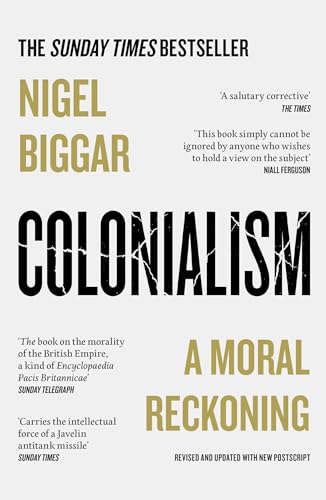
Colonialism: A Moral Reckoning
Written by Nigel Biggar Reviewed By Mark EarngeyNigel Biggar’s Colonialism: A Moral Reckoning is a courageous and timely intervention into contemporary debates about the British Empire and the broader history of colonisation. Written by the Regius Professor Emeritus of Moral Theology at the University of Oxford, this book addresses what Elie Kedourie calls “the canker of imaginary guilt” and challenges prevailing assumptions that colonialism was an unmitigated evil. Instead, the recently elevated Lord Biggar carefully evaluates the historical and moral complexities of the colonial enterprise, offering a measured and thoughtful analysis that will be of great interest to all who are concerned with history, ethics, and public discourse.
From the beginning, Biggar shuns the simplistic narrative that colonialism was systematically oppressive and driven by greed and racism. Rather, he argues that colonialism encompassed a range of motives, combining profound injustice with instances of benevolence and progress. This skewers some of the postcolonial orthodoxies that portray colonialism exclusively in negative moral terms. Moreover, he highlights the moral agency of historical actors and underscores the importance of historical accuracy in ethical judgments. This emphasis is particularly relevant in contemporary contexts grappling with misinformation, political polarisation, and the reductionist tendencies of social media. Biggar’s work reminds readers that the moral evaluation of history must be undertaken with a sympathetic appreciation for historical context, avoiding anachronistic condemnations that fail to acknowledge the complexities of human motivation and action. For instance, he contends that historical curiosity and careful moral deliberation are necessary when assessing past attitudes toward violence through the lens of contemporary Western standards (p. 9).
The book is structured into eight chapters, each addressing key moral and historical dimensions of colonialism. Chapter 1 (“Motives, Good and Bad”) challenges the notion that the British Empire was driven by a singular motive—whether exploitation or altruism. While this reviewer, as a Tudor church historian, might question some of Biggar’s interpretations of Elizabethan ecclesiastical realities, his historical summaries effectively illuminate the multifaceted nature of British imperial motives. Chapter 2 (“From Slavery to Anti-Slavery”) severs the naïve equation of colonisation with the presence of slavery by surveying the ancient and universal presence of slavery (e.g., from Mesopotamia to the Mediterranean, from the Incans to Islamic societies, and from China to the Barbary Coast) and by showing the extraordinary—though imperfect—leadership of the British (especially British evangelicals) from the late eighteenth-century to abolish the slave trade. He concludes that equating British colonialism with slavery, as some anticolonial narratives do, requires “amnesia about everything that has happened since 1787” (p. 65). He argues that as the British Empire expanded, anti-slavery rather than slavery became central to imperial policy.
Chapter 3 (“Human Equality, Cultural Superiority and ‘Racism’”) addresses whether the British Empire was fundamentally racist. Here, Biggar provides a nuanced discussion of the concepts of race and culture, arguing that moral judgments about cultural differences need not be racist if they are based on developmental disparities rather than biological determinism (p. 70). Chapter 4 (“Land, Settlers and ‘Conquest’”) explores the ethical dilemmas surrounding colonial settlement, including questions of rights, sovereignty, and legal jurisdiction.
Chapter 5 (“Cultural Assimilation and ‘Genocide’”) asks whether British colonialism involved genocide. Focusing primarily on Canada and Australia, Biggar engages with the work of historians such as Henry Reynolds, critiquing instances where sources have been misquoted or accounts exaggerated. While this chapter touches on sensitive issues, it highlights the need for careful historical scrutiny. Chapter 6 (“Free Trade, Investment and ‘Exploitation’”) interrogates the claim that colonialism was primarily exploitative. Biggar presents evidence that colonial administrations invested heavily in infrastructure, legal systems, and education, laying the foundations for future economic development in many regions. While he does not absolve colonial powers of economic injustices, he situates them within a broader historical and moral framework.
Chapter 7 (“Government, Legitimacy and Nationalism”) considers whether British rule was inherently illegitimate and harmful to native interests. Biggar challenges the assumption that nationalist resistance was the inevitable response to ineffective British administration. He contends that such a view overlooks the complexities of governance and the degree of indigenous cooperation. As he notes, “Colonial rule would not have been possible at all without the widespread acquiescence, participation, and cooperation of native peoples” (p. 213). Chapter 8 (“Justified Force and ‘Pervasive Violence’”) scrutinises six of the most infamous episodes of British imperial military violence, including the First Opium War, the Second Anglo-Boer War, and the Indian Mutiny. While acknowledging the moral failures in these cases, Biggar argues that colonial governments typically repudiated such violence rather than institutionalised it (p. 272). Thus, he challenges the notion that violence was intrinsic to British colonial expansion.
Despite the book’s many strengths, it is not without its challenges. Some readers may feel that Biggar underplays certain aspects of colonial exploitation or is too willing to defend the motivations of colonial administrators. Others may argue that his approach, while historically rigorous (with over 100 pages of footnotes), does not sufficiently account for the enduring structural inequalities that emerged from the colonial period. Yet even those who disagree with Biggar’s conclusions should recognise that his work is a valuable contribution to the ongoing discussion about the legacy of colonialism.
Biggar’s willingness to challenge anticolonial assumptions has made his work controversial in some quarters. His qualified defense of Cecil Rhodes in 2015 and 2016 placed him at the center of debates over Britain’s imperial past, leading to the six-year “Ethics and Empire” research project, which began in 2017. This initiative drew criticism from around sixty Oxford students and modern historians, who publicly rejected his views. As someone who was studying in Oxford during this period, I recall attending a Latin class at Oriel College where the fate of the Rhodes statue overlooking High Street was a topic of discussion. Stepping outside afterward, I encountered a rather lackluster “Rhodes Must Fall” protest in Oriel Square—one of its lead chanters, I later heard, was a Rhodes Scholar. Intrigued by the debate, I subsequently borrowed a biography of Rhodes from the Bodleian Library to investigate the matter further. All this reinforced my conviction that evidence-based research is essential for the moral evaluation of colonial history. Biggar’s book meets much of this need, offering a compelling call for nuanced moral evaluation. I am therefore very grateful for Professor Biggar’s book and trust that others who take up and read it may be stimulated, sharpened, and strengthened to seek the truth, speak with wisdom, and act with courage.
Mark Earngey
Moore Theological College
Newtown, New South Wales, Australia
Other Articles in this Issue
Against a wider cultural narrative that now pathologizes even biologically determined differences between men and women, evangelicals respond with a theological anthropology grounded in the biblical texts...
Christ Existing as Church-Community: Bonhoeffer’s Ecclesiology and Religionless Christianity
by Ryan CurrieBonhoeffer’s theology is well known for generating many contradictory interpretations...
Slavery, Submission, and Separate Spheres: Robert Dabney and Charles Hodge on the Submission of Wives and Enslaved People
by Isaac TuttleRobert Dabney and Charles Hodge were two of the most influential Presbyterian theologians of nineteenth-century America...
Interpreters need a systematic taxonomy for interpreting Colossians 1:24, a pivotal yet challenging passage in Colossians...
In Galatians 2:15–21 the apostle Paul addresses the core issue of the epistle and sets forth his central thesis concerning the “truth of the gospel...
Other Reviews in this Issue