
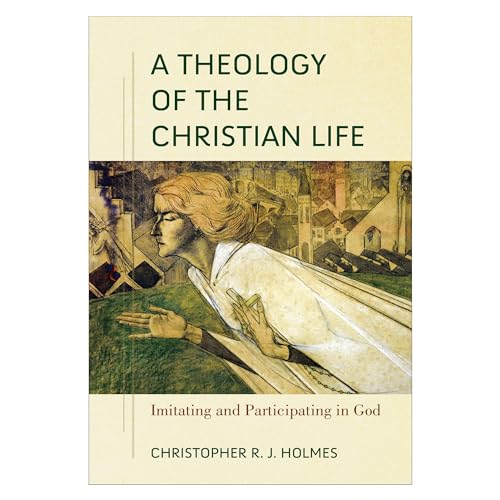
A Theology of the Christian Life: Imitating and Participating in God
Written by Christopher R. J. Holmes Reviewed By Jeremy KimbleWork in the area of classical theology aimed at biblical faithfulness and historic connectedness continues to come from academic printing presses at an astonishing rate, a blessing for which we can be truly thankful. One of those inherent blessings is the reminder that our theology is not meant to be divorced from our moral formation; rather, they are to be wed in blissful harmony, as God would have it. Meditating on Scripture, contemplating the glory, beauty, greatness, and goodness of God makes us into a certain kind of people (Ps 1:1–6; 2 Cor 3:18; Eph 5:1; 1 Pet 1:13–16).
Another example of such a volume comes from Christopher R. J. Holmes, Professor of Theology at the University of Otago, author of several other theological works. Holmes, maintaining that theology is both theoretical (i.e., contemplative) and practical, argues that “God’s existence, perfection, infinity, and immutability form a wellspring for Christian life” (p. ix). Highlighting the doctrine of God as “fertile ground for Christian life,” he asserts we should see the Christian life in “utterly theocentric terms, for conceiving Christian life as a pilgrimage toward ever greater likeness to God in and through Jesus Christ, in order that his Father, our Father, might, in the Spirit, be ‘all in all’ (1 Cor. 15:28)” (pp. xvi–xvii).
Holmes’s treatment is a prime example of “biblical reasoning,” as coined by John Webster, wherein the author treats God’s names (i.e., attributes) with a view to our imitation and participation. Holmes wants to describe what these attributes say about God and what kind of life they call us to, both now and in eternity. The book has two parts, the first five chapters dealing with God’s existence, perfection, infinity, and immutability (questions arise here, as often such attributes are thought of as incommunicable, though Holmes treats such matters with care). In the second section, the author touches on how these attributes of God inform our understanding of the hypostatic union, virtue, and the church. Each chapter focuses on a particular passage of Scripture to frame the discussion, as well as a particular historic theologian to offer guidance along the way (e.g., Augustine, Gregory of Nyssa, Origen, Maximus the Confessor, Aquinas, etc.).
The aim of the book is clear. Holmes rightly recognizes theology as both descriptive and prescriptive. That is, “It not only describes the mystery of God revealed in the Holy Scriptures, but also promotes the movement of the heart, soul, and mind toward God” (p. 155). As theologians, then, we want ourselves to be stimulated and so exhort others toward formation in Christ by meditating on the Word of God, engaging in the life of the church, and offering prayers in the form of praise, confession, and supplication (particularly, that we would know and love God). This is a right and clear emphasis, one which would be appreciated in more theological works as we consider the object and aim of our study and affection.
Holmes speaks much throughout the book concerning imitation and participation. These twin themes are indeed receiving more attention in the evangelical theological world, and this is right and good as they are constrained by the testimony of Scripture. Holmes speaks clearly on such matters; however, explicitly defining such terms would help rightly affirm the author’s argument. A case in point, the language of participation can be used in this work at times that would seem to indicate that what awaits us in the new creation is a kind of deification or theosis that makes us one with God in an essential sense. Holmes repeatedly appeals to his readers to maintain the Creator-creature distinction throughout the work, but clearer definitions and explanations at points could have strengthened his argument.
Also, while Scripture is appealed to throughout the work, further attention could have been given to more detailed contextual exegesis. Interaction with historic figures proved immensely helpful, the author even indicating at points where he held his own uncertainty about the precise nature of what they were arguing. As such, readers are exposed to retrieval done in a responsible and contextual way, modeling a good path for such studies. Again, it simply seems that at certain points of his work, greater detail could have been given to that which grounds all of our theology, namely, the exegesis of Scripture. Holmes offers other theologians a number of texts within which such work could be done, for which we should be thankful.
One final strength of this book, while others could certainly be adumbrated, is its focus toward the latter chapters, which argue that virtue is found within the life of the church. Holmes, rightly, does not allow for detached observations of God but rather argues that such meditation and contemplation will result in virtue, particularly love. It is in this way that we are called to imitate God and participate by grace in who he is. The theologian must speak of God in a way that stems from a heart of love steeped in the pursuit of God’s character that will be lived out perfectly, eternally.
Jeremy Kimble
Jeremy Kimble is associate professor of theology at Cedarville University in Cedarville, Ohio.
Other Articles in this Issue
Against a wider cultural narrative that now pathologizes even biologically determined differences between men and women, evangelicals respond with a theological anthropology grounded in the biblical texts...
Christ Existing as Church-Community: Bonhoeffer’s Ecclesiology and Religionless Christianity
by Ryan CurrieBonhoeffer’s theology is well known for generating many contradictory interpretations...
Slavery, Submission, and Separate Spheres: Robert Dabney and Charles Hodge on the Submission of Wives and Enslaved People
by Isaac TuttleRobert Dabney and Charles Hodge were two of the most influential Presbyterian theologians of nineteenth-century America...
Interpreters need a systematic taxonomy for interpreting Colossians 1:24, a pivotal yet challenging passage in Colossians...
In Galatians 2:15–21 the apostle Paul addresses the core issue of the epistle and sets forth his central thesis concerning the “truth of the gospel...
Other Reviews in this Issue