
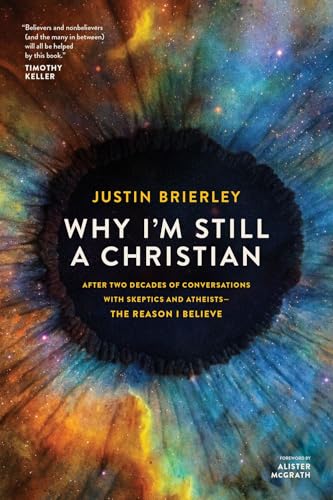
Why I’m Still a Christian: After Two Decades of Conversations with Skeptics and Atheists—The Reason I Believe
Written by Justin Brierley Reviewed By Daniel SuterJustin Brierley’s Why I’m Still a Christian builds on the speaker and broadcaster’s two-decade-long experience hosting conversations between leading Christian and atheist thinkers to create a compelling case that “Christianity makes the best sense of the world we inhabit” (p. 188). Serving both skeptics and Christians seeking to get equipped in their apologetic ministry or personal walk with God, Brierley provides an invaluable resource in this revised update to his 2017 book, Unbelievable.
The ten chapters of this book are divided into four main thematic movements. First, Brierley opens with a chapter on creating better conversations between people who inhabit opposing worldviews—a skill the author excels at in contemporary apologetics. Then, Brierly launches into three chapters covering empirical, philosophical, and intuitive theistic arguments to posit that God best explains human existence, value, and purpose.
Having argued God’s existence in general, Brierley moves to Christianity in particular through historical arguments. Both “The Evidence for Jesus” and “Facts That Only Fit the Resurrection” rank among the strongest chapters in the book. Brierley enlists such authoritative voices as Gary Habermas, Michael Licona, Josh McDowell, and Peter J. Williams to debunk “Jesus Mysticism” and to apply the “Minimal Facts” approach to demonstrate how Christianity best explains the historical data on Jesus.
Third, the author engages with the most common atheistic objections to Christianity with an emphasis on theodicies addressing questions related to evil and pain, as well as a practical chapter on answering popular atheist internet memes, such as the classic “You don’t believe in Zeus, Thor, or Odin. Well, I just believe in one less god than you” (p. 155).
Fourth, and equally valuable, is “Deconstruction, Reconstruction & Building a Durable Faith.” This new chapter not only directly addresses those struggling with their Christian convictions but also instructs believers on lovingly coming alongside their brothers and sisters during their deconstruction and reconstruction processes. Leaning on C. S. Lewis (whose influence is present throughout the book), Brierley suggests a “mere Christianity” approach that allows one to distinguish between non-negotiable “primary” theological truths and “secondary” doctrinal issues comparable to non-load bearing walls which might be altered without causing one’s Christian convictions to fall “like a house of cards” (p. 172).
In his concluding chapter, Brierley brings it back to conversations that matter as he invites seekers and skeptics to “move from examining the outside of the building to walking up to the front door and taking a step inside” the Christian story of reality (p. 198).
Brierley’s principal strength lies in his accessible tone and ability to communicate complex ideas in everyday language, yet another way the author emulates C. S. Lewis. Indeed, Brierley is a curator, cleverly arranging not only his impressive interview partners’ concepts and contributions but also ordinary people’s stories and personal anecdotes in order to illustrate his points.
What sets this book apart is that the author also includes objections and criticisms to Christianity. Featuring atheist thinkers alongside his Christian sources and including counterarguments in this way mirrors the format he cultivated in his groundbreaking apologetic radio show. Brierley models how to have good conversations by expressing respect and admiration even to those diametrically opposed to his views. Furthermore, he practices modesty when he acknowledges his limited knowledge on certain topics or admits times when he had to change his mind on theological questions or a particular apologetic argument’s validity, thus earning the reader’s trust.
Why I’m Still a Christian is more tightly argued and (despite the additional chapter) more succinct than its 2017 predecessor. Although this new edition omits some autobiographical and humorous elements, it nevertheless maintains a personal and conversational tone, while adding more weight to the actual apologetic arguments and the ideas discussed rather than the author’s experience in interacting with them. Additionally, its organization with shorter subchapters and clearer subheadings allows the reader to easily locate the most relevant parts, thus highly improving the reading experience.
While Brierley generally succeeds in rendering complex arguments concisely and comprehensibly, this brevity works against him in his chapter on “the atheist’s greatest objection” (p. 135). Five theodicies are given, when his case might have been improved by presenting only one or two to develop his ideas with more nuance. Furthermore, his second apologia, based on a cosmic spiritual battle, helps believers, but not atheists, grapple with pain, even though the challenge is posed as an atheistic argument. Lastly, some believers might disagree with the doctrines Brierley deems secondary, and his annihilationist view on hell or his elastic approach to biblical inerrancy might raise conservative eyebrows.
However, these minor grievances will not deter Christians or non-Christians from seeking to engage with pressing worldview questions about God’s existence, reality, and the human experience. From seekers and skeptics to believers on the spectrum between deconstruction and reconstruction over to apologists-in-the-making, this book provides a highly readable introduction to apologetics, while simultaneously modeling how to engage in these crucial conversations. For these reasons, Why I’m Still a Christian is highly recommended. Brierley’s work has served and further equipped me in my cross-cultural ministry in the Middle East. I trust it will serve you well also.
Daniel Suter
Columbia International University
Other Articles in this Issue
This essay is the second of a two-part analysis of John’s use of the articular substantival participle...
Empathy and Its Counterfeits: Navigating The Sin of Empathy and a Way Forward
by Jonathan D. WorthingtonIn our families, churches, or neighborhoods; in political discussions, situations of accused abuse, or racially charged conversations; in polarizing times, compassion must be wed with relational exegesis, the well-established name for which is empathy...
Philosophical Foundations of a Transgender Worldview: Nominalism, Utilitarianism, and Pragmatism
by Anthony V. CostelloEvery social and political phenomenon has some prior, underlying philosophical basis...
This article explores the relationship between Tolkien’s angelology, as reflected in his fictional writings, and classical angelology, particularly as represented by Augustine and Thomas Aquinas...
The Role of the Regula Fidei in the Twenty-First-Century Religious Landscape: How the “Rule of Faith” Can Help Address the Existential Issues of the Postmodern Christian Community
by Roland WeisbrotThis article offers a historical-systematic analysis of the role of the rule of faith in establishing and maintaining the Christian metanarrative and orthodox scriptural interpretation...
Other Reviews in this Issue