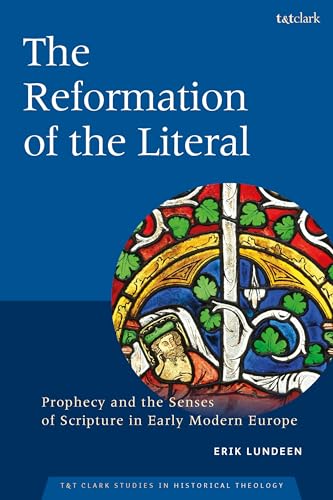

The Reformation of the Literal: Prophecy and the Senses of Scripture in Early Modern Europe
Written by Erik Lundeen Reviewed By Dylan EvansNearly thirty years ago, Richard Muller lamented that many works on Reformation-era hermeneutics “make no attempt to tell us whether or not the exegesis of Luther or Calvin is original or highly traditional on a particular text or issue in Scripture” (Richard A. Muller, “Biblical Interpretation in the Era of the Reformation: The View from the Middle Ages,” in Biblical Interpretation in the Era of the Reformation: Essays Presented to David C. Steinmetz in Honor of His Sixtieth Birthday, ed. Richard A. Muller and John L. Thompson [Grand Rapids: Eerdmans, 1996], p. 5). This deficiency is exacerbated among lesser-known Reformers. Erik Lundeen’s The Reformation of the Literal addresses this lacuna through an exploration of Johannes Oecolampadius’s commentary on Isaiah that compares the Basel Reformer to a wide range of Patristic, Medieval, and Reformation-era interpreters. Two primary concerns mark Lundeen’s analysis: the referentiality of Isaiah’s prophetic oracles and the variety of positions among the Reformers on the nature of the Bible’s literal and spiritual senses. Ultimately, Lundeen claims that “in the Reformation, there was no shared notion of what constituted Scripture’s sensus litteralis, nor a shared approach of how to go about establishing it” (p. 211). With this, Lundeen reminds us that, while the Reformers agreed on the principle of sola scriptura, a shared hermeneutic eluded them.
The initial chapter of The Reformation of the Literal studies the relationship between Johannes Oecolampadius—the seminal Reformer in Basel in the early sixteenth century—and the Dutch humanist, Erasmus of Rotterdam. Lundeen explores this relationship to reveal Erasmus’s crucial influence upon Oecolampadius’s early hermeneutical approach. Four areas of exegetical continuity between the two are given detailed attention: the concept of Christ as the scopus (the goal or target) of the entire Biblical canon, careful engagement with the church fathers on matters of biblical interpretation, the pursuit of an exegetical approach to theology, and the embrace of both the literal and spiritual senses of Scripture.
Lundeen then surveys the continuities and discontinuities between Oecolampadius’s reading of select texts from Isaiah with three patristic authors: Jerome, Cyril of Alexandria, and Chrysostom. Not only does this comparison disclose a high degree of continuity between Oecolampadius’s hermeneutic and that of the church fathers, but Lundeen claims that the Basler was not afraid to “push even further” than his patristic counterparts in his spiritual interpretations of several texts in Isaiah (p. 76). Lundeen also compares Oecolampadius with several other Reformers. This analysis further substantiates the author’s thesis that sixteenth-century opinions of allegorical interpretations varied significantly, “with no discernible pattern or unanimity” (p. 79).
Lundeen subsequently moves his comparative exegesis into the Middle Ages. Oecolampadius’s reading of five passages in Isaiah containing prophecies about the Virgin Mary is analyzed alongside commentaries by Thomas Aquinas and Nicholas of Lyra. Despite his departure from previous tradition regarding the veneration of Mary, Oecolampadius’s interpretation of these texts demonstrated “significant continuity with the majority of medieval Christian interpreters” (p. 118). Nevertheless, in an intentional move away from much of the focus within recent Reformation scholarship, Lundeen also highlights how Oecolampadius’s understanding of the literal sense in Isaiah differed from traditional Christian expositions. These discontinuities are, in part, explained by the influence that Jewish notions of coherence and contemporaneity had upon the Reformer’s reading of prophetic literature. In other words, along with medieval Jewish interpreters, Oecolampadius understood prophetic texts to embody a literary coherence—they are best understood when interpreted as entire literary units “that addressed a single subject matter” (p. 126). Likewise, before discerning Isaiah’s relevance to later Christian dogmas, Oecolampadius appropriated the Jewish concern of uncovering a passage’s contemporaneity—its meaning for the original audience.
The author then reviews Oecolampadius’s reading of Isaiah 40–66, prophetic oracles that are notoriously difficult to situate historically. Lundeen again notes the lack of uniformity among Lutheran and Reformed exegetes by focusing upon the diversity of Reformation-era interpretations regarding three key hermeneutical debates: the proper literal understanding of Isaiah’s figures of speech, the nature of New Testament quotations from Isaiah 40–66, and the questions of literary coherence and historical contemporaneity. The following chapter similarly argues that Lutheran and Reformed interpreters of Isaiah “held to strikingly different understandings of prophecy’s potential referentiality” (p. 185). For example, Lutheran commentators commonly understood Christ to be the sole referent of many of Isaiah’s prophecies. The Reformed tradition, on the other hand, generally understood Christ to be one of many legitimate referents within such texts. Between these two confessional traditions, Lundeen posits that Oecolampadius was a transitional and trailblazing figure in his understanding of prophecy’s literal sense. He also argues that several important Reformed interpreters (Calvin, Musculus, and Pellikan) followed and expanded upon Oecolampadius’s “pioneering” (p. 192) understanding of Isaiah’s multi-layered referentiality.
Because he compares Oecolampadius’s exegesis to so vast a number of interpreters—patristic, medieval, Jewish, Catholic, Lutheran, and Reformed—Lundeen occasionally limits himself to cursory reflections. At times, a reader would be justified in feeling overwhelmed by the sheer number of commentators and exegetical traditions examined. By narrowing the commentators that are compared to Oecolampadius, Lundeen could have contributed even more to the dearth of research on lesser-known Reformers and the perception of the multiple senses of Scripture found within Reformation commentaries.
Lundeen’s work, nonetheless, embodies well-researched and honest history. Such honesty can be seen chiefly in his refusal to force a tidy resolution to his frequently repeated claim that the Reformers embodied little to no unanimity concerning the nature of the Bible’s literal sense. Regarding Oecolampadius specifically, Lundeen highlights insightfully the Reformer’s novel combination of Christian and Jewish concerns in his approach to the nature of the literal sense, as well as his pivotal influence upon subsequent Reformed and Lutheran hermeneutics. Anyone seeking to understand the field of Reformation hermeneutics has, in The Reformation of the Literal, another innovative, worthwhile volume to consider.
Dylan Evans
Lakewood Baptist Church
Other Articles in this Issue
This essay is the second of a two-part analysis of John’s use of the articular substantival participle...
Empathy and Its Counterfeits: Navigating The Sin of Empathy and a Way Forward
by Jonathan D. WorthingtonIn our families, churches, or neighborhoods; in political discussions, situations of accused abuse, or racially charged conversations; in polarizing times, compassion must be wed with relational exegesis, the well-established name for which is empathy...
Philosophical Foundations of a Transgender Worldview: Nominalism, Utilitarianism, and Pragmatism
by Anthony V. CostelloEvery social and political phenomenon has some prior, underlying philosophical basis...
This article explores the relationship between Tolkien’s angelology, as reflected in his fictional writings, and classical angelology, particularly as represented by Augustine and Thomas Aquinas...
The Role of the Regula Fidei in the Twenty-First-Century Religious Landscape: How the “Rule of Faith” Can Help Address the Existential Issues of the Postmodern Christian Community
by Roland WeisbrotThis article offers a historical-systematic analysis of the role of the rule of faith in establishing and maintaining the Christian metanarrative and orthodox scriptural interpretation...
Other Reviews in this Issue